Skip to main content Skip to main menu Skip to footer

Data Search

Data Search

Here you will find diagrams, infographics, maps and tables for direct download.

Data Search

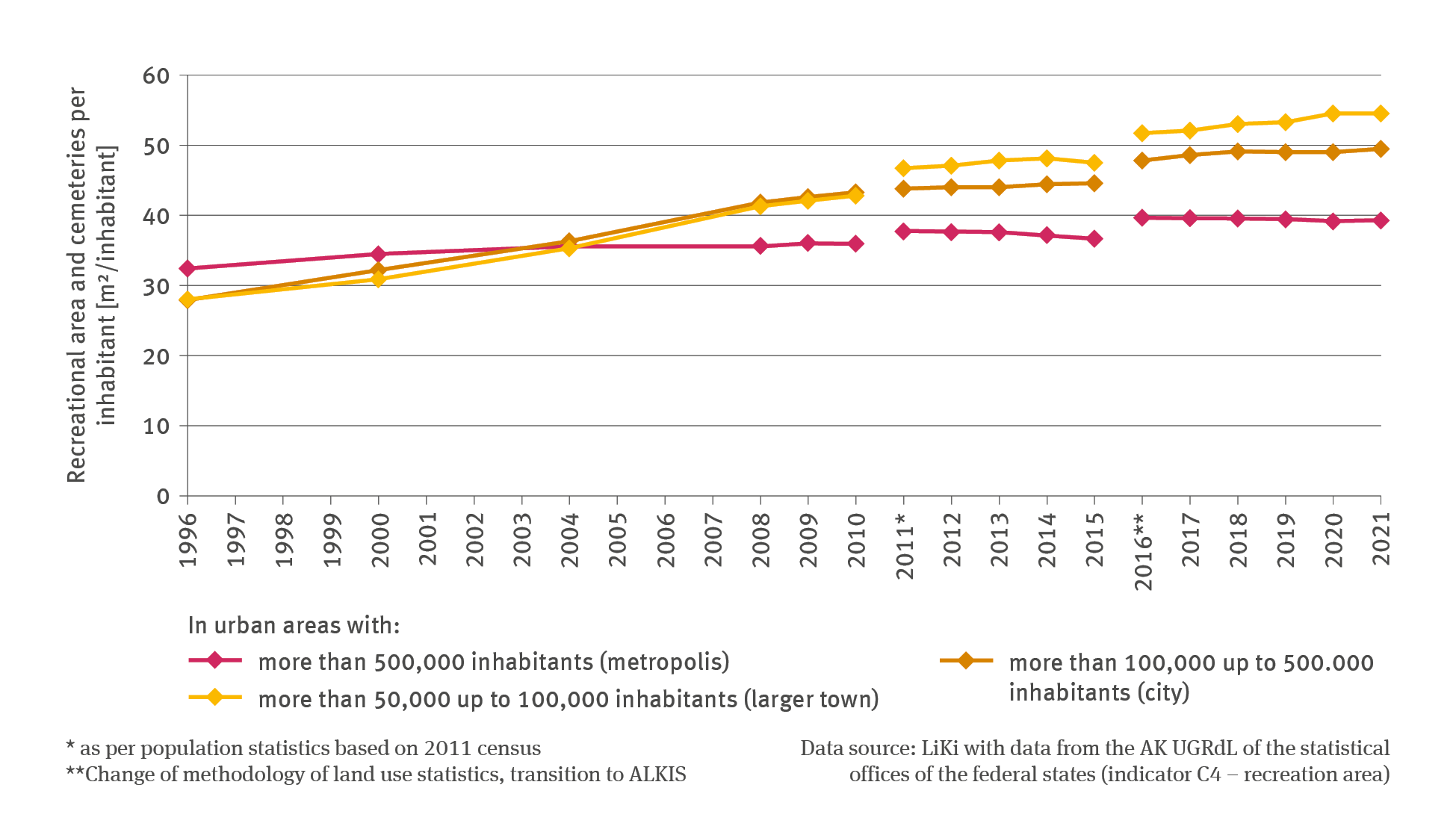
By way of a line chart, the illustration shows the recreation and cemetery areas in square metres per inhabitant, differentiated threefold in terms of cities with more than 500.000 inhabitants (metropoles), more than 100,000 to 500,000 inhabitants (cities) and more than 50,000 up to 100,000 inhabitants (large medium-sized town).

BAU-R-1: Recreation areas

  • Klima
  • Umwelt und Wirtschaft
  • Diagramme
Export data
PNG
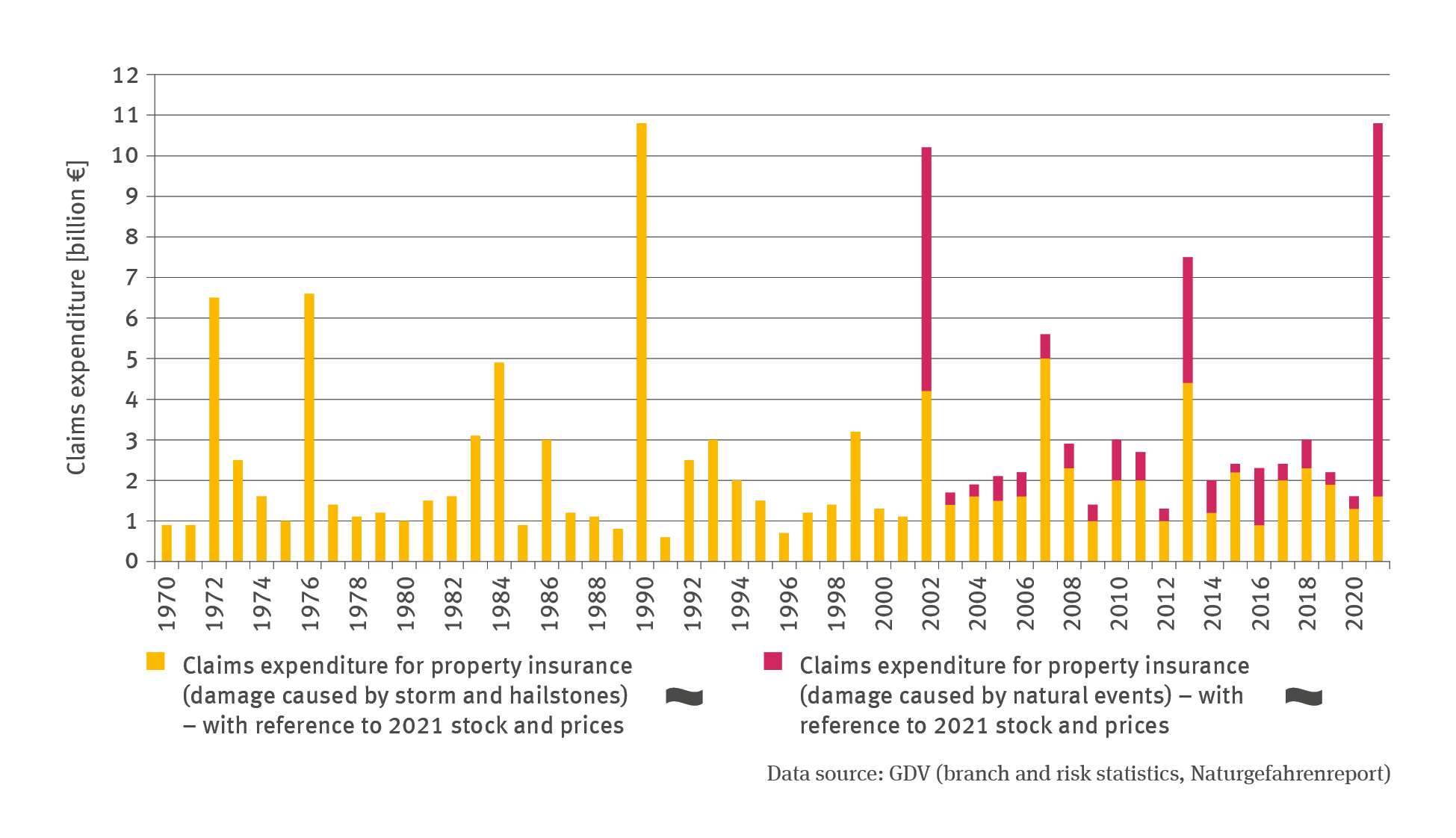
The illustration contains a stacked column chart for the period of 1970 to 2021, which shows the claims expenditure in billion Euros for property insurance (storm and hailstones) in relation to the stock and price information for 2021; and for 2002 to 2021 it also shows the claims expenditure for property insurance (damage from natural events) in relation to the stock and prices for 2021.

BAU-I-5: Claims expenditure for property insurance

  • Klima
  • Umwelt und Wirtschaft
  • Diagramme
Export data
PNG
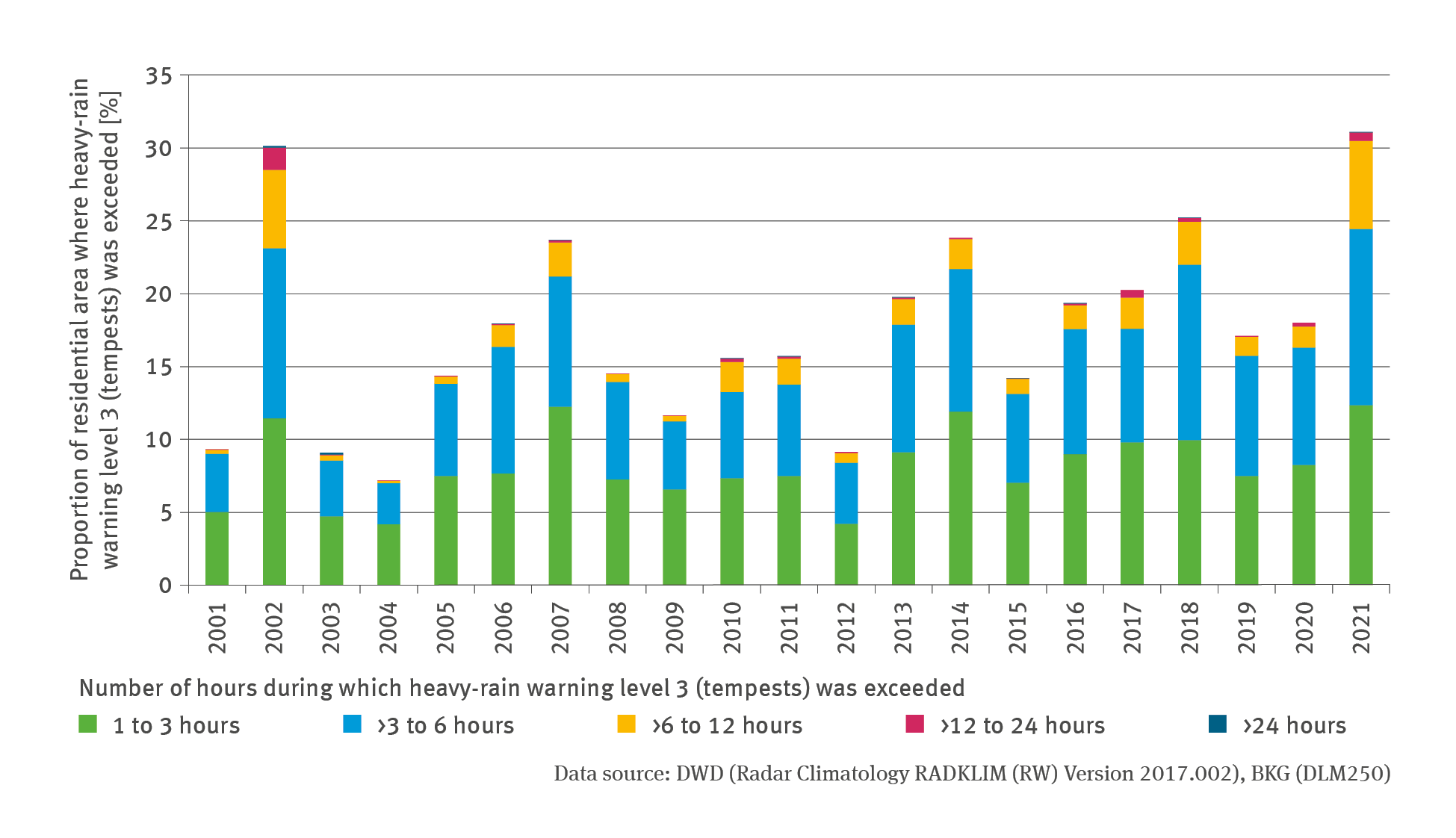
The stacked column chart in the illustration BAU-I-4 entitled ‘Heavy rain in residential areas’ shows the percentual proportion of settlement area where heavy-rain warning level 3 (tempests) was exceeded in terms of the number of hours. Five categories have been illustrated: 1 to 3 hours, more than 3 to 6 hours, more than 6 to 12 hours, more than 12 to 24 hours, and more than 24 hours. The highest category is represented only in a few years.

BAU-I-4: Heavy rain in residential areas

  • Klima
  • Wasser
  • Umwelt und Wirtschaft
  • Diagramme
Export data
PNG
The line chart illustrated in BAU-I-3 ‘Cooling degree days’ shows the mean of cooling degree days for 1951 to 2017 in summer climate regions according to DIN-4108-2:2013-2 in Kelvin per day. The illustration differentiates between the summer climate regions A, B and C. All three lines show a significantly rising trend over the years with distinct high points in 2003 and 2018, albeit with distinct fluctuations from year to year.

BAU-I-3: Cooling degree days

  • Klima
  • Umwelt und Gesundheit
  • Diagramme
Export data
PNG
The illustration BAU-I-1 ’Heat stress in urban areas – case study’ (Wärmebelastung in Städten – Fallstudie) shows three lines representing the number of hot days in the cities of Berlin, Frankfurt am Main and Munich during the period of 1986 until 2021. Apart from Munich, there are a few data gaps in these time series. In addition, a dotted line shows the areal mean for Germany as a whole. All lines show an increase, with fluctuations from year to year.

BAU-I-1: Heat stress in urban areas – case study

  • Klima
  • Umwelt und Gesundheit
  • Diagramme
Export data
PNG
The illustration BD-R-2 ’Restoration of natural flood plains’ contains a bar chart demonstrating the restoration of natural flood plains by means of dyke realignment in the period of 1983/2000 to 2020. For 2020 a cumulative areal gain of slightly more than 7,000 hectares is shown. The time series shows a significantly rising trend.

BD-R-2: Restoration of natural flood plains

  • Klima
  • Fläche, Boden, Land-Ökosysteme
  • Diagramme
Export data
PNG
The illustration BD-R-1 ’Consideration of climate change in landscape programmes and landscape framework plans’ contains a grouped bar chart which indicates the consideration of climate change in landscape programmes and landscape framework plans. The chart shows the percentage proportion of evaluated plans in which climate change is taken into account. The evaluation of landscape framework plans and landscape programmes took place at the end of each of the following years: 2000, 2005, 2010, 2015, 2020 and

BD-R-1: Consideration of climate change in landscape programmes

  • Klima
  • Fläche, Boden, Land-Ökosysteme
  • Diagramme
Export data
PNG
The illustration BD-I-3 ’Temperature index of butterfly species communities’ contains a line chart indicating the temperature index of butterfly species communities in degrees Celsius. In the illustrated period of 2006 to 2021 the line rises significantly. While the index for 2006 amounted to approximately 8.9 degrees Celsius, in 2021 the value amounted to approximately 9.1 degrees Celsius. However, the increase did not proceed continuously. In 2010 and 2011, the index value dropped, and also in 2017, the v

BD-I-3: Temperature index of butterfly species communities

  • Klima
  • Fläche, Boden, Land-Ökosysteme
  • Diagramme
Export data
PNG
The illustration BD-I-2 ’Temperature index for bird species communities’ is a line chart with two lines. The first line shows the annual temperature index of frequently occurring breeding bird species for the period 1990 to 2021. The index value shows a significantly rising trend and has increased from 12.14 degrees Celsius in 1990 to 12.40 degrees Celsius in 2021. The second line illustrates the moving 5-year average. Here too the trend is rising significantly.

BD-I-2: Temperature index for bird species communities

  • Klima
  • Fläche, Boden, Land-Ökosysteme
  • Diagramme
Export data
PNG
The illustration contains a stacked column chart which shows the beginning and duration of the phenological seasons for the periods of 1951 to 1980, 1981 to 2010 and 1992 to 2021. This demonstrates that, by comparison, winter has become shorter which also applies to spring and high summer. The early summer has become longer by approximately two days.

BD-I-1: Phenological changes in wild plant species

  • Klima
  • Fläche, Boden, Land-Ökosysteme
  • Diagramme
  • Infografiken
Export data
PNG

You can also search in other data portals of the German Environment Agency

Short link: www.umweltbundesamt.de/n300701en