Skip to main content Skip to main menu Skip to footer

Data Search

Data Search

Here you will find diagrams, infographics, maps and tables for direct download.

Data Search

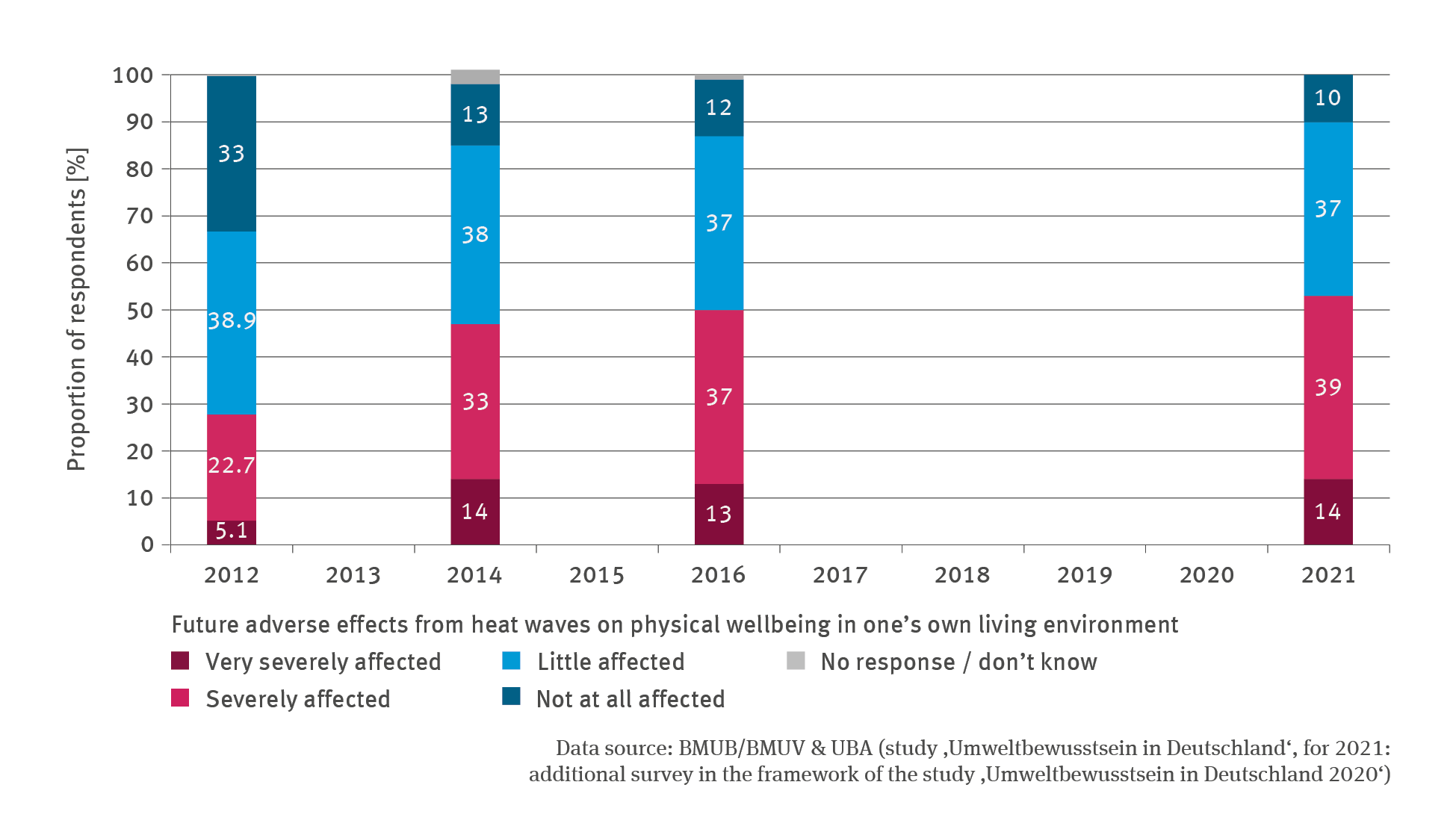
The bar chart GE-R-2 ’Public awareness of health problems caused by heatwaves’ illustrates the findings of a survey in which respondents were asked to state whether they expect that in future their physical wellbeing in their own living environment will be affected very severely, severely, little or not at all affected (by heatwaves). The survey was conducted in the years of 2012, 2014, 2016 and 2021. From 2012 to 2016 one of the options was ’don’t know’.

GE-R-2: Public awareness of health problems caused by heatwaves

  • Klima
  • Umwelt und Gesundheit
  • Diagramme
Export data
PNG
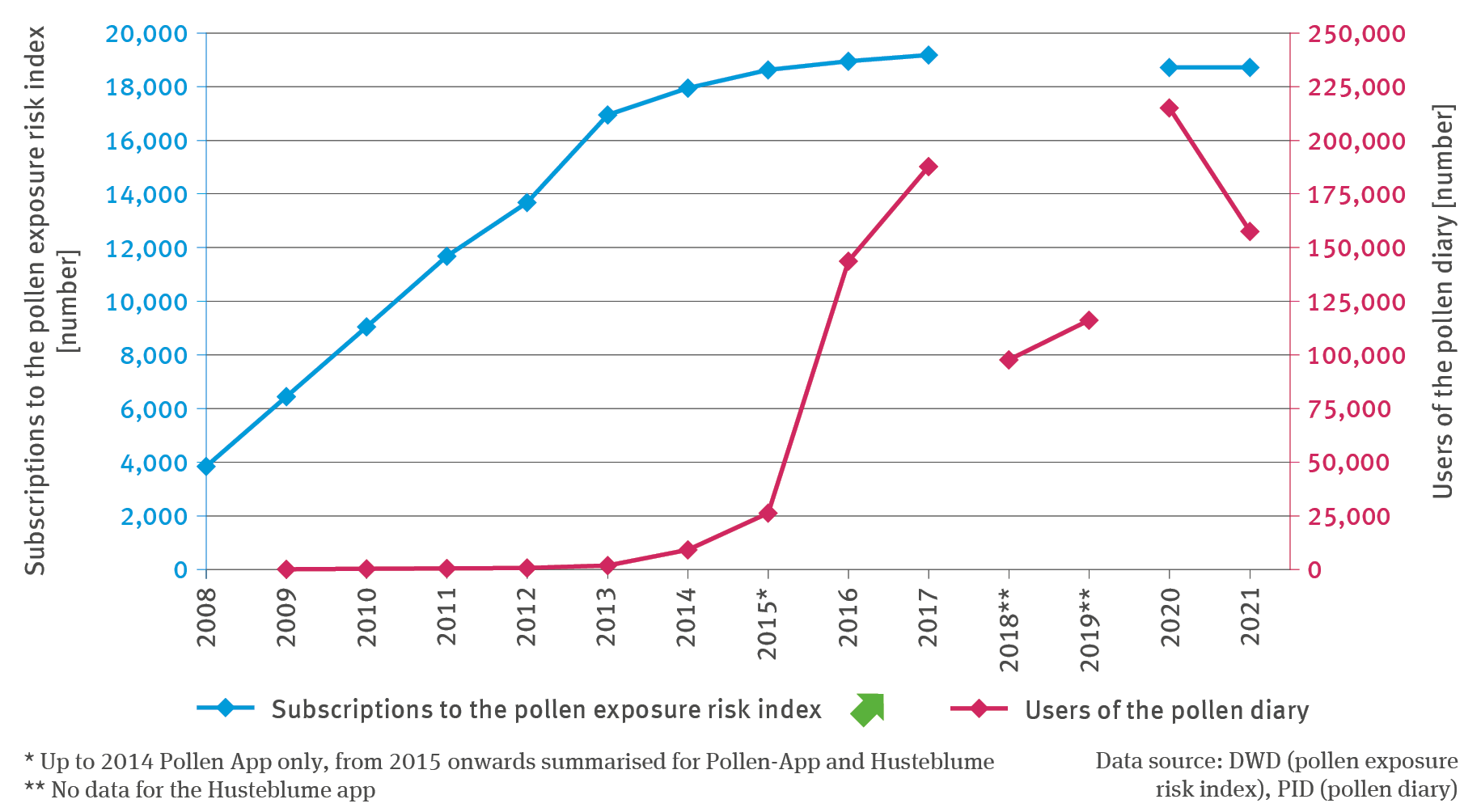
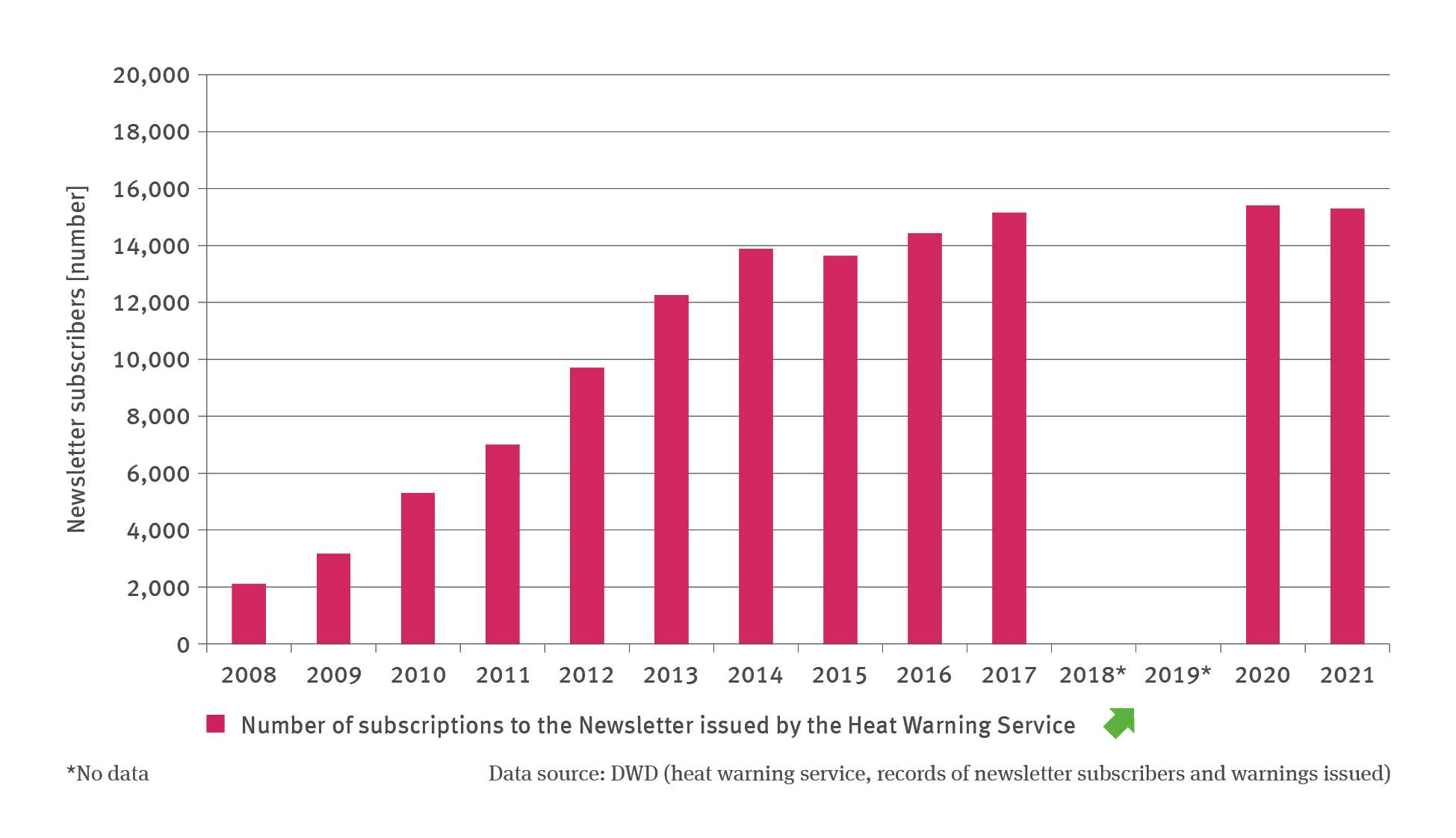
The bar chart GE-R-1 ’Heat warning service’ illustrates the annual number of newsletter subscriptions for the heat warning service provided by the GWS from 2008 onwards. The number was rising significantly and latterly amounted to just under 15,000 subscriptions. There are no data available for the years of 2018 or 2019.

GE-R-1: Heat warning service

  • Klima
  • Umwelt und Gesundheit
  • Diagramme
Export data
PNG
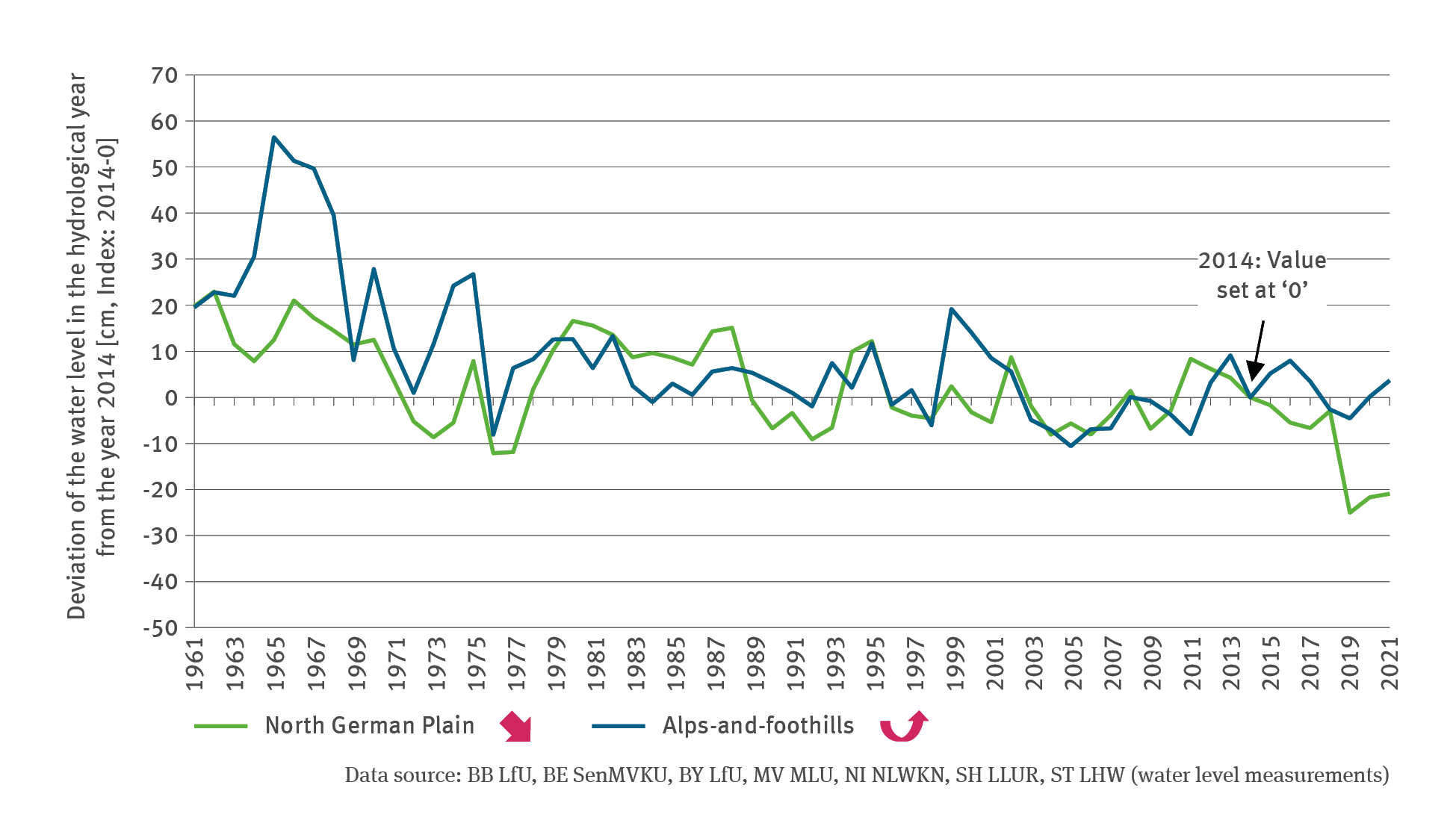
The line chart WW-I-7 ’Water levels in lakes’ indicates the annual deviation of the water level in lakes in two regions – the North German Plain and the Alps-and-foothills for the years 1961 to 2021 from the water level in 2014 in centimetres. The water level of the lakes in the North German Plain receded significantly by 2021 compared to 2014; ultimately the deviation amounted to –20 cm compared to 2014.

WW-I-7: Water levels in lakes

  • Klima
  • Wasser
  • Diagramme
Export data
PNG
The bar chart WW-I-6 ‘Low water* shows – for the years of 1961 to 2021 – the number of low-water days in the water-balance related winter half-year (1st October of the previous year to 31st March) and in the water-balance related summer half-year (1st April to 30th September) respectively, prevailing in Germany’s river basins. The structure of the indicator is characterised by individual pronounced low-water events which occurred latterly in the period from 2018 to 2020.

WW-I-6: Low water

  • Klima
  • Wasser
  • Diagramme
Export data
PNG
The bar chart WW-I-5 ‘Peak discharge values in watercourses’ contains a biaxial diagram. The bar chart shows for the years 1961 to 2021 – separately for the hydrological winter half-year (1st November of the previous year to 30th April) and the hydrological summer half-year (1st May to 31st October) – on one hand the highest peak discharge at selected watercourse gauges as a multiple of MHQ.

WW-I-5: Peak discharge values in watercourses

  • Klima
  • Wasser
  • Diagramme
Export data
PNG
The bar chart WW-I-4 ’Floodwater’ shows – for the years of 1961 to 2021 – the number of floodwater days in the hydrological winter half-year (1st November of the previous year to 30th April) and in the hydrological summer half-year (1st May to 31st October) respectively, prevailing in the river basins of the Danube, Elbe, Rhine, Eider and Weser. The structure of the indicator is characterised by individual flood events which typically influence several river basins.

WW-I-4: Floodwater

  • Klima
  • Wasser
  • Diagramme
Export data
PNG
The bar chart WW-I-3 ’Mean discharge’ shows the mean runoff depth for all river basins in Germany in the hydrological winter half-year (1st November of the previous year till 30th April) and in the hydrological summer half-year (1st May till 31st October) in the years of 1961 to 2021 in millimetres. The runoff depth in the hydrological summer half-year of 2021 decreased significantly during the period of observation, in the amount of slightly more than 100 millimetres.

WW-I-3: Mean discharge

  • Klima
  • Wasser
  • Diagramme
Export data
PNG
The illustration GE-I-5 ’Pathogen vectors – case study’ contains a biaxial chart. A bar chart is used to indicate – for the years from 2005 to 2021 – the proportion of samplings and traps with positive finds of the Tiger Mosquito (eggs or adult mosquitoes) in the Upper Rhine Rift Valley in per cent. The annual number of samplings is shown by means of dots. The chart contains three methodological breaks marked by dotted lines.

GE-I-5: Pathogen vectors – case study

  • Klima
  • Umwelt und Gesundheit
  • Diagramme
Export data
PNG
The bar chart WW-I-2a ’Groundwater level and spring flow – Northern Region’ indicates – for the years of 1961 to 2021 – the annual number of months in which the highest mean groundwater level was exceeded in the period 1971-2000 and the highest mean spring flow, as well as the number of months in which the lowest mean groundwater level and/or the lowest mean spring flow in the period 1971–2000 were not attained.
Export data
PNG
The illustration GE-I-4 ’Ragweed pollen burden’ contains a biaxial chart. For the years from 2006 to 2021 the lines show the annual mean total of ragweed pollen in pollen per cubic metre air. A differentiation is made between the central, northern, eastern, southern and western regions. In addition, the mean pollen total across all regions is illustrated. A particularly high ragweed pollen burden occurred in 2014 in the northern, eastern and central regions.

GE-I-4: Ragweed pollen burden

  • Klima
  • Umwelt und Gesundheit
  • Diagramme
Export data
PNG

You can also search in other data portals of the German Environment Agency

Short link: www.umweltbundesamt.de/n300701en