
Skip to main content Skip to main menu Skip to footer

Results of the Global Stocktake in the new NDCs



GST in NDCs: How the first Global Stocktake is reflected in the NDCs.
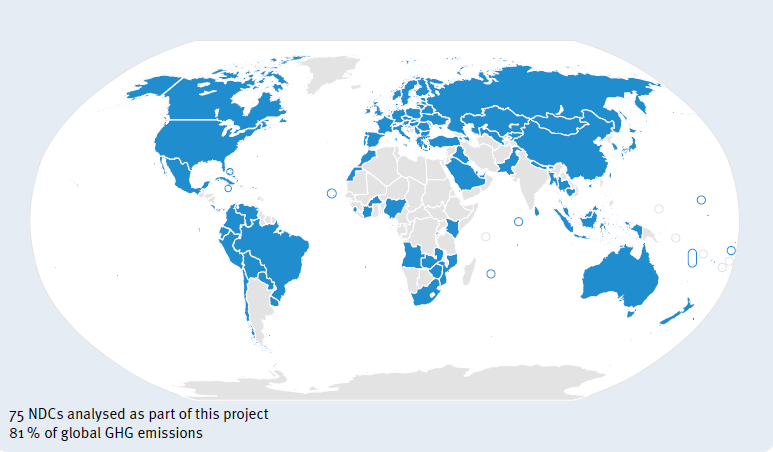
The project analyses the 75 NDCs marked on the above map.
Source: UBA graphic

Every five years the Global Stocktake (GST) evaluates the progress in global climate action. It is the core element of the ambition mechanism of the Paris Agreement, according to which new Nationally Determined Contributions (NDCs) need to be more ambitious than previous ones. The results of the GST are to set the direction of the new NDCs. An UBA project analyses how the GST is reflected in NDCs.

Table of contents

Background and introduction

Under the Paris Agreement, member states are required to explain how the results of the Global Stocktake (GST) will be reflected in their Nationally Determined Contributions (NDCs). The UBA research project “GST in NDCs – How are the results of the first Global Stocktake reflected in the NDCs?”, analyses the extent to which the signals and impulses from the results of the first Global Stocktake 2023 (Decision 1/CMA.5 ) have been taken up in the new Nationally Determined Contributions submitted in 2025. Based on this analysis of the impact of the results of the first GST, conclusions can be drawn for future GST and NDC cycles. 

Central to the analysis are paragraphs 28 (with subparagraphs), 33, 36, 37, 39, 40 and 42 of the GST decision. These contain key recommendations on global greenhouse gas reduction and the design of ambitious Nationally Determined Contributions, including the expansion of renewable energies, the phase-out of fossil fuels, climate neutrality by 2050 and macroeconomic transformation pathways. Parts of the GST decision relating to adaptation, financing, loss and damage, and international cooperation are explicitly not included in this analysis.
Results

The analysis reveals that 92 percent of the 75 NDCs mention the GST in some form. However, explicit alignment with specific GST mitigation outcomes varies considerably. Paragraph 28a (tripling renewable energy and doubling energy efficiency) emerged as the most widely referenced element, with 45 NDCs showing explicit alignment. A significant number of these 45 NDCs includes concrete targets or policies. More controversial or complex issues, such as transitioning away from fossil fuels (Para 28d) or phasing out fossil fuel subsidies (Para 28h), show lower levels of explicit referencing despite high thematic relevance in many countries. In many cases it is unclear whether or not the GST paragraphs informed the NDCs: many countries include topics of the GST decision but do not credit the GST as the informing driver. This is evident for Paragraph 36 (circular ecomomy). 61 of 75 NDCs cover circular economy somewhere in the NDC without mentioning the GST in these contexts. But only 16 of the 75 NDCs address circular economy and at the same time refer to the GST in this context. Additional findings related to specific paragraphs are presented in the infographic.

The findings suggest that the first cycle of the ratchet mechanism has been partially successful in signalling priority areas, yet the integration of GST outcomes into national planning processes varies greatly. While quantified GST benchmarks (e.g., renewables) are more readily adopted, others are not.

Recommendations

The results of the research project aim to contribute to the negotiations for the second GST. These negotiations will gather momentum in 2027, as will the negotiations on future NDCs (e.g. procedures, reporting requirements), which will start to be discussed in 2026. The research concluded on a list of ten recommendations, for the second GST and future NDC cycles, for example on

  • Standardization: Use standardized templates for Information to facilitate Clarity, Transparency and Understanding (ICTU).
  • Update Guidance: Revise ICTU section on GST to require paragraph-specific reporting.
  • Quantified Benchmarks: Develop more quantified goals for the second GST, particularly for renewables, nature, and the circular economy, to drive clearer national targets.
  • Transparency: Encourage reporting on the national relevance of GST decisions.
  • Structure: Organize future GST decision texts to serve as better "goalposts" for national climate planning.
GST in NDCs: How the first Global Stocktake is reflected in the NDCs. The project results were summarised in the above infographic.
Source: UBA infographic

Associated content

Links

Publications

Tags

Short link: https://www.uba.de/n306199en