Skip to main content Skip to main menu Skip to footer

Data Search

Data Search

Here you will find diagrams, infographics, maps and tables for direct download.

Data Search

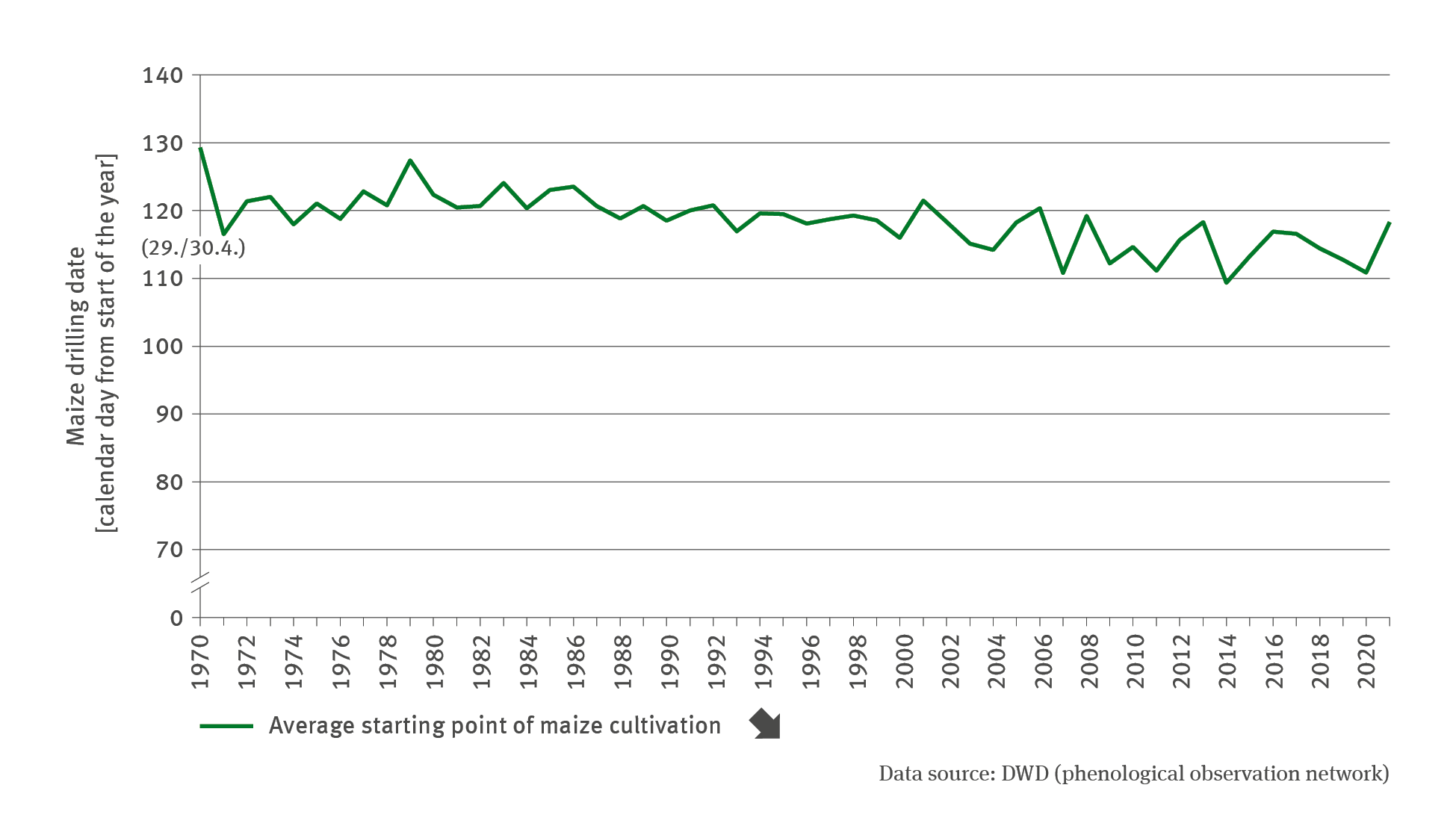
The line chart indicates – for the period of 1970 to 2021 – the mean point in time when maize cultivation begins, in terms of a calendar date from the start of the year. Although the time series proceeds with some fluctuation, it shows a significantly falling trend: To date, the latest onset of drilling occurred in 1970 on day 130 of the year – early May. In 2021 drilling began as early as day 119 of the year – end of April.

LW-R-1: Adaptation of management rhythms

  • Klima
  • Land- und Forstwirtschaft
  • Diagramme
Export data
PNG
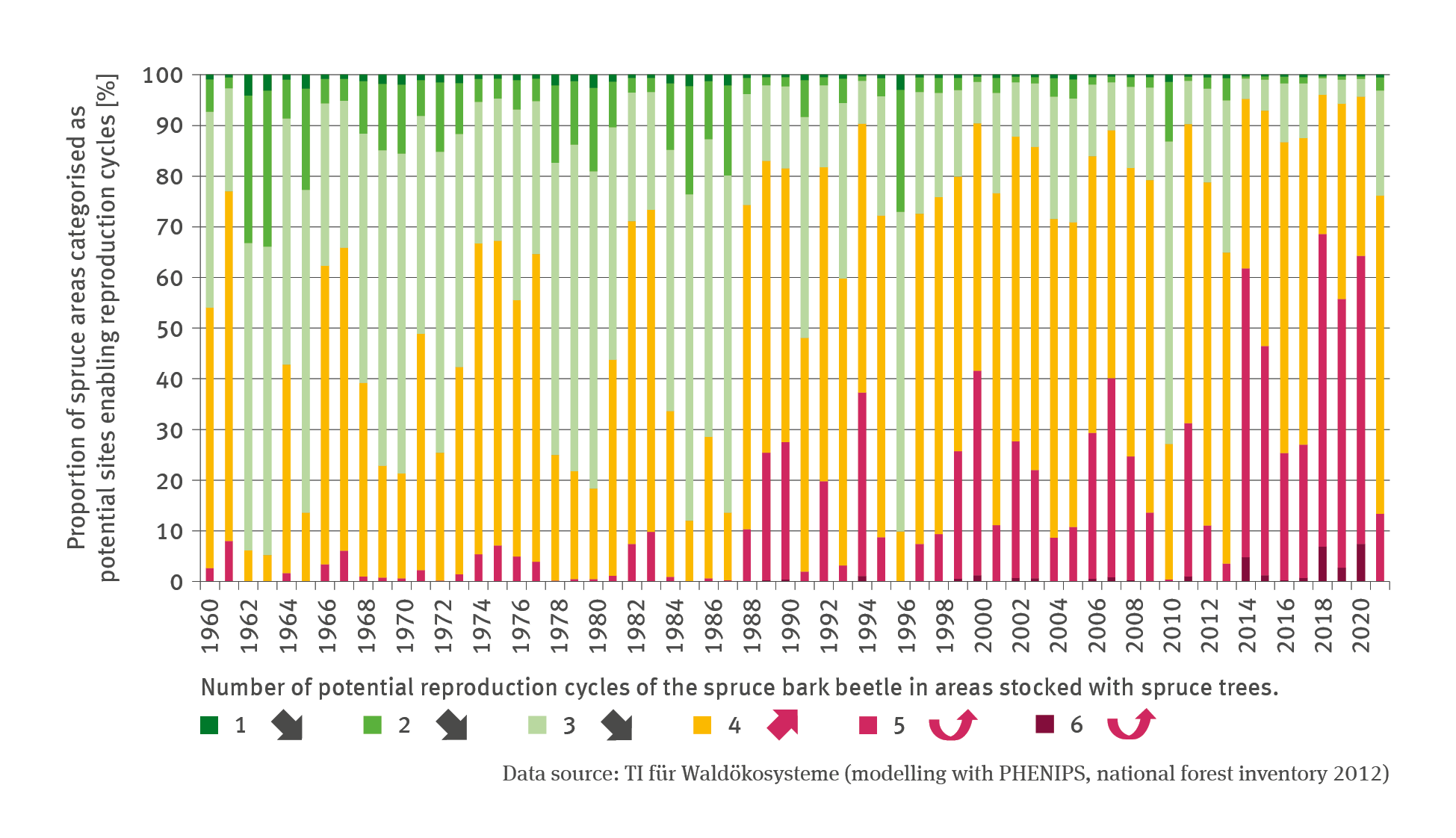
The stacked columns chart FW-I-6 ’Endangered spruce stands’ shows – for the period of 1960 to 2021 – the proportion in per cent of areas in Germany planted with spruce trees, in which the spruce bark beetle would be able to achieve a specific number of potential reproduction cycles. In this process, a differentiation was made between the number of potential reproduction cycles between 1 and 6.

FW-I-6: Endangered spruce stands

  • Klima
  • Land- und Forstwirtschaft
  • Diagramme
Export data
PNG
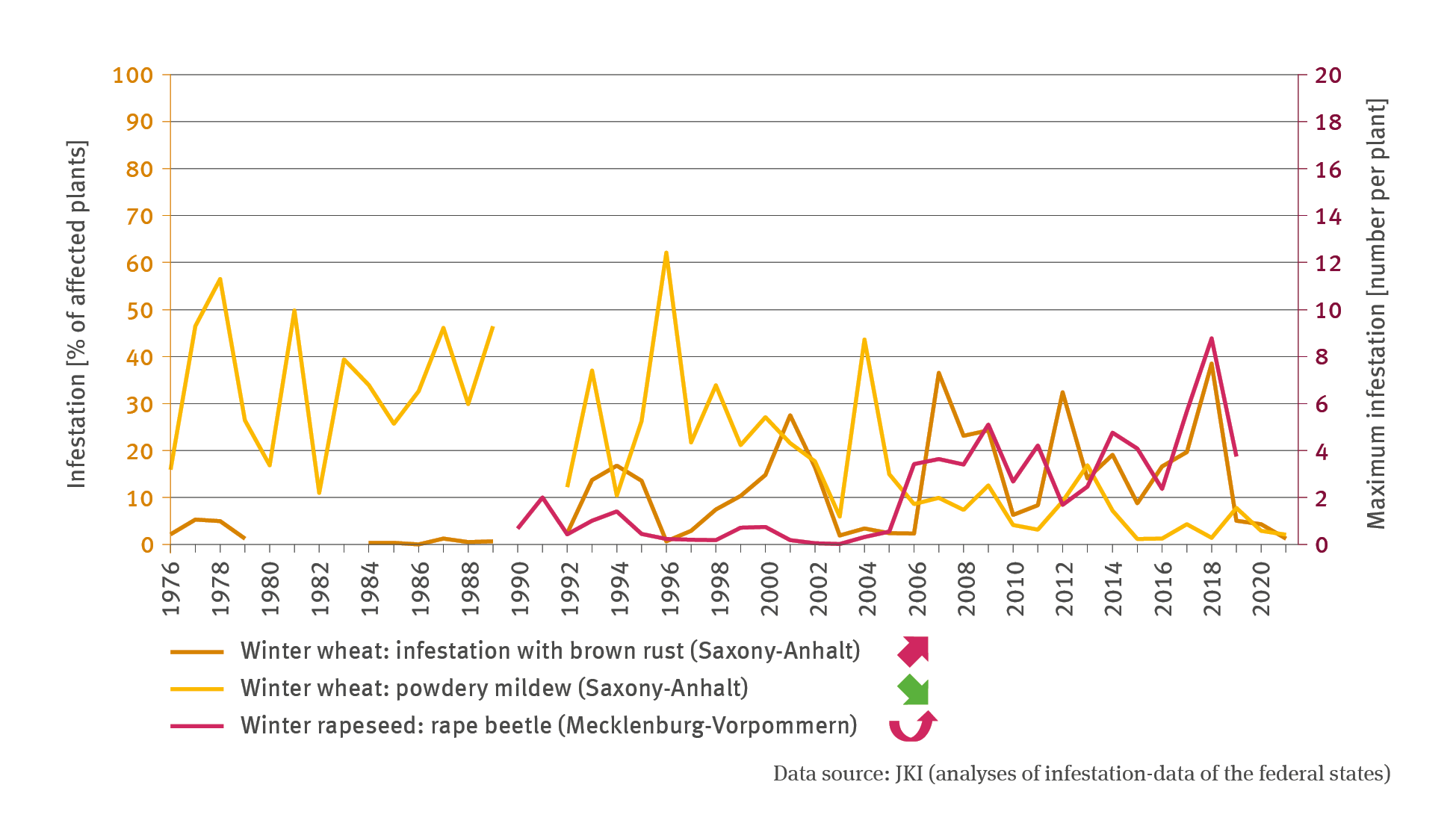
The illustration LW-I-4 ’Infestation with pest organisms – case study’ contains a biaxial chart. The lines in the chart indicate the infestation of winter wheat with brown rust and powdery mildew by stating the percentage of infested plants. In respect of winter rapeseed, the chart indicates the maximum infestation with rape beetle by stating the number of beetles per plant. There are data available from Saxony-Anhalt – with very few data gaps – for winter wheat from 1976 to 2021.

LW-I-4: Infestation with pest organism – case study

  • Klima
  • Land- und Forstwirtschaft
  • Diagramme
Export data
PNG
The illustration FW-I-5 ’Damaged timber – extent of random use’ contains a biaxial chart. The chart shows the proportion of random use compared to the logging total in per cent as a line, and the proportion of damage causes compared to the total of random use in per cent in terms of stacked columns. A differentiation is made between causes such as wind/storm, insects and other causes. The proportion of random use decreased steadily until the turn of the century, amounting to roughly 10 per cent in 1999.

FW-I-5: Damaged timber – extent of random use

  • Klima
  • Land- und Forstwirtschaft
  • Diagramme
Export data
PNG
The illustration contains a biaxial chart. The bar chart shows the annual claims ratio in per cent in respect of agricultural hailstorm insurance for the period of 1980 to 2021.

LW-I-3: Hailstone damage in agriculture

  • Klima
  • Land- und Forstwirtschaft
  • Diagramme
Export data
PNG
The line chart FW-I-3 ’Forest condition’ indicates – differentiated by the tree species of spruce, oak, pine and beech and all tree species combined – the crown defoliation mean in per cent for the period of 1991 to 2021. The time series for beech and oak indicate a more fluctuating progress than the time series for pine and spruce.

FW-I-3: Forest condition

  • Klima
  • Land- und Forstwirtschaft
  • Diagramme
Export data
PNG
The bar chart shows the deviation in percent of winter wheat yields and silage maize yields from the mean of 6 preceding years for the period of 1986 to 2021.

LW-I-2: Yield fluctuations

  • Klima
  • Land- und Forstwirtschaft
  • Diagramme
Export data
PNG
The XY scatter chart FW-I-2 ’Incremental growth in timber’ shows dots representing the annual incremental growth on the area of ground (growth in thickwood with bark) in square metres per hectare and year, differentiated by the following tree species: spruce, beech, oak and pine, for the periods of 2002 to 2008, 2008 to 2012 and 2012 to 2017 respectively. As yet, there are no data available for the years of 2017 to 2022. The incremental growth rates for beech, oak and pine trees have declined since 2002.

FW-I-2: Incremental growth in timber

  • Klima
  • Land- und Forstwirtschaft
  • Diagramme
Export data
PNG
The bar chart shows the annual change in tree species composition in natural forest reserves including the major climate change increase in percent expected for the periods 1971 to 2014, 2014 to 2018 and 2019 to 2023.

FW-I-1: Tree species composition in forest nature reserves – case study

  • Klima
  • Land- und Forstwirtschaft
  • Diagramme
Export data
PNG
The line chart shows the observed mean onset of flowering of winter rapeseed and early-ripening apples in terms of calendar days from the beginning of the year onwards.

LW-I-1: Agrophenological phase shifts

  • Klima
  • Land- und Forstwirtschaft
  • Diagramme
Export data
PNG

You can also search in other data portals of the German Environment Agency

Short link: www.umweltbundesamt.de/n300701en