Definitions
The reference value for a chemical substance in a body matrix (e.g., blood, urine) is a value derived from a series of measurements taken from a random sample of a defined population group using a specified statistical method (Hoopmann et al., 2023; https://doi.org/10.1016/j.ijheh.2023.114236).
Reference values are determined using a suitable reference population, such as that of the German Environmental Survey, GerES. Among other things, they enable the description of the current status (so-called background exposure) in a specific population group, with or without detectable specific exposure at the time of the study, the identification of specific exposure of individuals or groups of people to substances, the review of quality objectives from a preventive medicine per-spective, and their use as an assessment criterion in epidemiological studies of populations with specific environmental exposure without the need to examine additional large comparison groups. The Commission expressly points out that the reference values are purely statistically defined values that have no health significance per se.
In contrast, human biomonitoring (HBM) values (HBM-I and -II) are derived from toxicological and epidemiological studies. Originally, the derivation of HBM values relied on studies that demonstrated a correlation between the concentration of a substance or its metabolites in human body fluids and the occurrence of adverse effects. For numerous substances, however, suitable studies on relevant biological effects in humans are lacking. Against this backdrop, the HBM Commission has decided to also use toxicologically justified tolerable intake levels or appropriate points of departure from animal studies to derive HBM values. While fully aware that uncertainties are to be expected in these derivations and estimates, the HBM Commission sees this approach as an opportunity to make urgently needed HBM values available for substances for which there are not yet sufficient studies on effects in the environmentally relevant low-dose range (Policy Paper on the Derivation of HBM Values in German, https://doi.org/10.1007/s00103-013-1867-2).
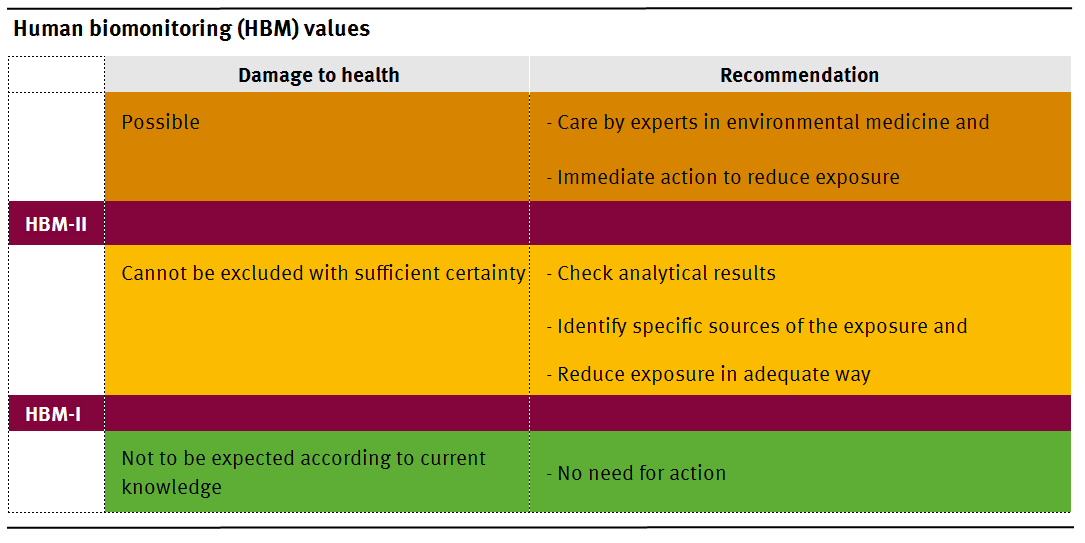
The HBM-I value corresponds to the concentration of a substance in a body matrix up to which, according to the current state of the assessment by the HBM Commission and when considering individual substances, no adverse health effects are expected. Exceeding the HBM-I value should prompt a review of the findings through further measurements. If the measured value is confirmed, the cause should be determined, and the source of exposure reduced or eliminated, to the extent that this is reasonable while maintaining proportionality. The HBM-II value corresponds to the concentration of a substance in a body matrix at and above which, according to the current assessment by the HBM Commission, a health impairment considered relevant is possible, such that urgent action is required to reduce exposure and environmental health consultation must be arranged. The HBM-II value should therefore be regarded as an intervention and action value. For measured values between the HBM-I and HBM-II values, an adverse health effect cannot be ruled out. As a precaution, the HBM Commission notes that the HBM values do not indicate a level up to which “replenishment” is possible. When applying the HBM values, medical history, symptoms, and temporal relationships must also be taken into account.