Not only is protecting our climate and ensuring clean air important for both people and the environment – it also pays. After all, damage to the environment and human health is expensive. You can find out just how expensive it is in this edition of “UBA aktuell”. We also want to present you with our proposals on the action the EU should take against antibiotic resistances in the environment. Another topic: the plans of the German Federal Ministry for the Environment to gradually phase out the use of the broadband herbicide Glyphosate and what will change as a result regarding the authorisation processes for plant protection products.
Wishing you informative reading,
The UBA press office
Failing to protect the environment comes at a cost
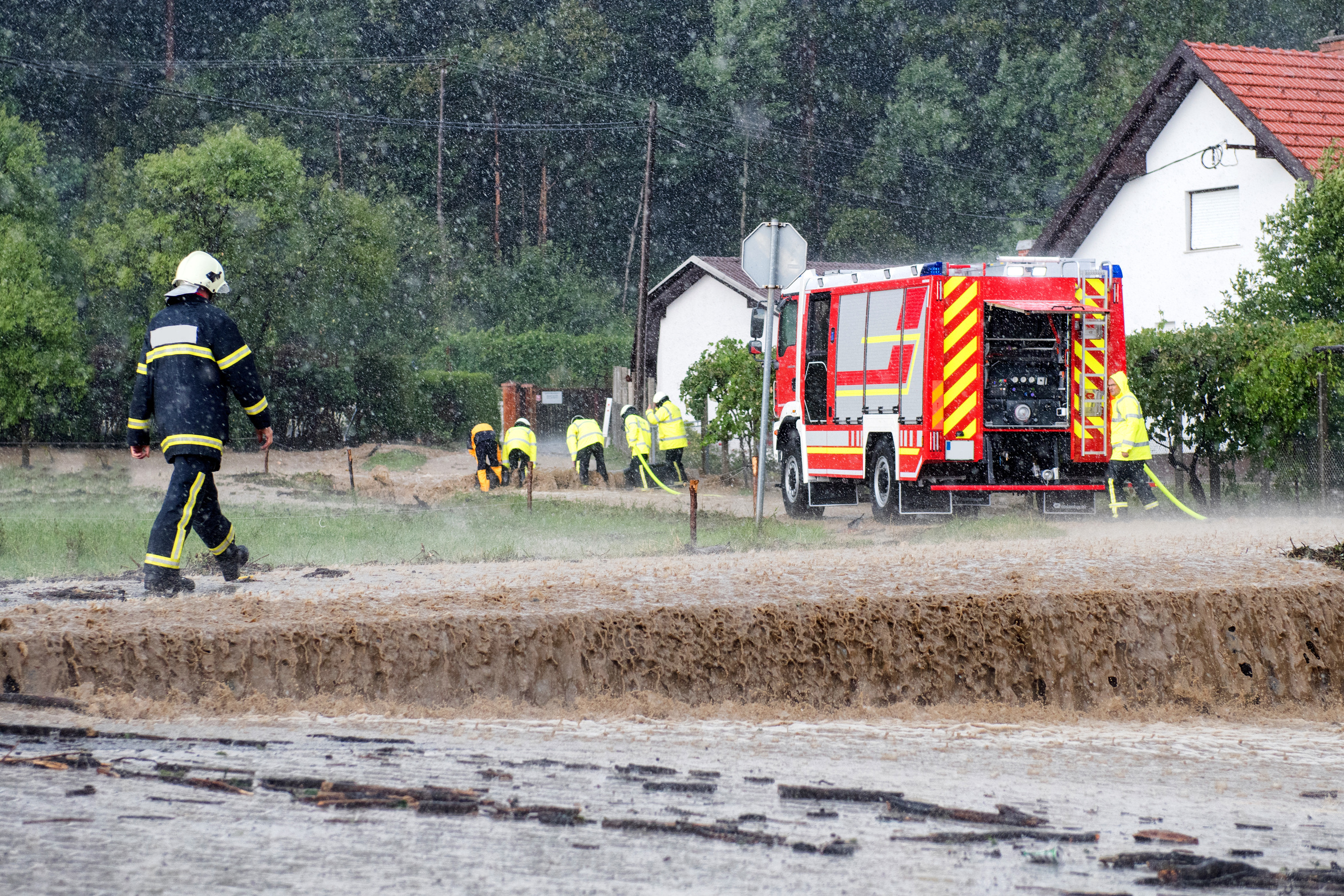
More heavy rainfall due to climate change can mean high costs in case of floods.
Source: asafaric / Fotolia.com
Protecting the environment can sometimes be inconvenient and cost money. But it is even easier to lose sight of the costs when no action is taken, or when that which is, proves insufficient. And yet these costs are anything but insignificant. Greenhouse gases, air pollution and other environmental hazards damage our health, destroy ecosystems, cause animal and plant species to die out and create a considerable economic burden. As a result of the more frequent cases of flooding due to torrential rain and higher waters, climate change caused by greenhouse gases, for instance, is resulting in production outages, losses of harvests and damage to buildings and infrastructure.
It is possible to put a figure on the costs – at least an approximate one. In this respect, with its Methodological Convention 3.0 for the Assessment of Environmental Costs, the UBA has presented updated cost rates. Accordingly, one tonne of CO2, for example, causes damage to the value of 180 Euros. Extrapolated in terms of the total greenhouse gas emissions in Germany in 2016, that is equivalent to 164 billion Euros. The figure for particulate matter emissions (PM2.5) from road traffic, for example, is 59,700 Euros per tonne.
According to the latest figures from the UBA, with its considerable emissions of airborne pollutants and climate-unfriendly greenhouse gases, electricity generated by burning lignite in Germany in 2016 was responsible for environmental damage with a value of 31.2 billion Euros. That is equivalent to 20.81 Cents per kilowatt hour. By way of comparison: one kilowatt hour generated by wind energy results in an environmental cost of just 0.28 Cents. President of the UBA, Maria Krautzberger: “The steps for protecting the environment and our climate will enable us and future generations to make several billion Euros of savings through lower levels of damage to the environment and human health. This is something that we shouldn’t forget in the discussions on air pollution control or the phasing out of coal.”
German Environment Agency presents seven priority areas for action
Protecting the climate: continue the privileged status of wind turbines
To call a halt on climate change, it is necessary for emissions of greenhouse gases to continue to fall. This is an area in which renewable energies play an important role, with wind energy, in particular, offering considerable potential. The UBA therefore recommends continuing with the privileged status of wind turbines and avoiding the introduction of blanket proximity-based restrictions on distances from residential areas. read more (in German)
The city and the countryside are closely interlinked, for example through daily flows of traffic and goods. In everyday practice, however, problems are common. The Federal Ministry of Education and Research (BMBF) is now launching the “Stadt-Land-Plus” funding measure and already providing support for twelve collaborative projects between science and practice across Germany to implement new ideas.
Nitrogen dioxide pollution in 2017 – updated data available
Based on the data from the air monitoring networks in the German federal states, the UBA completes its official reporting on air quality to the EU. Following an update from the federal state of Hesse, two changes have occurred to the list of cities which exceed the thresholds regarding the average annual NO2 value: with 72 µg/m3, Darmstadt is now the third most polluted city, while Frankfurt is in 12th place, with 54 µg/m3. read more (in German)
German environmental study on adult human health – GerES VI
As part of the German environmental study on adult human health (GerES VI), from 2018 until 2021, teams of researchers working on behalf of the UBA are gathering data on the environmental impact on the adult population. The teams are visiting the participants at home and measuring harmful substances in urine and blood samples, conducting interviews and, among others, examining drinking water, house dust and the quality of the indoor air. read more (in German)
Lettuce plants do not absorb any pathogens from soil
In the agricultural sector, sewage sludge is used as a fertiliser. It frequently contains bacteria which can trigger illnesses in people. With the cultivation of lettuce plants in soil of this kind, these bacteria are not easily absorbed by the plants. The agricultural use of sewage sludge, however, can support the dissemination of antibiotic resistances in the soil. This is the conclusion of a UBA study. read more (in German)
UBA study: awareness for socio-ecological change
A recent study by the UBA is addressing people’s ideas on a social change in the direction of sustainability and, as regards this situation, the opportunities that they are able to envisage for taking action in their living environment. The socio-scientific report is being published to complement the study entitled “Environmental awareness in Germany 2016”. read more (in German)
New UMID: perception and communication of risks
How can citizens be appropriately and sufficiently informed about the possible risks? The latest edition of the UMID journal addresses the subject of the perception and communication of risks. Other topics: ultra-fine particles in the environmental air, heat-related indicators and geo-information systems. read more (in German)
The Federal Ministry for Environment has presented a plan for the gradual phase-out of the use of the broadband herbicide glyphosate. The Use of Pesticides Ordinance will be amended for this purpose. The German Environment Agency as competent body for the authorisation procedure seeks to make the authorisation of products which harm biodiversity contingent upon certain conditions of their use.
The Blue Angel – the German government’s ecolabel – is celebrating its 40th anniversary. Since 1978 it has been setting high environmental standards for products and services, independent of economic interests.
The Federal Ministry for the Environment (BMU) and the German Environment Agency (UBA) awarded the Blue Angel ecolabel to the Bioblos children's construction blocks from Austria at a ceremony in Berlin today. It is the second toy to be awarded the Blue Angel.
Winning projects include sustainable silk production, a modularly constructed smartphone, an electric retrofittable bicycle engine, and an initiative to dispense free tap water for people on the move.
Germany narrowly missed the collection rate of 45 percent for waste electronic and electrical equipment (WEEE) in 2016. Large household appliances in particular are not being collected in sufficient numbers.
Federal Environment Minister Svenja Schulze presented awards to the winning projects of the National Sustainable Urban Logistics Competition which the Federal Ministry for Environment launched together with the German Environment Agency. The competition distinguishes innovative logistics strategies that foster environmentally and climate-friendly transport in urban areas.
Lower greenhouse gas emissions thanks to renewable energy
In 2017, the use of energy from renewable sources such as solar power, wind power or biomass in Germany prevented greenhouse gases with a climate impact of approximately 177.1 million tonnes of CO2 (CO2-equivalents). Facts like this and many more are available in the latest Emissions Balance report from the Working Group on Energy Statistics (AGEE). read more (in German)
How does emissions trading work?
Why is there a trading system for or with greenhouse gas emissions? Who determines the framework conditions and how does emissions trading actually work? An explanatory film gives answers to these questions and explains the contribution made to the protection of the climate by emissions trading. read more (in German)
How can independence from economic growth succeed?
The world over, societal well-being depends on whether the ecological limits of the planet are complied with. A new report by the UBA is presenting ideas on how this can succeed in industrialised nations like Germany. Accordingly, protecting the environment should not be made dependent on a short-term increase in economic growth. read more (in German)
Environment at municipal level
Protecting quiet areas: tips for noise action planning
Places in which inhabitants of urban areas go to find peace and quiet, such as local parks, are an important part of the noise action planning according to the EU Environmental Noise Directive. To date, however, few cities have made use of the “quiet areas” designation. A new brochure from the UBA provides help with the selection of the areas and the approach and highlights the wider statutory conditions. read more (in German)
December 11th is the designated International Mountain Day. The day was designated by the UN to show the important role of mountain regions for sustainable development. In line with this, UBA has published a background paper describing the Alpine region on its way to becoming a model region for green economy.
Law & legislation
Packaging Register: manufacturers can now register data
From 1 January 2019, manufacturers in Germany will be legally obliged to register data on certain packaging at the Central Packaging Register (Zentrale Stelle Verpackungsregister / ZSVR). They are already able to forward this data online. In addition, inspectors who are interested in playing a role within the scope of the Packaging Act can now register in the ZSVR inspection register. read more (in German)
The German Federal Government compensates for the climate gas emissions of its official trips. To do so the German Environment Agency (UBA) acquired and cancelled emissions credits worth roughly 300,000 tonnes of CO2 for official travel in 2017.
Environmental aspects have so far only partially been addressed in the discussion of antimicrobial resistance. To bring this issue into focus, UBA compiled background information and data on the topic 'Antibiotics and antimicrobial resistance in the environment'. The results show that previously considered requirements for reduction, from the perspective of UBA, are insufficient to adequately…
The Paris Agreement invites parties to provide their low carbon development strategies by 2020 in order to disclose their plans to support the implementation of the Agreement. The European Commission (EC) published a set of documents presenting its analysis of options for long-term climate policy in the European Union. This factsheet has been worked out for the German Environment Agency within a…
The Alpine area wants to turn into a green economy model region. The background paper describes important aspects for a development of a green economy in the Alps in four topic areas: Low-carbon economy and adaptation to climate change, resource-efficient economy, ecosystem services and natural capital, quality of life and well-being. To complement this, current information from relevant projects…
In 2012, Germany made a commitment to the conservation of natural resources through the Resource Efficiency Programme (ProgRess). Six years after its adoption, where do we find ourselves in Germany today? The German Environment Agency supports the implementation of ProgRess through a range of measures, including the production of this report on the use of natural resources in Germany, which is…
From the phase-out of CFCs to the phase-down of hydrofluorocarbons
On 16 September 1987, 24 States and the European Community signed the Montreal Protocol. It initiated the mandatory phase-out of chlorofluorocarbons (CFCs) and thus stopped the further destruction of the ozone layer by these substances. The switch to alternatives to CFCs with their high global warming potential also contributes to climate protection. Due to the worldwide implementation of the…
A range of studies on nationally determined contributions (NDC) of parties to the Paris Agreement disclose, that temperature objectives of the Paris Agreement are not in reach if current NDCs are implemented. A new study, commissioned by German Environment Agency, compares pre2015 and latest levelized cost projections and shows, that certain key mitigation technologies, i.e. power generation from…
The study analyses the country background, emissions trends, ongoing activities and barriers relating to the implementation of the Nationally Determined Contribution (NDC) of Georgia under the UNFCCC. A special emphasis is laid on further mitigation potentials in the fields of transport, energy efficiency opportunities across high-emitting industry sub-sectors and waste management.
The Methodological Convention 3.0 for the Assessment of Environmental Costs contains recommendations for methods to assess environmental costs (Part “Methods”) and provides new cost rates for emissions of greenhouse gases, air pollutants and noise, as well as for transport and energy generation (Part “Cost rates”). The cost rates show the benefit of environmental protection for society – and the…
The report describes the WORLD6-Model which was adapted in the SimRess project. WORLD6 model is developed to simulate potential future supply and scarcity of a numberof natural resources. The main objective of this report is to outline the overall structure of the WORLD6 model and provide a detailed description of the “resources” module implemented in the model. In the WORLD6 model, resources are…
UBA/BDL Workshop “Power-to-Liquid (PtL) in Air Transport” on 8 October 2019 in Brussels. The German Environment Agency (UBA) together with the German Aviation Association (BDL) would like to address the importance of sustainable fuels for the aviation industry as part of a pathway for greener air transport.
The German Environment Agency is hosting an international conference on environmental issues of mineral and metal supply and mining. It will bring together decision makers and experts in the areas of mining, raw material supply, environmental assessment and supply chain management. About 150 participants from academia, business, up- and downstream industry, civil society and policy are expected.
As recounted
1 million
1
Some one million employees in Germany work in organisations which comply with the strict standards of the European Eco-Management and Audit Scheme (EMAS). With the EMAS, it is possible to achieve and transparently present improvements in energy or material efficiency, and also in the reduction of emissions, waste water and refuse, at a specific location. “Indirect” environmental factors, such as the environmental compatibility of products and services, procurement, the conduct of subcontractors and the commuting distances of employees are also documented and assessed. In addition to businesses, public sector organisations also participate in the EMAS.