
Skip to main content Skip to main menu Skip to footer

Ecodesign for Sustainable Products Regulation

The EU Ecodesign Regulation aims to reduce the environmental impact of products throughout their entire life cycle. It creates the legal framework for setting minimum environmental requirements for products on the European market and for introducing digital product passports, promotes energy efficiency and product longevity, while strengthening the circular economy.

Table of contents

Overview of the Ecodesign Regulation

The Ecodesign Regulation (EU) 2024/1781 on "establishing a framework for the setting of ecodesign requirements for sustainable products" (ESPR) is a key piece of European legislation setting out environmental requirements for products. On July 18, 2024, it replaced the previous Ecodesign Directive 2009/125/EC on "establishing a framework for the setting of ecodesign requirements for energy-related products" and goes significantly beyond it in a number of aspects.

The Ecodesign Regulation focuses on further strengthening energy efficiency and resource and material efficiency, taking a holistic view of the respective product life cycle, digitalization (e.g., through digital product passports with information on the respective product), and strengthening the circular economy:

Scope: While the Ecodesign Directive only covered energy-related products, such as household appliances, the Ecodesign Regulation potentially applies to almost all products on the European single market (with a few exceptions). Another new feature is that not only end products but also intermediate products can be regulated.

Product requirements: The previous focus on minimum energy efficiency requirements will be maintained and systematically complemented and further developed. In addition to energy efficiency, resource and material efficiency will become even more important in the future. This will result in a more comprehensive view of the entire life cycle of a product—from manufacture to use to disposal. Aspects such as durability, reparability, recyclability, absence of harmful substances, and other aspects that promote the circular economy are now also being taken into account.

Digital product passports: A key new element is the mandatory introduction of digital product passports (DPPs). These are intended to create transparency and provide relevant information throughout the entire value chain. Which product groups will require a passport first and what data must be included will be determined progressively through product-specific delegated acts.

Public procurement: The regulation enables the introduction of binding environmental criteria in public procurement procedures—for example, in the form of minimum technical standards, performance criteria, or performance targets. Delegated acts will determine which requirements apply to specific product groups. In the future, public authorities will be required to prioritise sustainable and resource-efficient products that are consistent with the principles of the circular economy.

Handling of unsold consumer goods: The regulation creates a legal framework for a more responsible handling of unsold consumer goods and provides for restrictions on destruction as well as disclosure and information requirements. The aim is to prevent new or unused products—such as clothing, textiles, or electrical appliances—from being disposed of solely for economic reasons. Instead, they should be prioritised for reuse. The aim here is to conserve resources, keep products in circulation for longer, and significantly reduce waste streams.

Legal character: Unlike a directive, a regulation is legally binding in its entirety. This means that it has direct applicability in all EU Member States. This creates uniform and binding rules in the internal market without delays resulting from national transposition.

The following section focuses exclusively on the minimum environmental performance requirements set out in the Ecodesign Regulation. Other areas covered by the regulation—in particular the digital product passport, public procurement requirements, and regulations on the handling of unsold consumer goods—are intentionally not covered here. This information will be added in due course on dedicated topic pages.
Products Covered, Working Plan, and Selection of Product Groups

In principle, the Regulation covers all products placed on the market in the EU. Only a limited number of explicitly specified areas are excluded, including vehicles, food and feed, as well as medicinal products.

Product groups for which minimum requirements were already established under the Ecodesign Directive, they will progressively be brought within the scope of the Ecodesign for Sustainable Products Regulation (ESPR) by 31 December 2026. 

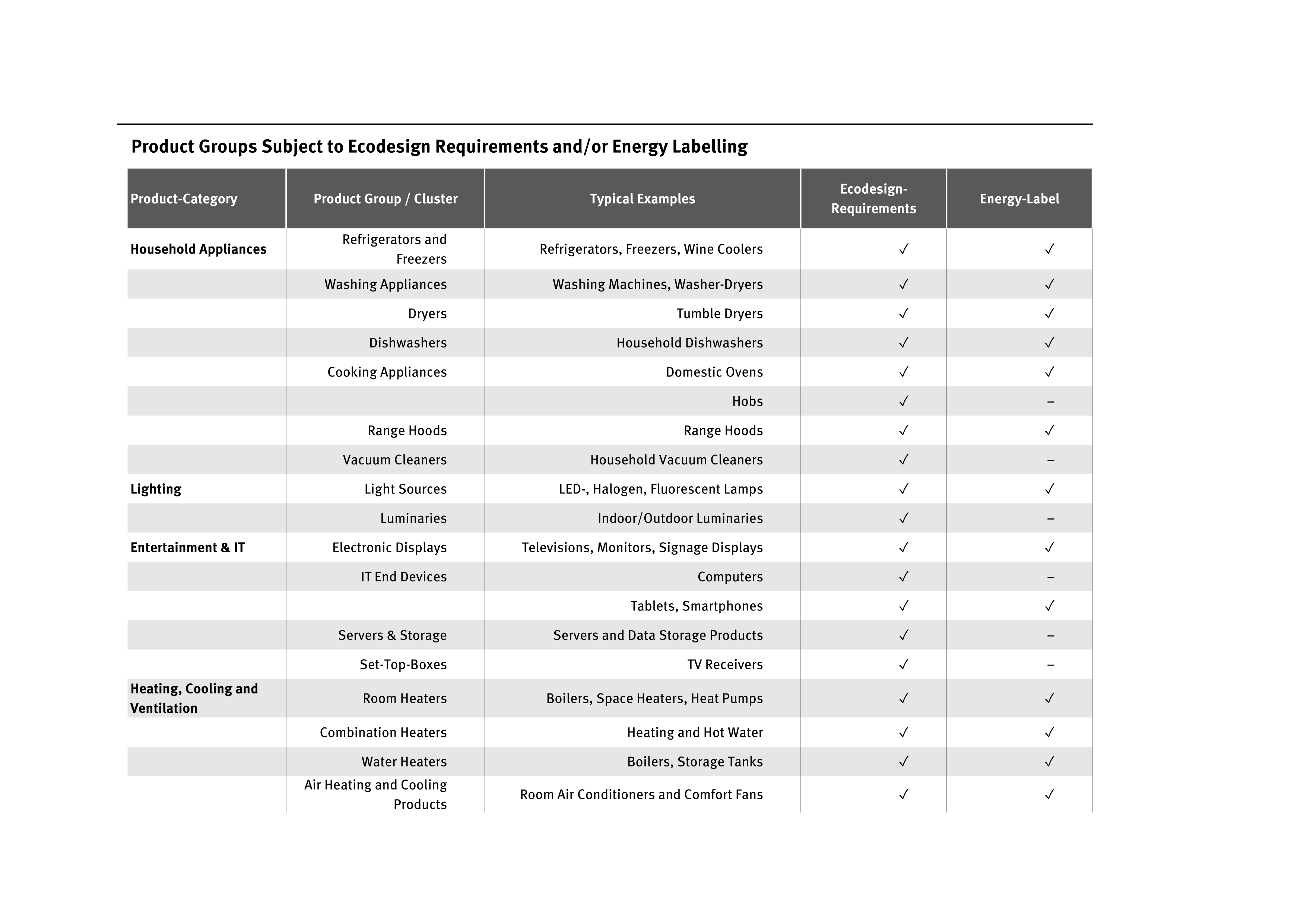
The table below shows the product groups subject to ecodesign requirements and/or energy labelling. Detailed information on the respective product groups, including references to the applicable product regulations, is published in the corresponding product list on the website of the European Commission.

Table showing different product groups and whether they are regulated Product Groups Subject to Ecodesign Requirements and/or Energy Labelling
Source: Umweltbundesamt

Downloads:

The European Commission sets out in a working plan which product groups will be subject to the development or revision of ecodesign requirements in the coming years. The first working plan under the Ecodesign Regulation was published in April 2025 and covers the period 2025–2030. An interim review is scheduled for 2028. 

The following product groups are given particular priority:

  • End products: textiles (especially clothing), furniture, mattresses, tires
  • Intermediate products: iron and steel, aluminum
  • Horizontal requirements: reparability (including repair score), recyclability, and use of recycled materials in electrical and electronic equipment

The product groups to be regulated are selected on the basis of a comprehensive assessment by the Joint Research Center (JRC), the EU Commission's research institute. The aim is to ensure that ecodesign is applied where it can deliver the greatest benefits for the environment and the economy. Further details of the underlying assessment can be found in the corresponding report by the European Commission. In particular, the following factors are taken into account:

  • the potential for improvement in terms of climate, environmental, and resource conservation at reasonable cost,
  • market significance (sales and trade volume in the EU),
  • climate and environmental impact throughout the entire life cycle (energy and raw material consumption as well as waste generation),
  • the need to adapt to technological and market developments,
  • and the contribution to strengthening the European economy.

Basic Concept of the Ecodesign Regulation, the Energy Label, and Delegated Acts

The Ecodesign Regulation is a framework regulation. It does not specify any concrete product requirements itself, but rather creates the legal framework within which specifications can be developed.

These requirements are usually established by so-called delegated acts—product-specific EU regulations that specify exactly which requirements individual product groups must meet. In exceptional cases, industry self-regulatory initiatives may also be permitted, provided they achieve the objectives of the regulation.

Products only have to meet the requirements once these have been laid down in a delegated act or in a recognized self-regulatory measure. The central starting point remains the definition of energy efficiency requirements, supplemented by possible specifications for resource and material efficiency and for limiting so-called substances of concern. In particular, requirements for durability, reliability, repairability, and recyclability can be defined.

Ecodesign acts as a red line: the requirements defined in the delegated acts are minimum benchmarks. Only if a product meets these requirements may it be traded on the EU internal market and receive the CE marking. Products that do not meet these requirements may not be placed on the market—this is intended to exclude an inefficient market segment with particularly high environmental impacts.

Energy labelling complements this system. Similar to the Ecodesign Regulation, the Energy Labelling Regulation (EU) 2017/1369 provides the legal framework for the labelling of products and the provision of uniform product information. It guides consumers with efficiency classes ranging from A to G and makes it easier to compare products that exceed minimum requirements, for example in terms of energy or water consumption or battery charging cycles. At the same time, the label creates incentives for manufacturers to improve their products beyond the minimum standards in order to achieve better efficiency classes and thus gain competitive advantages.

The specific design of the energy label for individual product groups is also laid down in EU regulations by means of delegated acts. Product groups that are subject to both the Ecodesign Regulation and Energy Labelling Regulation are regulated by two separate delegated acts, which lay down the ecodesign requirements on the one hand and the energy labelling requirements on the other.

In future, comparable product-related information labels (known as ecodesign labels) may be introduced under the Ecodesign Regulation for product groups that are not primarily relevant to energy consumption, such as textiles. These will provide information on the key environmental and sustainability characteristics of the products.

Contents of a Delegated Act for Product Groups and Horizontal Requirements

Delegated acts translate the Ecodesign Regulation into productspecific requirements—for example, for electronic displays, refrigerators, or other product groups. A distinction is made between two types of requirements:

Performance requirements: These refer to measurable characteristics of a product, such as limits for energy consumption, limits on pollutant emissions, or the obligation to provide spare parts.

Information requirements: These regulate what information manufacturers must make publicly available, for example on materials, reparability, reusability, or recyclability. The digital product passport plays a central role here, as it is intended to ensure transparency throughout the entire product life cycle.

All delegated acts are freely accessible in all official EU languages via the official legal information system EUR-Lex.

Background: Environmentally Friendly, Climate-Friendly, and Circular Economy-Oriented Product Design

Products account for a significant proportion of resource and energy consumption in the European Union. From raw material extraction to manufacturing, use, and disposal, they have a considerable impact on the environment, including greenhouse gas emissions, pollutant inputs, and high water and energy requirements. The life cycles of our everyday products therefore have a significant impact on the environment and climate.

However, products with the same function often differ significantly in terms of their environmental impact. This is precisely where there is great potential for savings: emissions can be reduced and resources used more efficiently—while at the same time, corresponding efficiency strategies promote innovation and competitiveness.

This is precisely where the Ecodesign Regulation (ESPR) comes in: it creates a legal framework designed to improve the environmental performance of products throughout their entire life cycle—from manufacture to use and disposal. The priority requirements are: energy and resource efficiency, durability, reparability, and recyclability.

The regulation thus supports climate protection, the goal of a low-pollution environment, and the transition to a circular economy, ensuring that sales on the EU internal market are subject to minimum environmental standards. At the same time, uniform EU-wide rules prevent different national regulations from creating barriers to trade, thereby ensuring a level playing field in the internal market.

The impact of ecodesign and energy labelling requirements is regularly calculated by the European Commission using a model-based approach as part of Ecodesign Impact Accounting (EIA). Based on this calculation model, it is estimated that the existing measures are expected to having achieved around 1,072 terawatt hours in 2023, which corresponds to approximately 13% compared to a scenario without regulation. By 2030, savings of up to 1,492 terawatt hours of primary energy per year are expected—equivalent to around 10% of the EU's total primary energy consumption. In addition to the associated positive environmental effects, consumers and the economy will also benefit significantly: calculations show considerable economic effects: For 2023, net savings in user costs of around €88 billion, additional corporate revenues of around €26 billion, and around 380,000 additional jobs are projected.

The Ecodesign Regulation was a central element of the European Green Deal and the second action plan for the circular economy. It is embedded in the EU's current overarching policy guidelines, including the Competitiveness Compass, the Clean Industrial Deal, the EU Single Market Strategy, and the Circular Economy Act (CEA), which is scheduled for adoption in 2026.

Process for Creating Delegated Acts and Participation

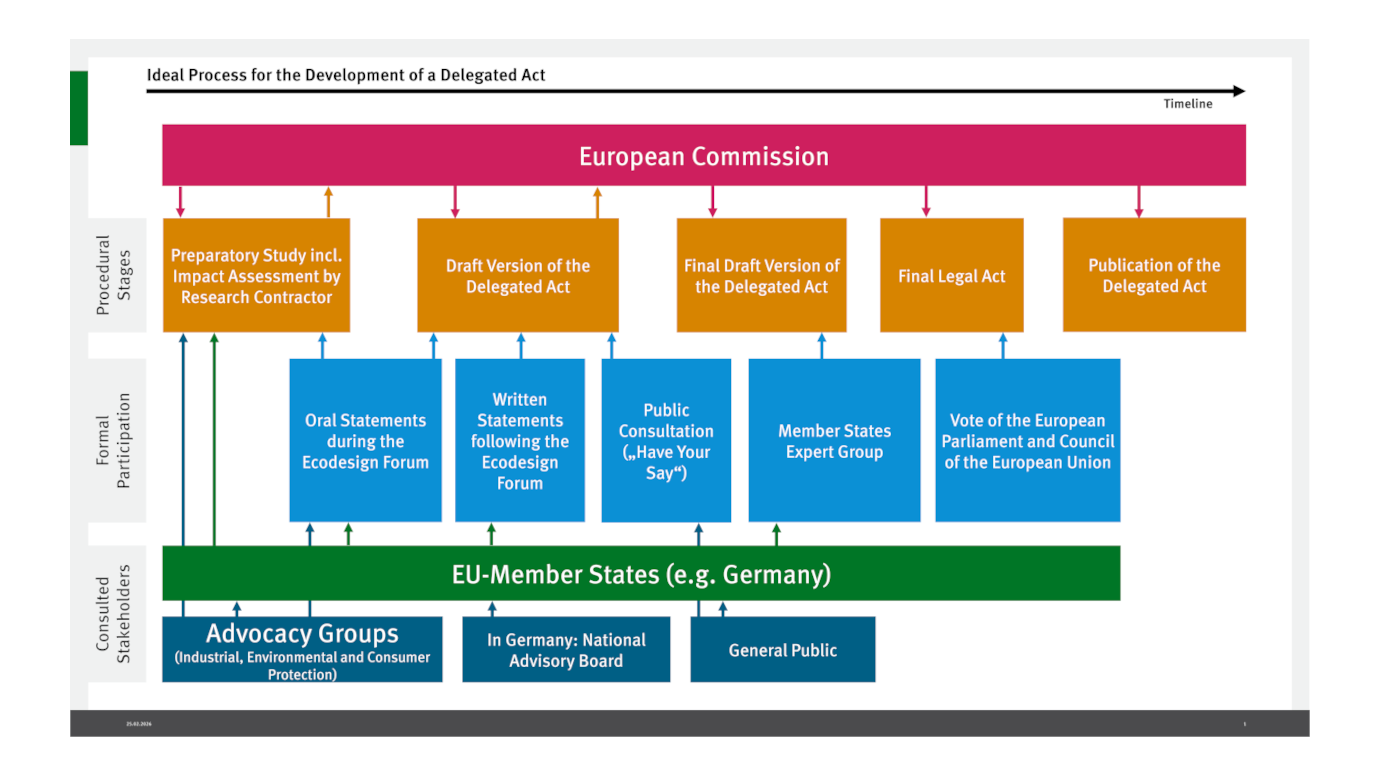
The establishment of ecodesign requirements for a specific product group is a multi-year process involving numerous political actors from the European Commission and EU Member States, as well as the relevant industries, academia, and non-governmental organizations (NGOs). All EU citizens are also invited to comment. The following image shows the process leading up to the adoption of an ecodesign product regulation. The individual procedural steps are explained in the accompanying text.

Flowchart showing the multiple steps involved in adopting a delegated act Ideal Process for the Development of a Delegated Act
Source: Umweltbundesamt

Legal Basis

The European Parliament and the Council of the European Union define the scope, main objectives, and basic principles in the so-called basic act (in this case, the Ecodesign Regulation). At the same time, the European Commission (pursuant to Article 290 of the Treaty on the Functioning of the European Union) is empowered to supplement or amend certain non-essential requirements (in this case: specific ecodesign requirements). This authorization includes, in particular, the establishment of technical requirements, assessment methods, or other technical specifications for certain product groups.

Preparation by the Commission and Participation

On this basis, the European Commission, under the lead of the relevant Directorate-General (e.g. DG ENER, DG GROW, DG ENV), draws up draft delegated acts. These are based on scientific preparatory studies, impact assessments, and technical analyses that examine the feasibility and the expected environmental and economic effects. The corresponding assessments are conducted in accordance with the MEErP Methodology (Methodology for Ecodesign of Energy-Related Products).

Already in the preparatory phase, the Commission is advised closely and at an early stage by the Member States Expert Group, which includes representatives of the European Member States, and by the Ecodesign Forum, which brings together representatives of industry, environmental organizations, consumer associations, and other stakeholders. The Federal Environment Agency (UBA) can participate in both forums. Within this framework, the content, benefits, and effects of planned measures are discussed on the basis of the studies that have been conducted. This ensures that national authorities and affected interest groups are involved in the drafting of delegated acts at an early stage.

National Coordination in Germany

To prepare Germany's position, the Federal Institute for Materials Research and Testing (BAM) coordinates the German advisory group on ecodesign. This is a national advisory body in which interested parties (independent experts, authorities, environmental and consumer associations, and representatives of the affected economic sector) exchange views and advise on the Commission's drafts.

Based on the advisory group and its own scientific studies, the BAM and the Federal Environment Agency (UBA) prepare, in coordination with the Federal Ministry for Economic Affairs and Energy, the Federal Ministry for the Environment, and other departments as necessary, a statement that will be submitted to the European Commission.

If you have a legitimate interest in participating in the German advisory group, you can access the BAM registration website.

Public Consultation

Public consultation is a key part of the process of preparing delegated acts. It is a structured procedure in which the European Commission seeks feedback and assessments in order to take into account the interests of a wide range of groups.

In addition to formal consultations in the Ecodesign Forum and the Member States Expert Group, the European Commission provides the general public with the opportunity to comment. 

The draft delegated acts developed on the basis of the preparatory studies are published on the "Have Your Say" online portal. Within a period of usually four weeks, all interested parties – citizens, companies, associations, non-governmental organizations (NGOs), or other stakeholders – can submit their comments. In addition, the portal offers the option of subscribing to a topic-related newsletter, the content of which is based on self-defined areas of interest.

This process is intended to ensure transparency and participation and, in particular, to give a voice to those stakeholders who are not represented in the formal consultation bodies. After the deadline, all feedback received will be evaluated by the Commission and may be incorporated into the revision of the draft.

Internal Coordination within the Commission and Scrutiny by the European Parliament and the European Council

Once the technical preparatory work, consultations in the Ecodesign Forum, discussions in the Member States Expert Group, and the public feedback phase have been completed, the European Commission finalizes the draft delegated act. From this point on, there is no further opportunity for external stakeholders to participate.

In an internal decision-making process (known as "Interservice Consultation"), the text undergoes quality assurance and consistency checks within the Commission services – both legally and linguistically. The draft delegated act is then notified to the World Trade Organization (WTO).

Once the WTO notification has been completed and all relevant Directorates-General have given their agreement, the draft enters the adoption process. To this end, it is submitted to the members of the Commission in a written decision-making procedure (known as the "written procedure"). If no objections are raised within a specified period, the draft is deemed to have been adopted. 

The legal act is then forwarded to the two legislative bodies—the European Parliament and the Council of the European Union—for review. Both institutions now have a two-month review period during which they can adopt or reject the delegated act. After the review period has expired and the Parliament and Council have approved it, the delegated act is published in the Official Journal of the EU. This completes the delegated act adoption process. The act usually enters into force 20 days after publication and is immediately valid and legally binding in all EU Member States from that point on. The requirements specified therein apply equally to products manufactured in the European Union and to goods imported into the EU from third countries.

Market Surveillance

Ecodesign sets requirements that are intended to make products more sustainable. However, these requirements are ineffective if they are not complied with. To ensure that products available on the market meet the specified requirements, they are checked randomly by market surveillance authorities. In Germany, this task is performed by the market surveillance authorities of the federal states.

Market surveillance checks, for example, whether commercially available light sources such as LED lamps actually achieve the prescribed energy efficiency values. If it is found that a lamp consumes more electricity than specified, a violation has been detected. If this is the case, manufacturers can be obliged to make improvements, administrative penalties may be imposed, or products can be withdrawn from the market.

Market surveillance measures are reported to the Federal Institute for Materials Research and Testing (BAM). The results are published in the ICSMS (Information and Communication System for Market Surveillance) – a European reporting and information system for non-compliant or dangerous products. Consumers can also use this system to find out which authority is responsible and report suspected cases.

Here you will find an overview of the respective competent state authorities.

Associated content

Links

Publications

Tags

Short link: https://www.uba.de/n306515en