What is the state of the environment in Germany and where is there an urgent need for action? Read our 2020 summary in this edition of the newsletter. You will also find our recommendations on a number of areas of work in progress regarding environmental protection. These include how rivers can be restored to good condition, green start-ups can be better promoted, farm animals can be kept in a more environmentally friendly manner and public authorities can be rendered neutral in terms of greenhouse gases.
Wishing you an interesting read,
The Press Office of the German Environment Agency
State of the Environment 2020: UBA draws mixed results
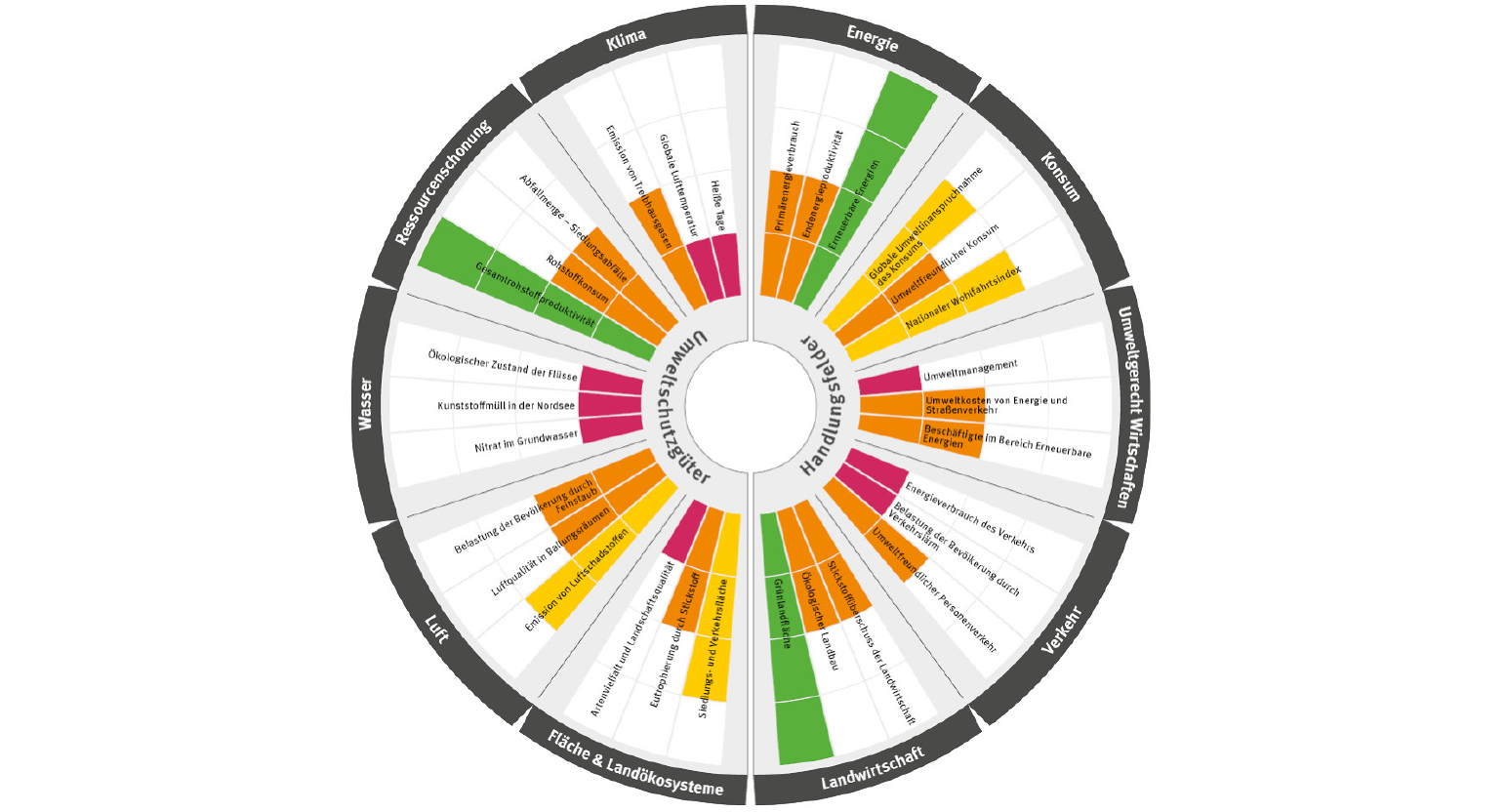
The UBA Environmental Monitor 2020 shows at a glance: Much is to be done to protect the environment.
Source: Studio Good / Umweltbundesamt
What is the state of the environment in Germany? This question is answered by the recently published UBA Environmental Monitor 2020. It illustrates ten central topics from climate, water and air to energy and transport, each with three key indicators.
The results are quite mixed: There have been recent improvements in air quality or greenhouse gases, while other indicators are not performing well. For instance, on the subject of water, the Environmental Monitor shows "red" in all three indicators. Only seven percent of the rivers are in a good ecological condition. This means that the target of the Water Framework Directive has been missed by a considerable margin. In the case of groundwater, the threshold value for nitrate is still exceeded at almost every sixth measuring point. The cause is the high nitrogen input from agriculture. There is also a need for action in the area of transport. The targets of the German Sustainability Strategy for reducing final energy consumption in transport were clearly missed.
German Environment Agency President Dirk Messner: "Short-term improvements such as the reduction in greenhouse gas emissions should not blind us to the considerable need for action to protect the environment."
There are new energy labels for some electrical appliances, initially for televisions, dishwashers, washing machines and refrigerators with effect from 1 March 2021. The energy performance is now displayed again on a scale from A to G. Efficiency differences are therefore easier to identify. In addition, eco-design requirements apply, which enable these products to be repaired more easily. read more (in German)
‘Less is more - also when it comes to spring cleaning’.
Various substances from cleaning agents are released into the environment via wastewater and pollute ecosystems. Tips for environmentally friendly spring cleaning from UBA expert Marcus Gast. read more (in German)
UBA positions
Nine recommendations for the good quality standard for our waters
Germany's waters are not in a good condition. Only a small proportion of rivers and lakes meet the environmental targets required by the European Water Framework Directive. More measures are required to achieve these targets. The position paper contains nine recommendations that contribute to restoring the ‘good condition’ of our waters. read more (in German)
Germany produced about 739 million tonnes of greenhouse gases emissions in 2020 – roughly 70 million tonnes (8.7%) less than in 2019. These are the conclusions drawn from emissions data from the German Environment Agency (UBA) which were submitted according to the specifications of the Federal Climate Protection Act for the first time. The cut in emissions achieved is the largest since 1990.
Measured concentrations of nitrogen dioxide (NO2) in 2020 exceeded the annual mean limit of 40 µg/m³ of air at only about 3 to 4 percent of measuring stations located near road traffic, compared to 21 percent in 2019. Nitrogen dioxide pollution overall continues to decline throughout Germany.
Airborne ultrafine particles can be harmful to human health. A study by the German Environment Agency (UBA) at Frankfurt Airport has demonstrated that ultrafine particle (UFP) load in the vicinity of airports can be significantly elevated. Engine emissions are shown to be the major cause, contributing 90 per cent of total load.
How do climate change and environmental degradation affect human health? What can people in the health professions do to promote climate protection and adaptation to climate change? This and much more is covered by experts in 15 video lectures, many of which are recorded online. UBA provided support for the lecture series from the funding programme for associations (Verbändeförderung).
As long as the Covid-19 pandemic makes face-to-face events impossible, online conferencing formats serve to inform German SAICM stakeholders and provide opportunities for exchange with each other and with BMU and UBA. A series of online workshops focuses on different topics of chemicals management throughout the first half of 2021.
Facts and figures on coal: Status quo and perspectives
There are many facets to the phase-out of coal: Following the adoption of the Coal Phase-out Act, coal will no longer be used to generate electricity in Germany from 2038 at the latest. In the meantime, the use of lignite and hard coal will not only have a considerable impact on the climate, but also on the quality of the air, water and soil. read more (in German)
Avoiding waste with target group-specific communication
Consumers of all social groups are aware that waste causes environmental problems. In the process, reference is predominantly made to a person's own consumption habits, but the responsibility of companies and politics is also called into question. A study commissioned by the German Environment Agency investigated consumption and potentials of waste prevention by social groups and developed approaches for communication. read more (in German)
On 15 March 2021 the European Energy Exchange AG (EEX) in Leipzig was awarded the contract for the sale of fuel emission allowances in the national emissions trading scheme (nETS). The German Environment Agency (UBA) had put this task out to tender on a Europe-wide basis as the body responsible for the implementation of the nETS. The first sale date is scheduled for October 2021.
More support for green start-ups
Innovative green start-ups are central to managing environmental challenges. However, the existing start-up support programmes do not support them effectively. A study commissioned by the German Environment Agency shows the deficits and also proposes two variants for start-up financing specifically for green start-ups. read more (in German)
Prospects for environmentally sound livestock farming
Livestock farming damages the air, soil and water and pollutes the climate. According to a publication by the German Environment Agency, the negative effects of this can be significantly reduced by process engineering measures which can be implemented in the short term (such as lower-emission housing systems), a better spatial distribution of animals and a reduction in the production and consumption of animal foodstuffs. read more (in German)
Annual report on German auctions in EU emissions trading
How was the third trading period of the European emissions trading system? How many emission certificates were auctioned in Germany in 2020? And what are the proceeds of these auctions used for? The annual report on German auctions provides an overview. read more (in German)
How can the EU electric power market quickly and cost-effectively become climate-neutral?
How can a rapid, cost-effective and sustainable transformation of the European electric power supply towards a climate-neutral system with renewable energies be achieved? And what climate and energy policy framework is suitable for that purpose? Three UBA studies have examined these questions. read more (in German)
Questions and answers on the recycling economy
Increasingly more raw materials are being extracted around the world to meet the growing demand of the global economy. This intensifies global environmental problems such as climate change, soil degradation or the loss of biodiversity. In order to address this, we need a more efficient use of resources, to question our consumption and to recycle resources where possible. read more (in German)
Recommended action for a sustainable bio-economy
A project commissioned by the German Environment Agency on the opportunities and risks of bio-economy strategies shows that they are often not compatible with the global sustainability goals of the 2030 Agenda. In accordance with these findings, specific political recommendations for action to the Federal Government for a sustainable bio-economy are being devised. read more (in German)
The state and its administration have an important role to play in protecting the climate. That is why many public authorities have set themselves the goal of becoming greenhouse gas-neutral. The guide describes the path to a greenhouse gas-neutral administration with the help of nine stages, gives recommendations and makes implementation on site easier with many practical examples.
The EU Commission will award prizes within the framework of EMW in two categories to the municipalities with the most innovative and ambitious programmes. An international jury draws up a shortlist of finalists. Two German cities are among the finalists this year.
EMW Motto 2021: Active, healthy and safe on the move
This year, health and safety are the focus of the EUROPEAN MOBILITY WEEK (EMW). The motto "Active, healthy and safe on the move" aims to encourage municipalities to engage with local people on the issues of health and safety on the move. Here, we summarise how these topics are connected and what action is possible. read more (in German)
Providing shade: The UBA participation campaign
Stress due to heat exposure will continue to increase over the next few years. For many people, this will mean a change in everyday life during the hot months. The participation campaign Shade Givers invites communities, initiatives and private individuals to get involved and put the issue of heat stress on the local agenda. read more (in German)
The United Nations Environment Programme, the United Nations Development Programme, the International Science Council, the German Environment Agency, the Government of Kenya, Future Earth, and Sustainability in the Digital Age have joined forces to act as co-champions for a new global initiative called CODES (Coalition for Digital Environmental Sustainability).
Carbon Leakage: Climate policies and investment behaviour
The shifting of emissions abroad due to varying ambitious goals in climate policies, carbon leakage for short, has various facets. A research project commissioned by UBA has examined some of these, including the influence of CO2 pricing on the investment behaviour of industrial companies and a comparison of the climate policies of the EU's main trading partner countries. read more (in German, linked publications partly in English)
New EU strategy for adapting to climate change
The European Commission adopted the new Climate Change Adaptation Strategy on 24 February 2021 as one of the key measures in the framework of the European Green Deal. read more (in German)
Sustainable solutions on water and agriculture
Germany's waters are not in a good condition. One of the reasons for this is the nutrient and pollutant load from agriculture. The report by the European Environment Agency and UBA staff shows that more ambitious measures to promote sustainable agriculture are needed in the EU's Common Agricultural Policy (CAP) in order to protect waters. read more (in German, linked publications partly in English)
Law & Legislation
COVID-19: Proper disposal of quick tests and vaccination waste
Is there any risk of infection from used Corona quick tests or from vaccination waste? And how should waste generated during testing or vaccination be disposed of? A federal/state recommendation has now been published on current issues concerning the disposal of waste from COVID-19 containment measures. read more (in German)
Evaluation of the Federal Environmental Information Act
The Federal Environmental Information Act (UIG) governs access to environmental information and its active dissemination. A UBA study shows: The Act has essentially proven to be successful. However, the law could be improved and particularly better implemented in some areas. Therefore, the study is primarily addressed to the federal authorities and private bodies obliged to provide information. read more (in German)
A mandatory energy savings system for Germany
New policy instruments such as a mandatory energy savings system are needed to reduce energy consumption and achieve European and national energy efficiency targets. The German Environment Agency has commissioned a study on how such a policy instrument could be designed for Germany within the existing legal framework with regard to sectors and energy sources or the savings target. read more (in German)
Pharmaceuticals, detergents, pesticides etc. – ever more chemicals are polluting our waters. The Trace Substance Strategy of the German Federal Government focuses on preventing further inputs of such trace substances to the aquatic environment. UBA will move ahead on work to implement the Trace Substance Strategy at a newly established Federal Centre for Trace Substances.
The UMWELT & BAUEN award recognises projects that are already realizing the idea of a new European Bauhaus in terms of sustainable building. The prize will be awarded for the second time in 2021, this time in four categories. All stakeholders in the building sector are eligible to apply by the 25 May 2021 deadline.
This is the fifth time that the publishing house Matthes & Seitz Berlin is awarding the German Prize for Nature Writing in cooperation with the German Environment Agency and the Stiftung Kunst und Natur (Foundation for Art and Nature), which was already a cooperation partner last year. The competition is under the patronage of President Dirk Messner of the German Environment Agency.
The Chiemsee, Ammersee, Tegernsee, and Starnberger See are a few of the 14 impressive alpine lakes in Germany that enjoy popularity beyond the borders of the Alpine foothills. Clear, cold and comparatively oligotrophic water is their common property. Excessive algal growth is rare.
The authorisation process is a central instrument of REACH, aiming at reducing risks from the use of Substances of Very High Concern (SVHC). The goal is a stepwise elimination of such substances from the market with the option to grant temporary exemptions. The authorisation process comprises the identification of SVHCs for the candidate list, prioritisation Annex XIV, applications for…
Staying within the limit of the Paris Agreement of 1.5 °C global warming requires closing the global 2030 ambition and action gap arising from insufficient current policies and contributions. This background paper documents the methodology and criteria for assessing multilateral initiatives of the G20 countries in four policy fields. In four steps and with the use of twelve criteria and further…
Tropospheric ozone is an air pollutant that causes risks to human health and vegetation. This literature study summarises results of experiments, in which the effects of ozone on plants has been investigated in combination with factors of climate change, enhanced concentration of carbon dioxide in the air as well as nitrogen deposition. The results are needed for a sound risk assessment for plants…
Achieving the goals of the Paris Agreement requires increased global climate action, especially reduced deforestation and restoration of forests to protect and rebuild ecosystems carbon stocks. Based on a sound analysis of existing multilateral cooperation the paper presents five recommendations to increase climate ambition of the G20 countries in the respective policy field: increasing…
Achieving the goals of the Paris Agreement requires increased global climate action for sustainable food systems, especially a reduction of food loss and waste and dietary shifts towards plant-based diets. Based on a sound analysis of existing multilateral cooperation this paper proposes four potential initiatives to increase climate ambition in the respective policy field: an international…
An essential prerequisite for a sustainable energy supply and greenhouse gas neutrality in Germany and worldwide is the complete conversion of the energy supply to renewable energies. Wind and sun are the sources with the greatest supply potential. However, these energy sources have a low energy density and are not uniformly available everywhere to the same extent. Therefore, a system is needed…
The project conducted the third application of the OSPAR Common Procedue for the assessment of the eutrophication status of the German coastal and marine waters of the North Sea, based on data from 2009-2014. The assessment results were also used in the implementation of the Marine Strategy Framework Directive for descriptor 5 “eutrophication”. The project thereby provided decision-making support…
The UBA invites representatives from the EU Commission, national authorities, academia and NGOs to discuss options to declare and communicate VOC emission classes for construction products. This will be framed by an overview of the policy framework, the state harmonisation at EU level and stakeholder views on the need for such VOC emission classes.
The minerals and metals industries, including the mining sector, have been associated with incidents related to human rights violations and serious environmental impacts. How to address human rights violations and conflict related risks has been taken up broadly in due diligence guidance and company practice in mineral supply chains.
The GIZ and the German Environment Agency (UBA) on behalf of the Federal Ministry for the Environment (BMU) are holding the international Green Cooling Summit which addresses the question of how to implement the Kigali Amendment to the Montreal Protocol. The main issue will be the replacement of hydrofluorocarbons (HFCs) especially in the air conditioning and refrigeration sector.
As a partner event of the EU Green Week, UBA is organising this online seminar on the Directive on the Sustainable Use of Pesticides and the benefits of including biocides as well.
As recounted
90
More than 90 per cent of our flowing waters are not in good ecological condition and hardly provide a habitat for many animals and plants anymore. Renaturation measures are urgently required. Implementing the measures, however, remains a major challenge even after 20 years of the EC Water Framework Directive. Eight billion Euro are to be invested in watercourse development by 2027.