Use alternatives to air travel: other means of transportation, closer holiday destinations or video conferences instead of business trips.
Voluntarily offset your air travel by donating to high-quality climate protection projects in order to compensate for the high climate impact of air travel.
Know how
Flying is the most climate-damaging way to travel. For example, a flight from Germany to the Maldives and back causes a climate impact of around 2.8 tonnes of CO₂ equivalents per person. You can drive more than 13,000 km in a car, which is more than the average annual mileage of a car in Germany, before you reach the greenhouse gas impact of such a flight (based on consumption of 7 l/100 km, source UBA-CO₂-Rechner).
Use alternatives: Far distant destinations can only be reached without flying in exceptional cases. However, within Germany or Europe, there are often more environmentally friendly alternatives by train or bus (e.g. express connections or night trains). Contrary to common assumption, video conferencing can make air travel unnecessary in your professional life. Existing routines and a lack of technical familiarity are often the reasons why aeroplanes continue to be used. Last but not least, we should question our travel wishes themselves. Even within Europe, there are more exciting sights and destinations than we could ever hope to discover in our lifetime.
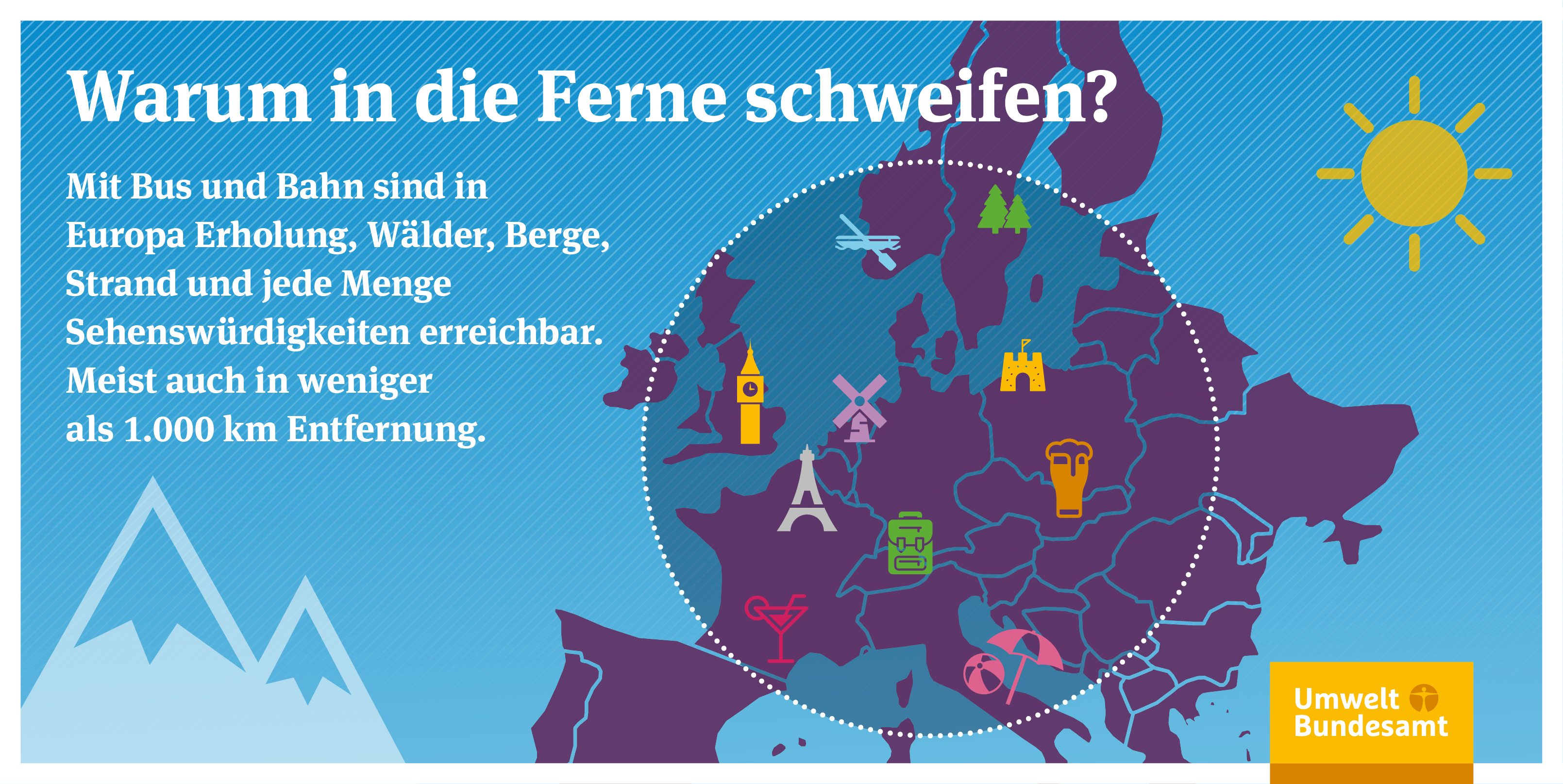
Why look far afield?
By bus and train, relaxation, forests, mountains, beaches, and plenty of sights are accessible within Europe. Usually even within a distance of less than 1,000 km.
Source: Umweltbundesamt
Voluntary compensation: various providers offer so-called CO₂ compensation services. The traveller pays an additional amount on top of the flight ticket price, thereby supporting specific climate protection projects in the form of a climate contribution. When making your choice, ensure that the climate impact is calculated realistically and that the climate protection projects are of high quality. The ‘Gold Standard’ provides guidance (see illustration). Of course, there is nothing wrong with supporting climate protection projects financially, even if you don't fly. Further information is available in the UBA Environmental Tips section Kompensation von Treibhausgasemissionen.
The Gold Standard
Source: The Gold Standard Foundation
Here is something else you can do:
Please also note our environmental tips for holiday travel (Urlaubsreisen) and travelling by bus and train (Bus & Bahn fahren).
Flying economy class is cheaper and produces fewer greenhouse gases than flying first or business class.
Advocate for climate-friendly business travel regulations, for example at your workplace or for school trips.
Background
The climate impact of air travel is not solely based on CO₂ emissions. The combustion of kerosene produces other substances, such as nitrogen oxides, aerosols and water vapour, which contribute to the warming of the Earth's atmosphere. These substances have a greater impact at typical cruising altitudes of around 10 kilometres than they do at ground level, thereby increasing the greenhouse effect accordingly:
Depending on the ambient temperature and ice saturation, the emission of water vapour leads to the formation of contrails and cirrus clouds.
Nitrogen oxides form ozone under the influence of sunlight, which acts as a powerful greenhouse gas at cruising altitude.
These various effects combine to make the greenhouse effect of flying, on average, two to five times greater than CO₂ emissions alone (see illustration).
Furthermore, air traffic has an impact on both the global climate and local areas. Almost 40 per cent of the German population is affected by aircraft noise. The risk of cardiovascular disease and heart attack is increased by constant aircraft noise. It has been found that children living near airports have difficulty concentrating and learning. For example, local air quality is also deteriorating due to nitrogen oxide emissions. The construction and operation of airports also has further environmental impacts due to the land consumption involved.
Further information can be found at the following links:
UBA (2023): Climate impact of air transport (Klimawirkung des Luftverkehrs). Scientific knowledge, developments and measures (flyer).
Source: Umweltbundesamt
UBA-Erklärfilm: Flugreisen und Klimawirkung
Wie wirken sich Flugreisen auf das Klima aus und welche Alternativen gibt es? Hier finden Sie ein Text-Transkript des Videos im Sinne der Barrierefreiheit.
Hintergrund
Die Klimawirksamkeit von Flugreisen beruht nicht nur auf dem Ausstoß von CO2. Auch andere bei der Verbrennung von Kerosin entstehenden Substanzen wie Stickoxide, Aerosole und Wasserdampf tragen zur Erwärmung der Erdatmosphäre bei. Diese Stoffe wirken sich in typischen Reiseflughöhen von etwa 10 Kilometern stärker aus als am Boden und vergrößern den Treibhauseffekt entsprechend:
In Abhängigkeit von der Umgebungstemperatur und der Eissättigung führt der Ausstoß von Wasserdampf zur Bildung von Kondensstreifen und Zirruswolken.
Stickoxide bauen unter der Sonneneinstrahlung Ozon auf, das in Reiseflughöhe als starkes Treibhausgas wirkt.
Diese verschiedenen Effekte summieren sich derart, dass die Treibhauswirkung des Fliegens im Durchschnitt etwa zwei- bis fünfmal höher ist als die alleinige Wirkung des ausgestoßenen CO2 (siehe Abbildung).
Der Luftverkehr belastet jedoch nicht nur das globale Klima, er hat auch lokale Auswirkungen. So leiden fast 40 Prozent der deutschen Bevölkerung unter Fluglärm. Dauernder Fluglärm erhöht das Risiko für Herz-Kreislauf-Erkrankungen und Herzinfarkt. Bei Kindern im Umkreis von Flughäfen wurden Konzentrations- und Lernschwierigkeiten festgestellt. Auch verschlechtert sich die lokale Luftqualität durch den Ausstoß von z.B. Stickoxiden. Weitere Umweltbelastungen ergeben sich durch den Flächenverbrauch beim Bau und Betrieb von Flughäfen.
Weitere Informationen finden Sie unter folgenden Links: