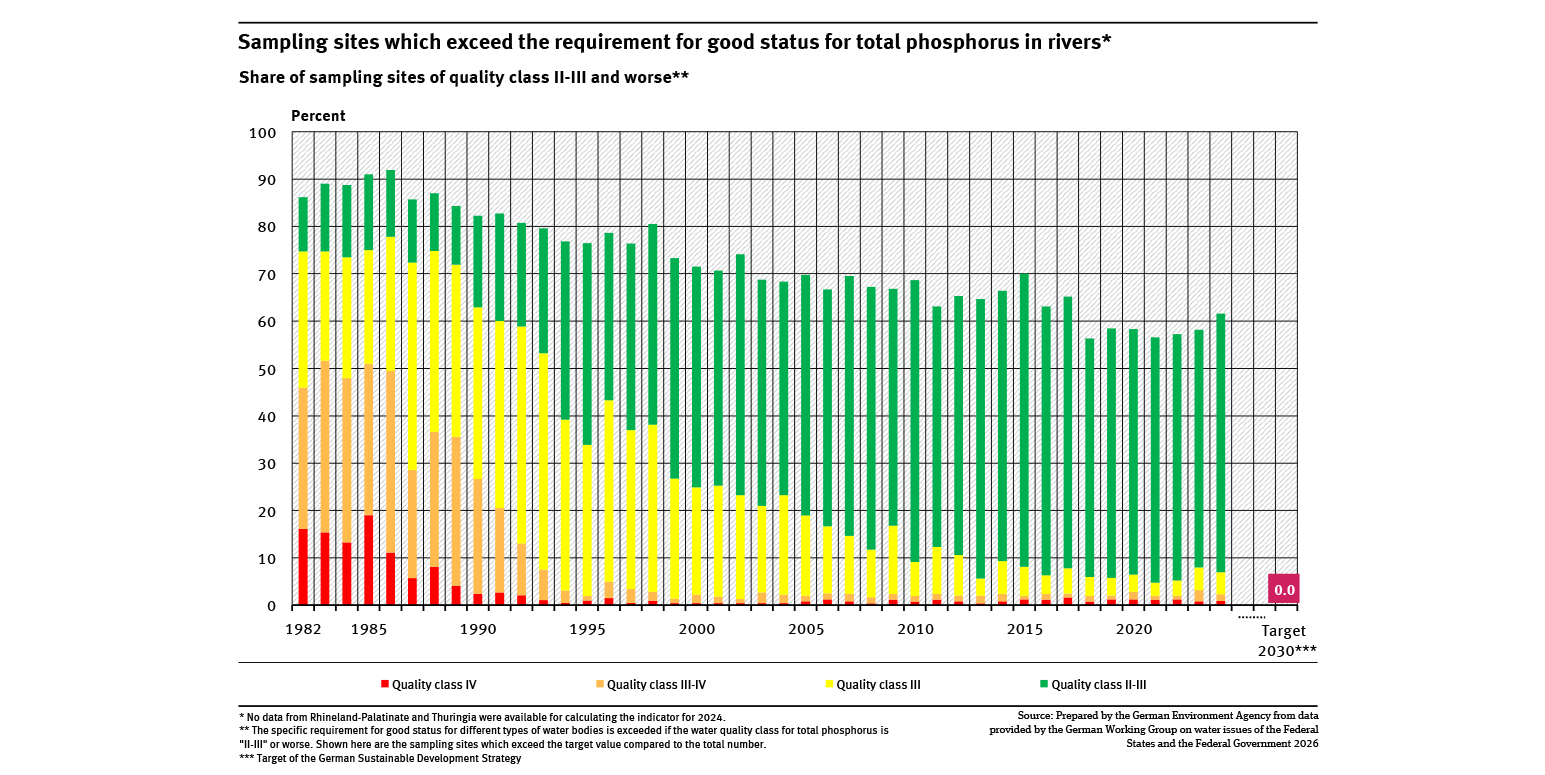
In the early 1980s, excessive phosphorus concentrations were measured at almost 90 % of sampling sites. Since 2018 this share has remained slightly below 60 %. Major improvements can be seen across the different quality classes: overall, the proportion of more heavily polluted water bodies has declined. This improvement has been driven primarily by the introduction of phosphate-free detergents and the expansion of third treatment stage including phosphate precipitation in larger sewage treatment plants since the 1990s.
The requirements for reducing phosphorus concentrations in water bodies are diverse: According to the European Water Framework Directive (EU Directive 2000/60/EC), all water bodies must achieve good ecological status by 2027. The Fertiliser Ordinance stipulates that less fertiliser must be applied to soils with high phosphorus levels. The Waste Water Ordinance stipulates that even small sewage treatment plants must remove phosphorus from waste water using state-of-the-art technology. In accordance with Objective 6.1.a of the German Government’s Sustainability Strategy, the phosphorus limits must be met by 2030 at the latest.