In the summer of 2022, frightening pictures were circulating in the German media showing masses of dead fish in the River Oder on the German-Polish border. The bad news is that this is precisely what can happen again in the Oder and in other stretches of water. You can read in this newsletter what can be done about it. Other topics include how Germany can still achieve its climate targets for 2030, the recycling of fibre composites and the EU Interreg project "NiCE – from niche to centre" coordinated by the UBA, which aims to make city centres more attractive again by means of sustainable products and services.
We hope you find it an interesting read
The Press Office of the German Environment Agency
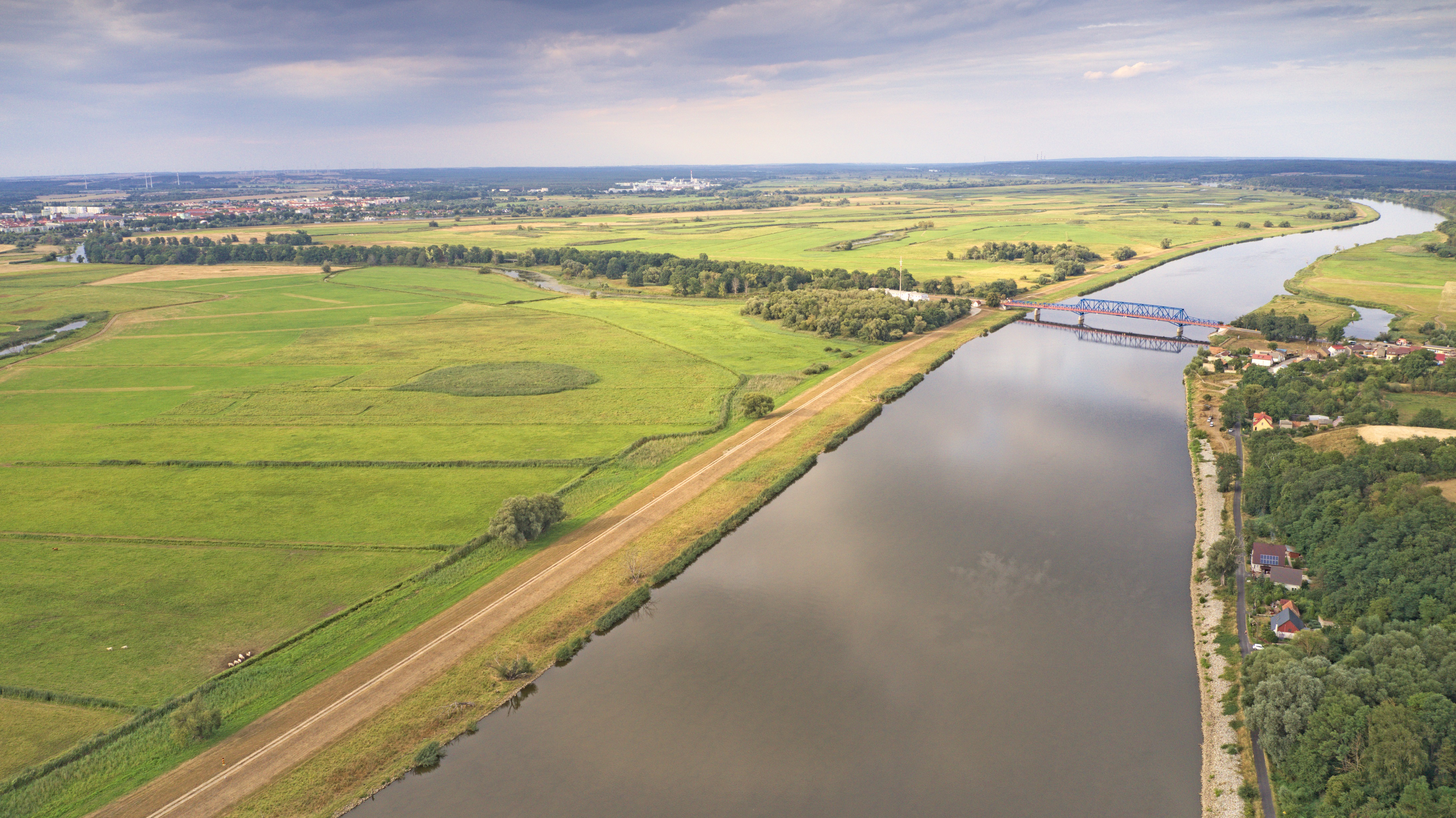
What needs to be done to prevent a repetition of fish die-off in the Oder and other bodies of water
The river Oder
Source: Marco Rudolph / Adobe Stock
The massive fish die-off in the Oder River in August 2022 showed that science, water management and politics are facing new challenges. Due to climate change and the resulting increase in hot and dry summer periods, this type of fish die-off could be repeated in the Oder and other stretches of water if no counter measures are taken.
The cause of the fish die-off in the Oder was a toxin produced by an algae. The combination of the factors of high salt discharge into the river, high temperatures, low water levels and intense sunlight allowed the algae to proliferate and the toxin to reach high concentrations, causing fish and mussels to die en masse.
To avoid this in the future, the German Environment Agency recommends:
reducing nutrient inputs and salt discharges into bodies of water, for example by eliminating fertilisation along water margins and by requiring permits for salt discharges from mining and industry to provide for a reduction when water levels are low in summer
making bodies of water more resilient to similar disasters and to climate change, for example by restoring floodplains and clearing riverbed and bank defences
monitoring endangered watercourses across authorities and federal states and defining immediate measures in the event of a crisis, such as reducing salt discharges or discharging unpolluted water from dams
Increasing research, for example on improving water monitoring and on early warning systems.
More on the findings and recommendations is summarised in the following five-page factsheet.
Germany can still achieve its climate targets by 2030. This is the conclusion of a new study by the German Environment Agency (UBA). To do so, Germany would need, among other things, more rail traffic, a reform of the motor vehicle tax and restrictions on fossil-fuel heating. In addition, all emissions would have to be priced and charged to the polluter.
Emissions from energy plants rose by three percent, while those from industry fell by six percent. This was due to the war against Ukraine and the associated distortions on the energy markets, according to the German Emissions Trading Authority (DEHSt) at the German Environment Agency (UBA).
The European Emissions Trading Scheme (EU ETS) will be aligned with the European climate protection target of reducing emissions by at least 55% by 2030 compared to 1990. In May and June 2023, the legal acts entered into force. Now the European Commission, in agreement with the member states, must draw up a variety of rules to implement the reform.
Sustainable cooling and heating of buildings is becoming more and more important – this years Green Cooling Summit leads the way to hands-on solutions. The event jointly organized by GIZ Proklima and the German Environment Agency on the behalf of the German Ministry for the Environment will be held again as a pure online format.
Ambitious CO2 pricing via emissions trading is a key lever for achieving the statutory climate targets in the building and transport sectors. This makes climate protection measures economical, ensures target achievement through a binding upper limit on emissions and helps to keep the economic costs of climate protection low. However, it must be ensured that no social hardship arises. This study by…
The EU will introduce a carbon border adjustment mechanism (CBAM) on October 1, 2023. The main idea is to apply the same carbon price to imported emission-intensive goods as if they had been produced under EU carbon pricing rules (EU ETS). This is intended to prevent the relocation of domestic industry, which has to bear rising CO2 costs within the EU ETS, to countries without comparable carbon…
In November 2022, the European Commission put forward a proposal for a regulation for a Carbon Removal Certification Framework (CRCF).This proposal includes various provisions that would empower the Commission to adopt delegated acts. Delegated acts are intended to specify a number of provisions of the regulation.
This report examines whether the proposed provisions on delegation are in line with…
National Inventory Report for the German Greenhouse Gas Inventory 1990 – 2021
As a Party to the United Nations Framework on Climate Change (UNFCCC), since 1994 Germany has been obliged to prepare, publish and regularly update national emission inventories of greenhouse gases. Pursuant to Decision 24/CP.19, all Parties listed in ANNEX I of the UNFCCC are required to prepare and submit annual National Inventory Reports (NIRs) containing detailed and complete information…
The principle of equity plays an important role in the Global Stocktake under the Paris Agreement. This paper discusses several concepts of equity, which can guide the distribution of mitigation efforts, adaptation actions, and means of implementation and support, namely the concepts of responsibility, capabilities, egalitarianism and sufficientarianism. The application of one concept only may not…
Climate Change
51
Teaching modules on the CO₂ calculator commended
The teaching materials with the title “ich, du, wir, sie – Was kann die/der Einzelne für den Klimaschutz tun?” (I, you, we, they – what can the individual do for climate protection?) were subjected to an independent quality check by the service portal for consumer education of the vzbv (Federation of German Consumer Organisations) and rated as "good". They provide templates and building blocks for up to six school lessons at intermediate level. The starting point is the theme of the UBA CO₂ calculator. read more (in German)
First half of 2023: Less renewable electricity, but proportion increases
The expansion and use of renewable energies developed differently in the various sectors in the first half of 2023. In the energy sector, less renewable electricity was generated than in the previous year despite an increase in installations. In the heating sector, on the other hand, there was significant growth. In the transport sector, approximately the same amount of biofuels were used as the year before, but significantly more renewable electricity was consumed. read more (in German)
Expansion of onshore wind energy: Two per cent target is sufficient
A key prerequisite for the expansion of onshore wind energy is sufficient usable land. The German Wind Energy Area Requirements Act stipulates that 2 percent of Germany's land must be designated for wind energy by 2032. A study for the German Environment Agency has now calculated that this area target is sufficient to achieve the expansion targets for onshore wind energy. read more (in German)
New info centre: emissions trading explained in simple terms
Through a new information centre, the German Emissions Trading Authority at the German Environment Agency explains the basics of CO₂ pricing in Germany. It also answers questions from citizens about the emissions trading systems and emissions reductions. read more (in German)
Winners of the RE:DESIGN EFFICIENCY creative competition announced
They make the invisible visible and the unwieldy topic more memorable: the picture entries on energy saving and energy efficiency for the creative competition RE:DESIGN EFFICIENCY. This raises the profile of the often neglected energy demand side as a central pillar of the energy transition. The winners have now been chosen. The jury also included Dr. Jürgen Landgrebe, head of division at the UBA. read more (in German)
Launch of the "Strengthen Nature – Protect the Climate" campaign
On 5 June – World Environment Day – the starting signal was given for the campaign "Strengthen Nature – Protect the Climate" organised by the Federal Ministry for the Environment (BMUV). The focus is on forests, peatlands and floodplains, which are among the key spheres of action in the Climate Action Programme and whose conservation and restoration will be strongly promoted over the next few years. read more (in German)
Health
Environmental pollutants: what is polluting humans?
Heavy metals, plasticisers or the "eternal chemical" PFAS – what environmental pollutants do people in Germany have to deal with? Which pollutants are found in our drinking water and in our living environment? The sixth German Environmental Health Survey for Adults (German Environmental Survey / GerES VI) gets to the bottom of these and other questions. read more (in German)
Chemicals
Trifluoracetate (TFA): persistent substance found everywhere
An interactive map of TFA – a very mobile and persistent substance – produced for the first time by the German Environment Agency shows the nationwide TFA findings in Germany in surface waters and groundwater with hotspots along the Rhine and Elbe river systems. TFA cannot be removed from the environment on a large scale and therefore accumulates in the environment. read more (in German)
Support for EU restriction of PFAS in fire-fighting foams
The Scientific Committees of the European Chemicals Agency (ECHA), the Committee for Risk Assessment (RAC) and the Committee for Socio-economic Analysis (SEAC), have agreed their position on the restriction proposal and their support for an EU-wide restriction of PFAS (perfluorinated and polyfluorinated alkyl substances) in fire-fighting foams. read more (in German)
The climate neutrality of air and sea transport can hardly be achieved without the accelerated use of almost GHG-neutral fuels. Such fuels are generated from renewable electricity and are thus called electro fuels or (synthetic) e-fuels. To illustrate how these e-fuels can be made available and how to ensure that in both sectors only such fuels are used, several policy roadmaps have been sketched…
The study "Sustainable mobility concept EURO 2024" deals with the promotion of sustainable mobility in the context of the European Football Championship 2024 (EURO 2024) in Germany. The transportation sector is one of the main sources of greenhouse gas emissions. For that reason, it is crucial to promote sustainable mobility as part of the fight against climate change. For major sports events…
City centres have long been characterised by high levels of consumption. They now face major changes due to online retailing, the aftermath of COVID19 and the climate crisis. The UBA coordinated EU Interreg project “NiCE – from niche to centre”, started in May 2023. The project aims to take advantage of these changes and make city centres more attractive again by offering sustainable options.
The German Environment Agency (UBA) recommends measures to increase the lifespan of technological devices and gives advice on how consumers can protect themselves.
Blue Angel eco-label: criteria for 5 new product groups
On 20/21 June 2023, the Environmental Label jury decided on criteria for five new product groups: Heat Pumps, Liquid Coolers, Foam and Water Fire Extinguishers, Building Sealants made of Liquid Plastics, and Event Catering and Canteen Operations. Manufacturers of particularly environmentally friendly products will soon be able to apply for the "Blue Angel" eco-label for their products. read more (in German)
UBA CO₂ calculator: new details in consumer behaviour can be recorded
The CO₂ calculator of the German Environment Agency (UBA) has already been used by over 250,000 people this year. Now the calculator has been fundamentally revised and improved in some parts. Milk and meat consumption can now be entered more precisely, as can computer and clothing purchases and streaming behaviour. For users in a hurry, there is still the quick check with just a few questions. read more (in German)
Sustainable palm oil – problems and possible solutions
The production of palm oil is often accompanied by massive environmental destruction and the violation of human rights. The demand for palm oil that is sustainable in production and consumption is difficult to meet. The German Environment Agency has taken a closer look at initiatives to create more transparency in order to make sustainability visible. The study identified areas in need of improvement. read more (in German)
Requirements for "climate neutral companies" needed
A survey of 34 voluntary business initiatives and networks shows that uniform requirements for the use of the terms "climate neutral" and "greenhouse gas neutral" are necessary. Strict minimum requirements could significantly increase the credibility of statements and ensure an effective contribution to international climate goals. read more (in German)
Sports boats and light aircraft as well as certain leisure equipment, such as bicycles, skis and musical instruments, contain fibre-reinforced composites (FRC). They are often durable, valuable and, as waste, ideally suited for preparation for reuse or recycling. However, structured processing is currently still considered uneconomical and therefore does not take place.
Recommendations on how to take forward the EU Commission's proposal for a Critical Raw Materials Act
With the overall objective of ensuring a secure and sustainable supply of critical raw materials, the European Commission has proposed a new regulation, the Critical Raw Materials Act. This scientific opinion paper provides recommendations to EU policy makers on how to further develop this proposal from an environmental perspective.
This partial report shows decision-makers and interested parties the potential of the circular economy for greenhouse gas reduction in 2017 and for 2030 for the EU and 2 clusters of selected member states considering the current legal framework. Municipal waste, food waste and roughly commercial waste and construction and demolition waste are considered using the life cycle assessment method. The…
This partial report shows decision-makers and interested parties the potential of the circular economy for greenhouse gas reduction in 2017 and for 2030 in Germany. Municipal waste, food waste and roughly commercial waste and construction and demolition waste are contemplated using the life cycle assessment method. The crediting of self-composting in the recycling rate is estimated with regard to…
Texte
261
Starting school with the Blue Angel
200 million exercise books are sold in Germany every year, and only one in ten of them is made of recycled paper. Yet recycled paper is by far the best when it comes to environmental, climate and resource protection. After all, the production of paper places a heavy burden on the environment. It requires a lot of wood, energy, water and chemicals in the production process. read more (in German)
Satellites that measure the chemical composition of the atmosphere are becoming more accurate and numerous, providing a unique opportunity to independently monitor emissions for large geographical regions in a consistent way. This report elaborates the development of a software tool which is able to process satellite observation data and estimate NOx emissions from it for a pre-defined area. The…
This report is an important collection of tools used in the framework of the Geneva Convention on Long-Range Transboundary Air Pollution (CLRTAP). Thus, it provides for example a scientific basis on the application of critical levels and loads, their interrelationships, and the consequences for abatement. After the transfer of the Coordination Center for Effects from the Netherlands to Germany…
Particulate matter (PM) is the air pollutant that is responsible for the highest burden of disease in Germany and other European countries. Therefore, measures are needed to reduce its ambient concentrations. A large proportion of PM is not emitted directly: it is formed from gaseous precursors in the atmosphere. Hence, there is an urgent need to assess the contribution of gaseous emissions (NOX…
A new study for the German Environment Agency (UBA) foresees enormous tasks for the water supply along the Spree River if significantly less groundwater is pumped into the river with the end of brown coal mining in the Lausitz region. According to the study, in dry summer months this can lead to up to 75 per cent less water in the Spree locally.
The project lasted more than two years and is the prelude to a structural change in water management in the affected states of Saxony, Brandenburg and Berlin.
For seven years, the Marine Litter Round Table has been developing recommendations for actions against plastic pollution in the North Sea and the Baltic Sea. The contributors are meeting in Berlin with patrons, Federal Minister for the Environment Steffi Lemke, Minister for Environment of Lower Saxony Christian Meyer and UBA President Dirk Messner to present results.
The Water Framework Directive (WFD) calls for the protection of surface and groundwater. For this purpose, the ten river basin communities in Germany draw up management plans and programmes of measures every six years. The German Environment Agency and the Federal Ministry for the Environment, Nature Conservation, Nuclear Safety and Consumer Protection have evaluated these reports and present the…
This scientific opinion paper discusses the key topics of the European Commission’s Proposal for a Recast Urban Wastewater Treatment Directive. It shows how the proposed changes could affect wastewater treatment in Germany and highlights further refinement needs.
In general, the proposal of the revised UWWTD is endorsed. The clear shift from basic wastewater collection and treatment to efficient…
Scientific Opinion Paper
13
Dry conditions in Germany – Questions & Answers
After dry conditions in Germany in recent years, with 25 % less precipitation in 2018, 7 % less in 2019 and 10 % less in 2020, the evaluations of the German Weather Service show that precipitation will also be too low in 2022. Only in 2021 were precipitation conditions reported to be in balance. read more (in German)
Agriculture
The new CAP – how much climate protection does the first pillar provide?
Negotiations on the Common European Agricultural Policy (CAP) 2023-27 have largely been concluded. Germany recently sent its "national strategic plan" to Brussels. The new instruments of the first pillar are intended to make the CAP more environmentally and climate friendly. But on closer inspection, the new first pillar falls considerably short of the climate protection goals it has set for itself. read more (in German)
Questions and answers on livestock farming and nutrition
Intensive livestock farming and the high consumption of animal-based foods are associated with negative impacts on the environment and climate. Changes in production and consumption can reduce the burden on the environment and the climate. read more (in German)
Sustainability / Strategies / International Matters
The vast majority of Germans already clearly feel the negative consequences of the climate crisis and consider measures for adaptation to be necessary. This is shown by the Environmental Awareness Study 2022 by the Federal Environment Agency (UBA) and the Federal Ministry for the Environment (BMUV).
We are facing an enormous challenge: the climate crisis and scarcity of resources require a consistent paradigm shift in housing construction and urban development. Quality of life, health and aesthetics must be combined with environmental, resource and climate protection. This position paper of the German Environment Agency and the Commission for Sustainable Building (KNBau) at the German…
Opportunities and Challenges for Technical Infrastructures
Cities in growth regions face major urban development challenges in meeting the demand for housing within the city. At the same time, capacity limits of urban technical infrastructures may arise and counteract the guiding principle of compact and thus land-saving inner development. The project therefore investigated the potentials for inner-city development using model cities as examples to…
brochure / flyer
48
Urban growth regions: exploiting the potential of inner development
Many cities and regions are having to deal with growth. The need for additional housing, social facilities, commercial space and the associated supply infrastructures is increasing. Research shows that inner development offers considerable potential to meet this growth and minimise environmental impacts and costs for additional technical infrastructure. read more (in German)
UBA News
Claudia Röhl new Head of Division II
On 1 June 2023, PD Dr. med. Claudia Röhl took over as head of Division II "Environmental Health and Protection of Ecosystems" at the German Environment Agency (UBA). She succeeds Dr. Lilian Busse, who previously moved to the post of UBA Vice President. read more (in German)