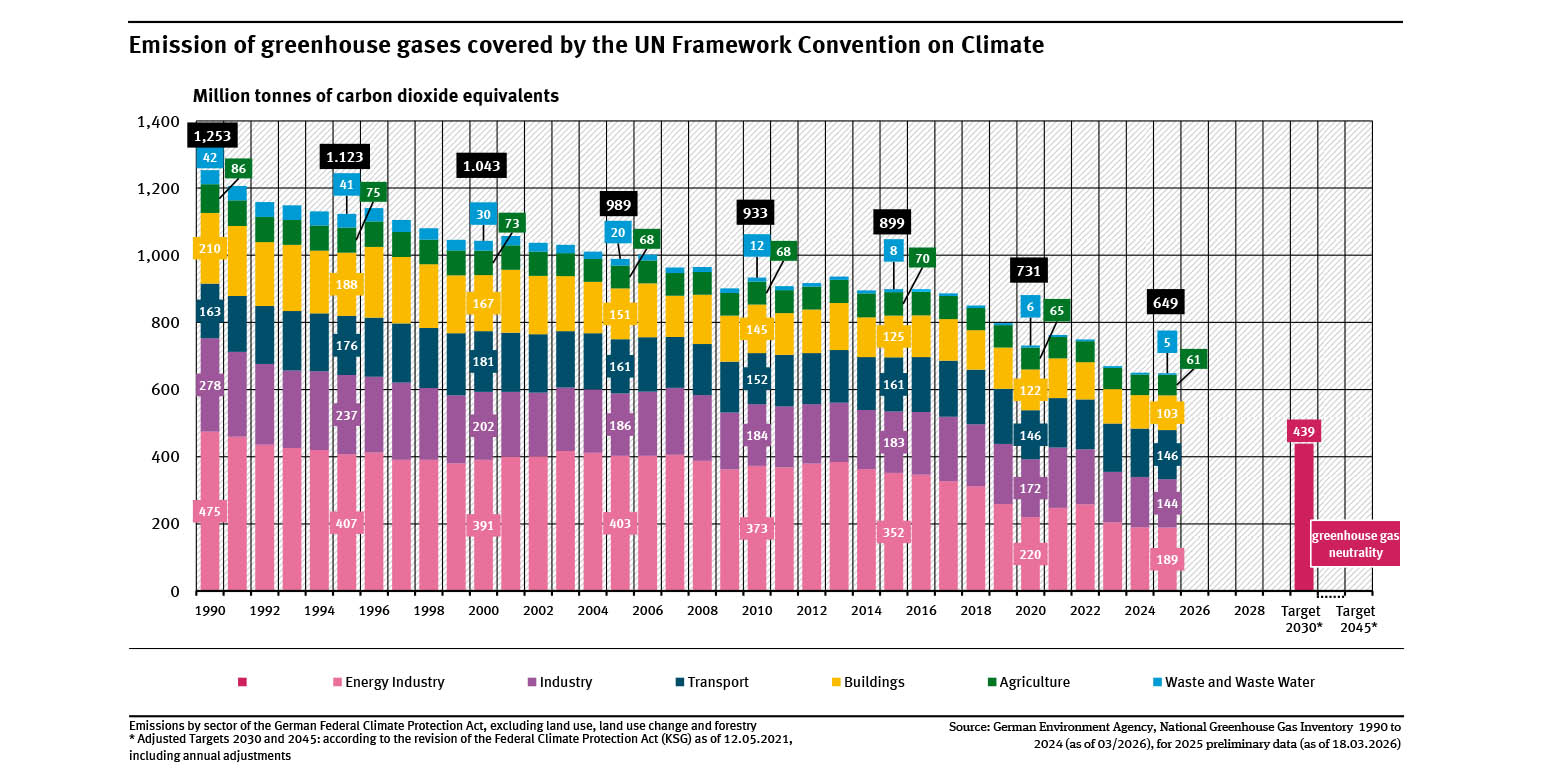
Greenhouse gas emissions in Germany have fallen since 1990: from 1,253 million tonnes of CO2 equivalents in 1990 to 649 million tonnes in 2025. Overall, this corresponds to a reduction of exactly 48 %. Excluding the low values in certain years with special circumstances, the indicator follows a long-term downward trend. After a period of stagnation, emissions have fallen significantly in 2018 to 2024, mainly due to the rising share of renewable energies and declines in fossil energy generation. In 2025, the emissions only declined by 0.9 Mio tons CO2 equivalents or 0.1 percent (cf. UBA press release 08/2026).
At the end of 2015, a successor agreement to the Kyoto Protocol was agreed with the Paris Convention. The development to date makes it clear that intensive efforts in climate protection are necessary to achieve the targets. The German government has therefore initiated measures in the form of the Climate Action Programme 2020, the Climate Action Programme 2030 and the Climate Action Programme 2023 (in German only). With the Federal Climate Change Act, binding total annual emission budget were agreed to ensure the greenhouse gas reduction target of ‘at least 65 % by 2030 and greenhouse gas neutrality in 2045.