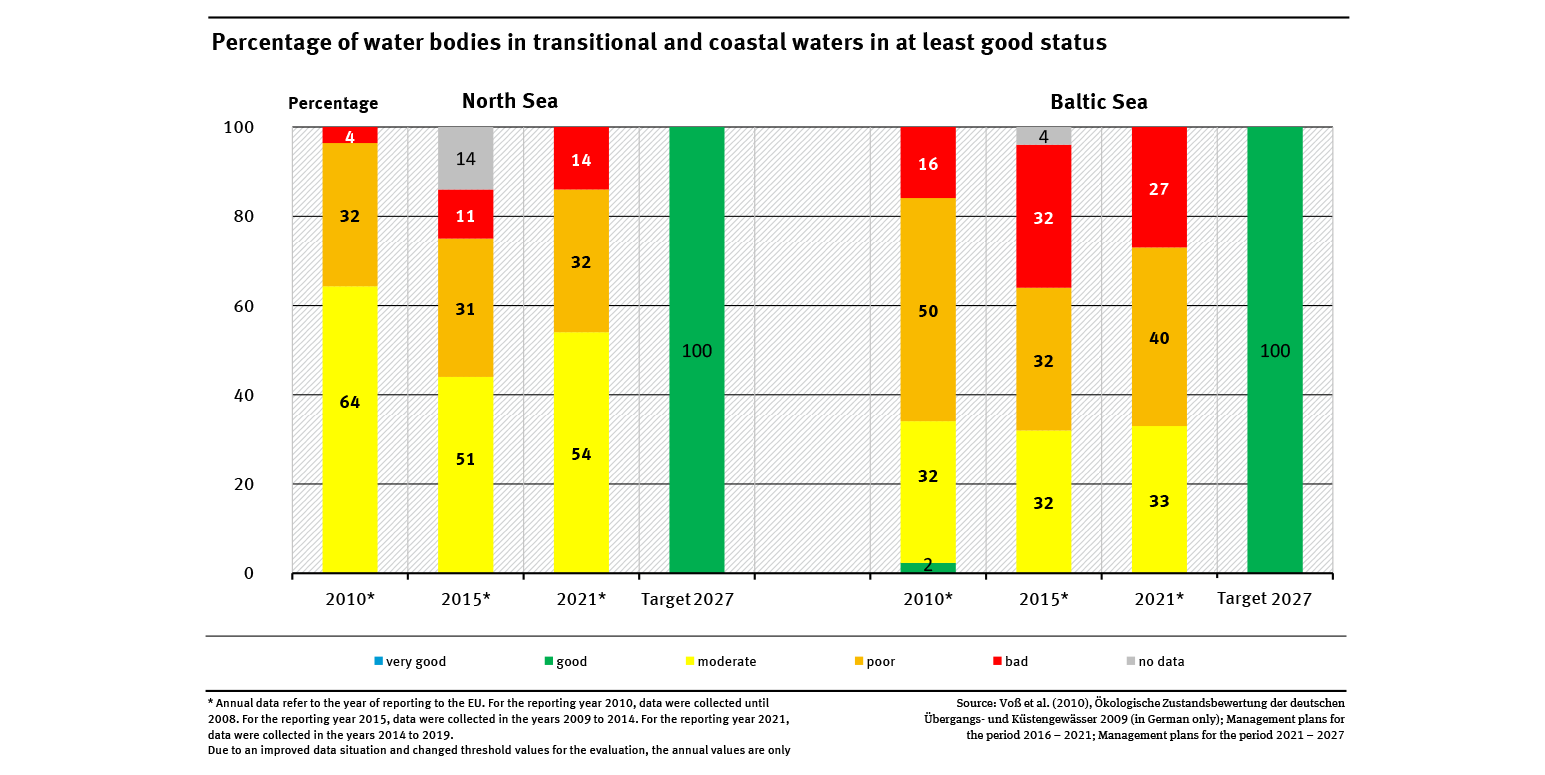
In 2021 no water body of the coastal and transitional waters of the German parts of North and Baltic Seas achieved good or very good ecological status. The target set by the European Water Framework Directive (WFD, EU Directive 2000/60/EC) i.e. that all waters should be in at least a good environmental status by 2015, was therefore missed by a wide margin. As this goal was clearly missed, the subsequent management cycle under the WFD now needs to be used to reach the ambitious targets by the deadline extension to 2027 at the latest.
The reason for missing the targets is primarily the excessive input of nutrients into coastal and transitional waters (eutrophication). These mainly come from agriculture, sewage treatment plants and shipping. The nutrients enter the sea via rivers or the atmosphere (cf. ‘Eutrophication of the North Sea and Baltic Sea’ and ‘River eutrophication by phosphorous’ indicators). The measures taken so far are not (yet) taking effect to an adequate degree. Efforts must be significantly increased in order to reduce nutrient inputs to a level which allows a good status to be achieved.
Compared to 2015 there has been an increase in the proportion of bad and poor areas. This can be explained mainly from the much improved availability of data and modified threshold values. In reality there has been almost no deterioration.