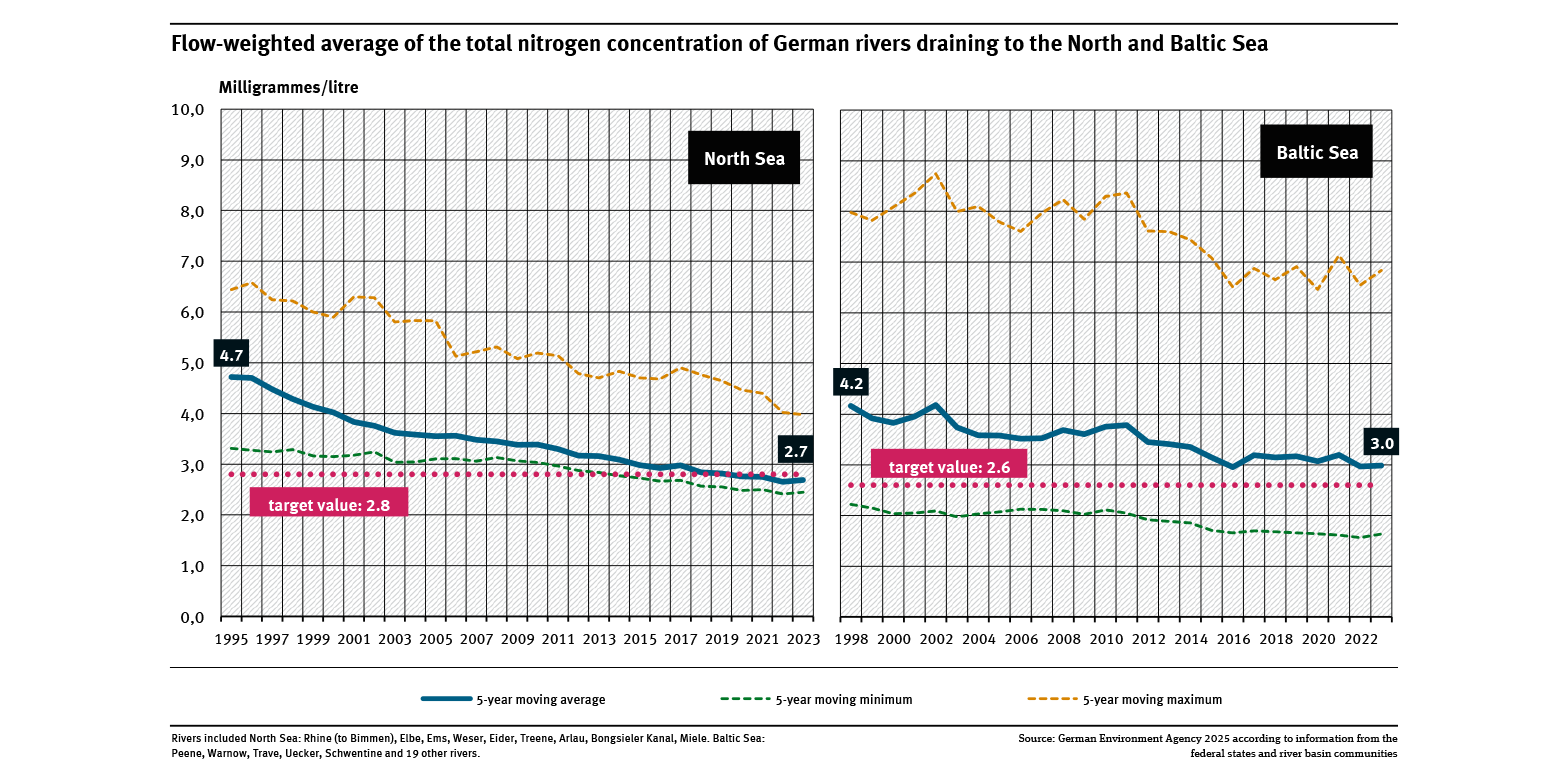
In order to achieve the EU Water Framework Directive (WFD, 2000/60/EG) and the EU Marine Strategy Framework Directive (MSFD, 2008/56/EG), the German Surface Waters Ordinance sets management target values for the rivers running into the North Sea and Baltic Sea (OGewV 2016, in German only): 2.6 milligrammes of total nitrogen per litre (mg/l) for rivers flowing into the Baltic Sea and 2.8 mg/l for those flowing into the North Sea. These target values were also adopted for the German Sustainable Development Strategy.
The average flow-weighted nitrogen concentrations for North and Baltic Sea have decreased, mainly due to improved wastewater treatment. However, concentrations have stagnated in recent years. While the moving-average of all rivers is approaching or has already achieved the target value, the concentrations of individual rivers are still well above. Rivers discharging into the Baltic Sea have generally higher maximum concentrations than the North Sea rivers. In recent years, the minimum nitrogen concentrations of the rivers are already below the target values. However, to assess the achievement of the target, the discharge-weighted average of all tributaries is not evaluated, as is the case here, but each North Sea and Baltic Sea tributary must achieve the management target value as a long-term average.
The federal government provides the legal framework to reduce nutrient inputs via ordinances such as the Surface Waters Ordinance, the Fertiliser Ordinance or the Wastewater Ordinance. The federal states implement these ordinances and review their compliance. Measures to reduce nutrient inputs are provided by the Nitrates Directive, the WFD and the MSFD. At present, a major source of riverine nutrient inputs is agriculture. The amendment to the Fertiliser Ordinance aims to reduce these nutrient inputs (see also indicator ‘Agricultural nitrogen surplus‘). In order to achieve the target values, further measures are likely to be required in the agricultural sector.