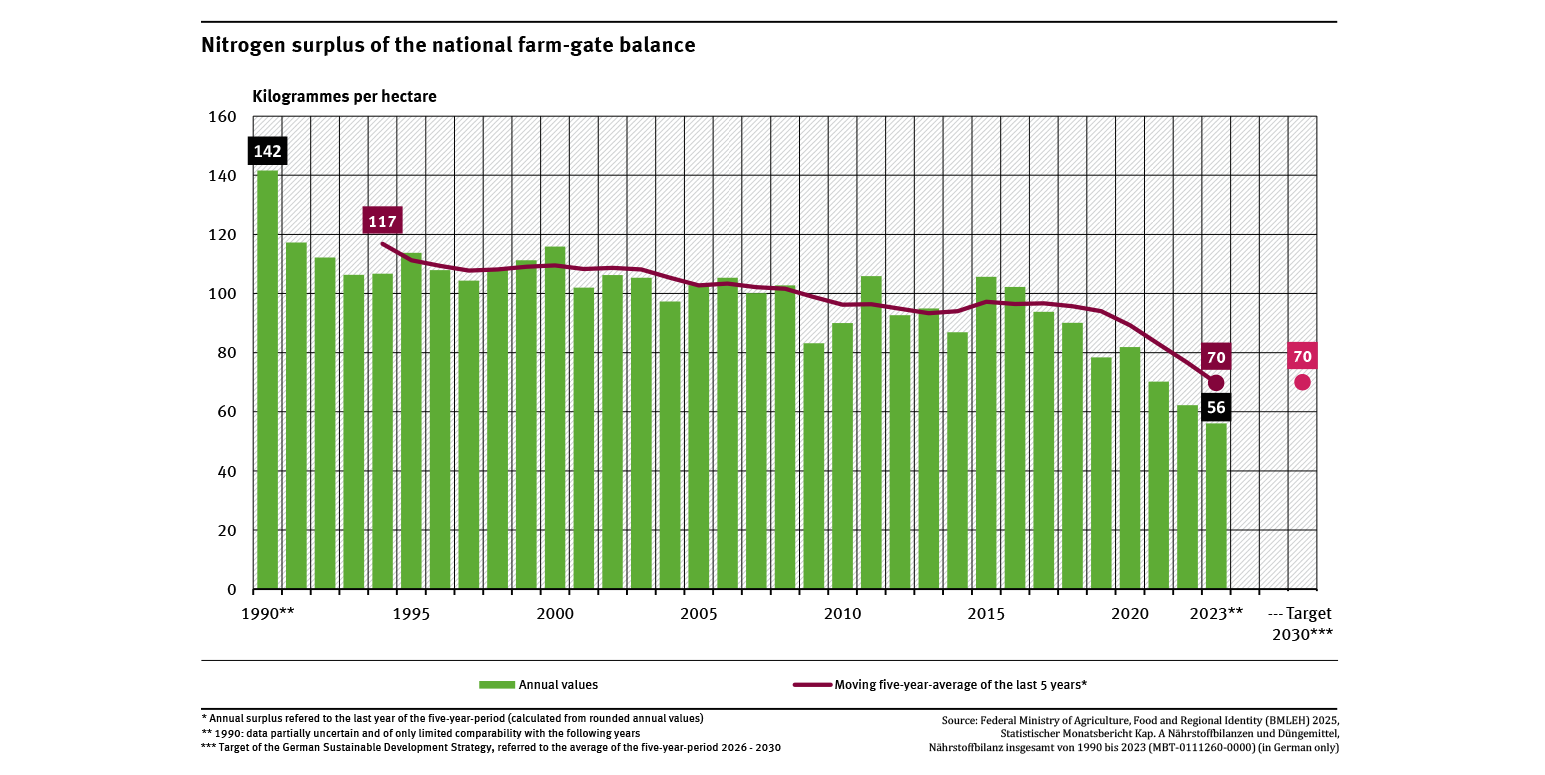
Between 1994 and 2023, the 5-year average nitrogen surplus of the total balance per hectare of agricultural land decreased by around 40 %. Farmers are thus using fertilizers more efficiently and feed conversion by domestic animals has improved.
In recent years, the implementation of more effective agricultural fertilisation legislation, a reduction in animal numbers, as well as lower sales figures for mineral fertilisers due to stricter fertilisation requirements, years of drought and higher prices for mineral fertilizers have also had an impact. Due to the significant reduction in nitrogen surplus by more than 50 kg N/ha over the past seven years, the goal of the sustainability strategy to reduce the nitrogen surplus to 70 kg N/ha*a in a moving 5-year average by 2030 is being achieved for the first time.
However, achieving the goal of the German Sustainability Strategy does not mean that no additional efforts are needed to further reduce nitrogen inputs into the environment. Rather, this should be seen as a sub-goal on the path to protecting the environment, health and climate from the effects of excessive nitrogen inputs. The need for further action to reduce nitrogen in the environment is shown by the indicators like 'Nitrate in groundwater' and 'Nitrogen eutrophication', which are closely linked to the nitrogen surplus and do not indicate any positive trends.