

Sustainable planning and development of spatial and settlement structures
The guiding principle of sustainability aims to assume comprehensive responsibility for economically, socially and ecologically sustainable development for all generations. In this context, it is clear that sustainability always has a spatial dimension.
Settlement and infrastructural development processes
In the case of settlement and infrastructural projects in the areas of housing, work, leisure, utility supply and mobility, decisions must always be made about locations and areas – their use and allocation. The necessary decisions regarding the utilisation of new areas or the conversion of existing areas have a considerable impact on the environment. The loss of semi-natural areas, increased material and energy consumption and the increase in traffic-related emissions all have a negative impact on the environment. Decisions on the utilisation of land must therefore always be checked for their environmental compatibility.
Coordinating demands for land use
In urban and rural areas, there are many competing demands for land use, such as:
- expansion of settlement areas,
- protection of green and open spaces
- expansion of electricity supply grids,
- construction of wind farms,
- road building projects.
The demands for land use are constantly increasing and require sustainable solution strategies from the federal government, federal states, regions and municipal authorities.
More than ever, there is a need for precautionary, interdisciplinary and coordinated planning and development of scarce space, both on land and at sea. The guiding principle is sustainable spatial development that harmonizes the social and economic demands on space with its environmentally relevant functions. At the same time, it ensures that the impact on the environment does not exceed an acceptable level.
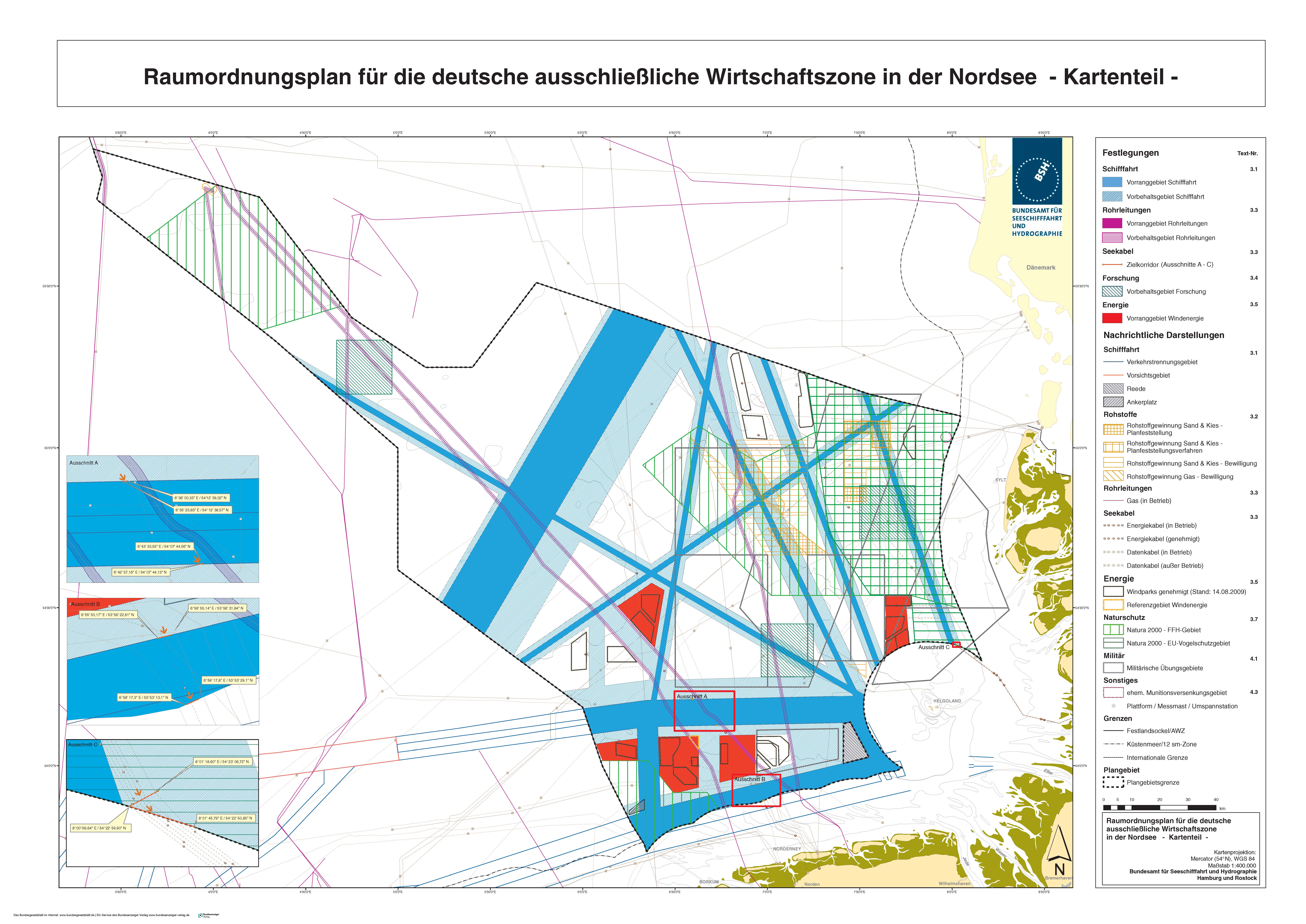
Raumordnungsplan für die deutsche ausschließliche Wirtschaftszone in der Nordsee - Kartenteil