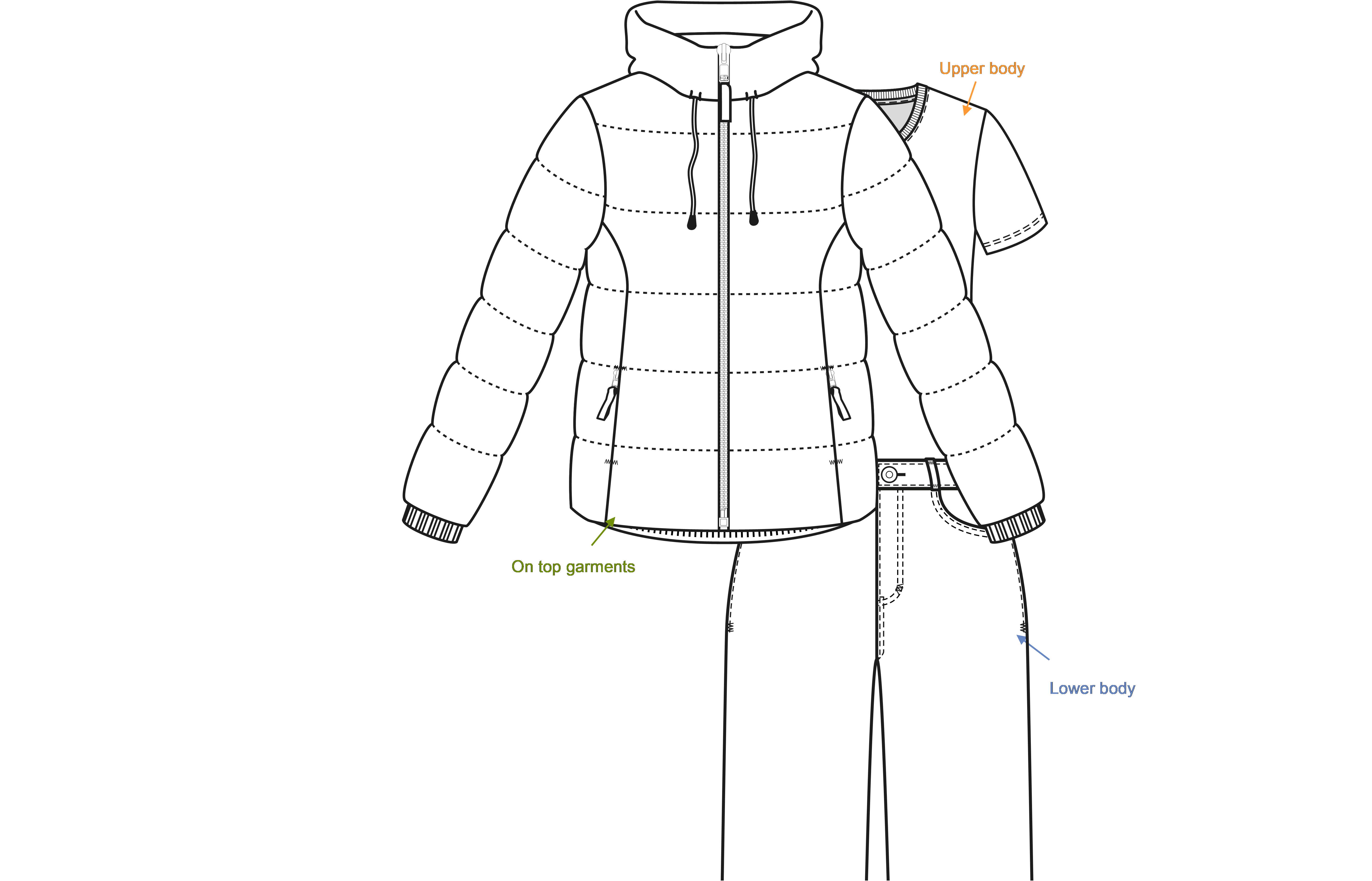
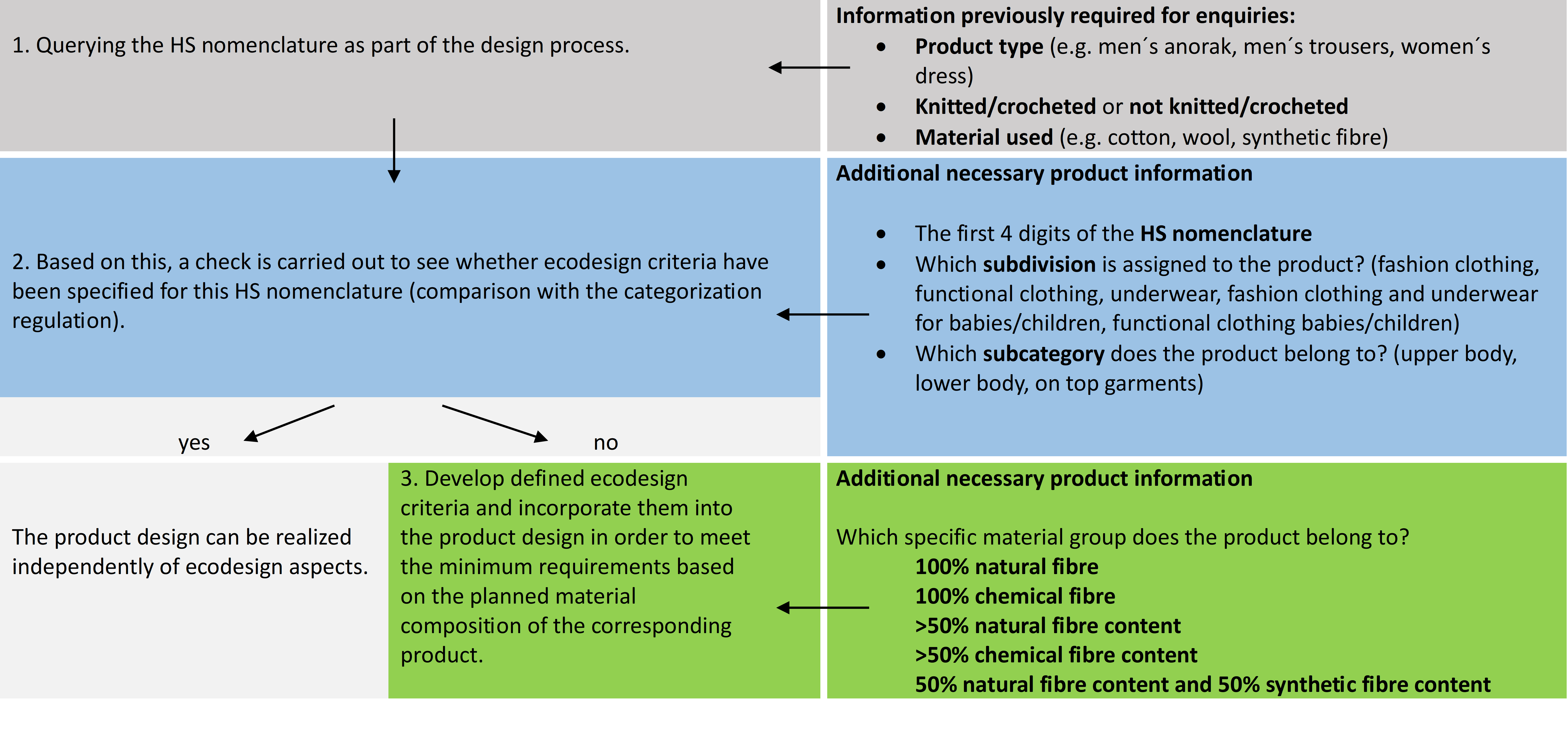
From the analysis of the differentiated product group codes, conclusions can be drawn for the creation of a system of product groups for ecodesign requirements. This concerns, among other things, the subdivision into men's, women's, and children's categories as well as the categorisation of products into knitwear and warp-knitted fabrics. The specific products listed within the product groups (BTE) and sub-groups (DTB) can be used for the categorisation within the new system to be defined. It should be emphasised that both product group codes do not constantly distinguish between differentiated materials within the product groupings. This aspect should be included where appropriate against the background of ecodesign requirements and a corresponding need for the definition of area-specific testing parameters. The inclusion of functional clothing products is not to be categorised as schematic; such products are only explicitly included in some cases. Due to the finishes and surface structures, functional products place individual requirements on criteria such as durability and recyclability (German Environment Agency 2022). With regard to ecodesign parameters, corresponding products should therefore be specifically included within a system.
4.2 International categorisation systems
Five internationally used systems are analysed according to the five evaluation criteria. To provide a suitable overview, only specific characteristics of the respective criteria are summarised and listed as examples. To this end, the focus is particularly on similarities between different product groupings and unique selling points that have characteristics with regard to ecodesign requirements, which can form the basis for the development of the product system. Following the presentation of the cumulative analysis results based on the existing international product groupings, it is also explained which systems were not included in the further analysis after an initial assessment and on the basis of which core aspects.
I. Categorisation architecture
According to GS1 Germany GmbH it is common to differentiate goods offered by model or article. Within the articles, this is subdivided according to colours and sizes, as well as other characteristics. It should be noted that it is common practice, especially in smaller retail companies, to categorise the product range according to the standard product group codes of the relevant associations. To make it easier for these companies to categorise the articles, the master data of the BTE and DTB product group codes are therefore used within the product grouping for textile and clothing products, among others. In addition to gender, age groups are divided into four categories - adults, teens, infants and babies(GS1 Germany GmbH 2019). Within the Textile Exchange product classifications, a distinction is made between men, women, infants, babies, and unisex products with regard to clothing. As a special characteristic of this categorisation, a further distinction is made between the respective denim products(Textile Exchange 2021). The French ecomodulation system has formed a product categorisation to define specific product parameters, which does not differentiate fundamentally between genders. Clothing-specific main product groups correspond here: Street trousers and shorts, trousers/skirts/ dress made of denim, dress and skirt made of woven fabric, dress and skirt made of knitted fabric, shirt and blouse, T-shirt/polo shirt/shirt/blouse made of knitted fabric, pullover, nightwear, lingerie, swimming costume. These main groups are underlaid with product examples, but are not further differentiated(Ministère de la transition écologique et de la cohésion des territoires 2022). The system of nomenclature for textile clothing products within the Harmonised system of the World Customs Organisation is based on Chapter XI. In sections 61 and 62 (first two digits of the nomenclature), the respective positions of the product categories are listed (further two digits). This includes the distinction between men and boys, women and girls, and babies. The different product types are summarised under this heading so that, for example, suits, jackets and trousers fall under one heading(World Intellectual Property Organization 2023). The JRC product categories represent ten different product categories that have no further specific subdivisions. A supplementary description of the respective category indicates that these categories were defined according to "covering/warming upper body", "garments to put on top", "garments to cover lower body", "one-piece to cover upper and lower body" and "garments to cover legs and/or feet". No distinction is made between age and gender or other specifications within the categories (Delre et al. 2024).
II. Orientation and basis
GS1 is responsible for the overlap-free article numbering system worldwide. The GS1 identification numbers as "Global Trade Item Number" thus form the basis of the barcodes as a unique identification of trade units for over 20 industries(GS1 Germany GmbH 2019). Textile Exchange checks the completeness of its product classification using the harmonised system for the designation and coding of goods (customs classification). Coverage is focussed on the textile-specific classes 50-63(Textile Exchange 2021). The JRC product categories were developed exclusively for the development of textile ecodesign requirements as part of the preparatory study on textiles for product policy instruments carried out by the JRC. A supplementary list of the PRODCOM codes of the products that fall within the scope of the preparatory study is linked in this context. In addition, the identified product categories are aligned with the ongoing work of the PEFCR A&F. The extent to which the linking of the PRODCOM codes will be maintained and included in the course of the development of requirements and a prospective practical implementation is not yet described at this time (Delre et al. 2024).
III. Depth of categorisation
Within the code list, GS1 separates between 19 main colours and colour gradations. In addition, industry-specific standard designations for clothing sizes are included. These standards vary from country to country, so that a country code is added within the system for specification purposes. Additional measurements (e.g., skirt length, waist size, sleeve length or collar width) can also be specified. Furthermore, the clothing items are categorised according to the respective cuts (e.g., wide, normal/comfort, tight/slim, super slim). Based on EU Regulation 1007/2011 on textile labelling, 49 fibre designations are added. For products with different material layers (e.g. upper and lower materials), an additional indication is determined. The occasion for which the corresponding products are designed is also included; for example, a distinction is made between maternity wear and festive wear. This information is predominantly based on individual labelling and is not based on a predefined basic structure. The area structure is differentiated into around 68 layouts(GS1 Germany GmbH 2019). Textile Exchange additionally specifies the products within the listed product groups on the basis of product details. This summarises corresponding details that can be classified as comparable. Examples include the categories "Suits, suit trousers" and "Jumpers, pullovers, cardigans". In addition, material compositions can be specified for product presentation. These are not based on existing product categories, but can be named individually(Textile Exchange 2021). Within the Harmonised system of the World Customs Organisation, a fundamental distinction is made between the surface construction of the product. Section 61 accordingly includes "Articles of apparel and clothing accessories, knitted or crocheted". Section 62 "Articles of apparel and clothing accessories, not knitted or crocheted". The subheadings are selected on the basis of material use. A distinction is made between cotton, synthetic fibres and other textile materials (World Intellectual Property Organization 2023). Within the JRC product categories no distinction is made between the product presentations (e.g. knitted, not-knitted). The use of materials is not included. The categorisation is exclusively based on the division into “T-shirts”, “shirts and blouses”, “sweaters and mid-layers”, “jackets and coats”, “pants and shorts”, “dresses, skirts and jumpsuits”, “leggings, stockings, tights and socks”, “underwear”, “swimwear”, “apparel textile accessories”. The surface structure and the use of materials are included in the PRODCOM codes, but not directly in the specific product categories of the system developed by the JRC (Delre et al. 2024).
IV. Coverage of product functions
Functional products are listed specifically within the Textile Exchange product classification under the product detail "activewear, sportswear" and are therefore presented individually. These products are not described in detail beyond this(Textile Exchange 2021). GS1 includes the water resistance of a material in the product system as part of the product attributes to be selected (GS1 Germany GmbH 2019). The Harmonised system of the World Customs Organisation and the other grouping systems do not differentiate between functional products. Accordingly, within the HS, for example, both functional jackets and fashion jackets fall under one heading (World Intellectual Property Organization 2023). The JRC product categories consider "sportswear" as a separate category. In addition, no product functions such as outdoor products are included separately and therefore also fall under the existing general product categories, similar to the harmonised system. It is also described that workwear is also included in the existing categories as long as they are defined as apparel textiles. A specific categorisation of these textiles is therefore not planned (Delre et al. 2024).
V. Occurrence of multiple allocation
Within the Textile Exchange product grouping, the "many-to-many" principle was applied to product categories and product details. Different combinations of classifications are therefore potentially possible and permissible. Instructions for pairing product categories and product details are provided, but any product details can be selected together with any product categories (Textile Exchange 2021). A systematic and clear allocation to specific product categories is not given. It must be checked in the further course whether this system should be included for the transfer of ecodesign criteria. The French ecomodulation specifies on the one hand knitwear and knitted fabrics in individual product groups. Woven goods, on the other hand, are not explicitly described (Ministère de la transition écologique et de la cohésion des territoires 11/23/2022). Based on the existing explanations and the assessment of the parameters set, which are to be ensured in the long term through textile testing, it cannot be concluded why no standardised specific subdivision is specified in this context. As a result, it is not possible, for example, to specifically allocate which criteria a dress or skirt made of woven fabric must fulfil, as (Cotton fabric in twill weave) product parameters are only set for skirts and dresses made of knitted or denim fabric within ecomodulation. Also, in view of the fact that dresses and skirts are predominantly made from knitwear in practice, there are also woven products that are not manufactured and sold as a denim weave.
Explanation of the exclusion of categorisation systems:
As part of the analysis, it can be summarised that the Nice Classification for the registration of trade marks is not a suitable system for the systematic categorisation of clothing products. Although the differentiated textile products are listed in the list of goods by class, they are not comprehensively specified. This applies in particular to the subdivision into women's, men's and children's articles and the inclusion of the fabric construction (woven, knitted/knitted) (World Intellectual Property Organization 2023). The SAP product groups are based on the implementation of the EU Regulation on Textile Composition (EU) No. 1007/2011. For example, fibres for several textile components of an article (mixed fibre products) can be processed within the system. Specific fibre codes can be assigned to fibre components. It should be noted at this point that the author does not have full access to this fee-based system. It was not possible to evaluate whether an existing basic categorisation for textile products is already available to the user. For this reason, the SAP product groups were excluded from the analysis (SAP SE n. d.). The Eco Mark programme of the Japan Environment Association sets certification criteria for the national eco-label. Product categories that are differentiated for this purpose are divided into seven summarised classes, including Uniforms/Workwear/Hygiene Articles/Sportswear/Outerwear, Underwear and Nightwear and Japanese Clothing, Socks/Tights/ Socks, Hats/Gloves, Other Clothing. Beyond this, no further specification is made with regard to product classification, for example in relation to material use or product function (Environmental Association Eco Mark 2022). This product grouping is therefore not suitable for the systematic definition of clothing products. The product categorisation under the EU Ecolabel also does not represent a comprehensive product scheme compared to the analysed groupings. The focus of the environmental criteria to be applied is primarily on ecological aspects and different emissions of the individual fibre types. For this reason, criteria are mainly defined for individual fibre materials as components, without considering the overall construction of the textile product. Minimum criteria for fitness for use are specified for semi-finished woven and knitted products and for the finished product. For this purpose, the textile products and material types are classified into categories based on the surface construction, mostly without specific product categories, for example for tolerances on dimensions during washing and drying. For criteria such as colour fastness to differentiated aspects, uniform values are prescribed for all applicable product types in order to comply with the minimum standards of the EU Ecolabel. For the pilling resistance criterion, for example, a distinction is made between "knitted and non-woven materials" and "woven fabrics" (European Union 2014). The underlying system of the EU Ecolabel is not a complete product classification system and does not include the specific aspects of differentiated textile products in the definition of ecological criteria.
The summarised result can be found in table 3