Skip to main content Skip to main menu Skip to footer

Data Search

Data Search

Here you will find diagrams, infographics, maps and tables for direct download.

Data Search

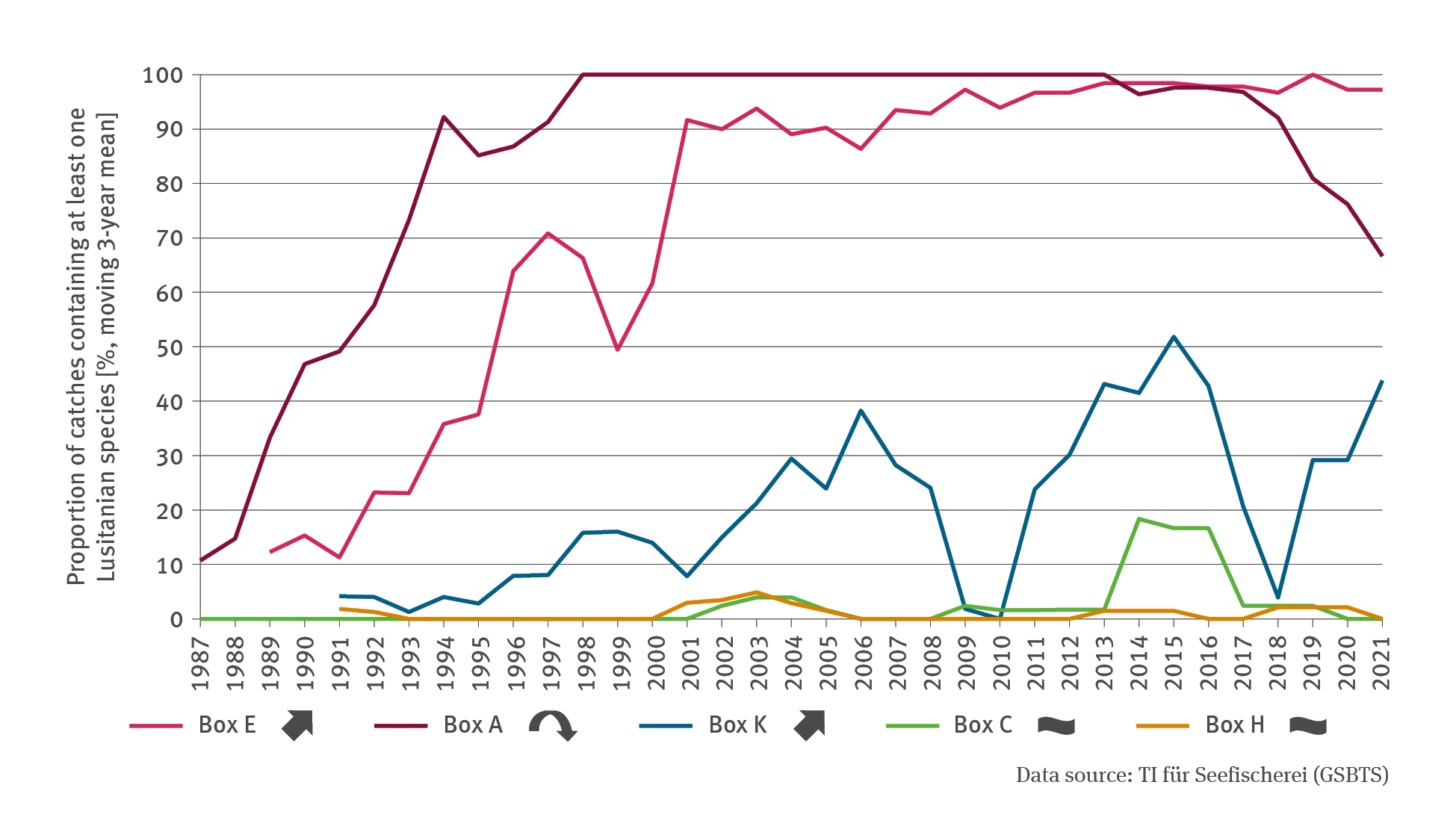
Six curves show the percentage of catches with at least one Lusitanian fish species for different boxes in a time series from 1987 to 2013. The time series for Box C runs close to the 0 axis with a maximum value of just under 20 per cent in 2014. The curve for Box H is similar, with a maximum of around 5 per cent in 2003.
Export data
PNG
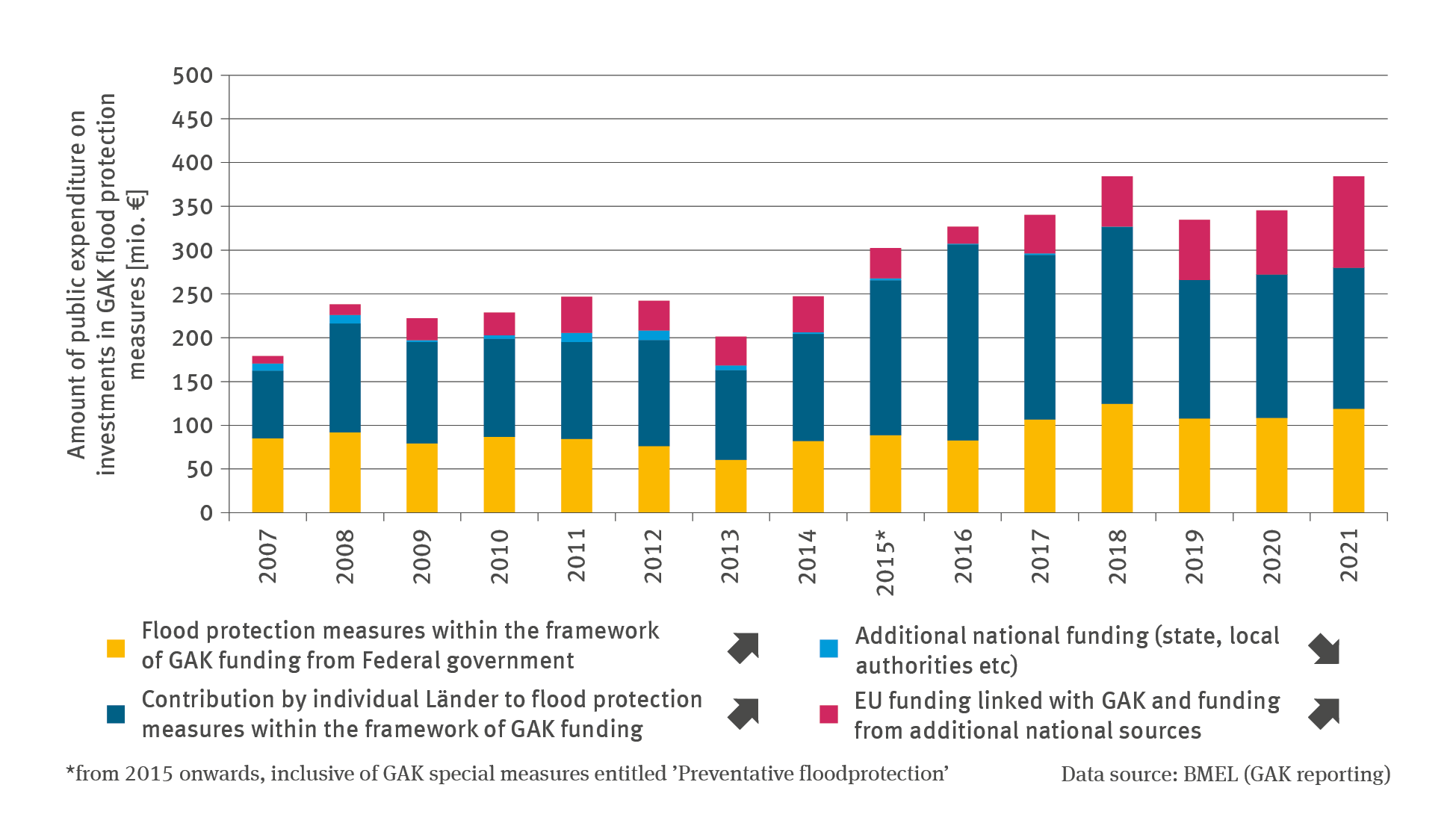
The stacked columns chart WW-R-2 ‘GAK funds for flood protection’ shows the amount of public expenditure on investments made in flood protection measures in million Euros from Federal Government funding, Länder funding, and from additional national funding as well as EU funding during the time series 2007 to 2021. The expenditure has increased significantly since 2013 reaching its highest point in 2018 with just under 400 million Euros. It was possible to reach the same level in 2021.

WW-R-2: GAK funds for flood protection

  • Klima
  • Wasser
  • Diagramme
Export data
PNG
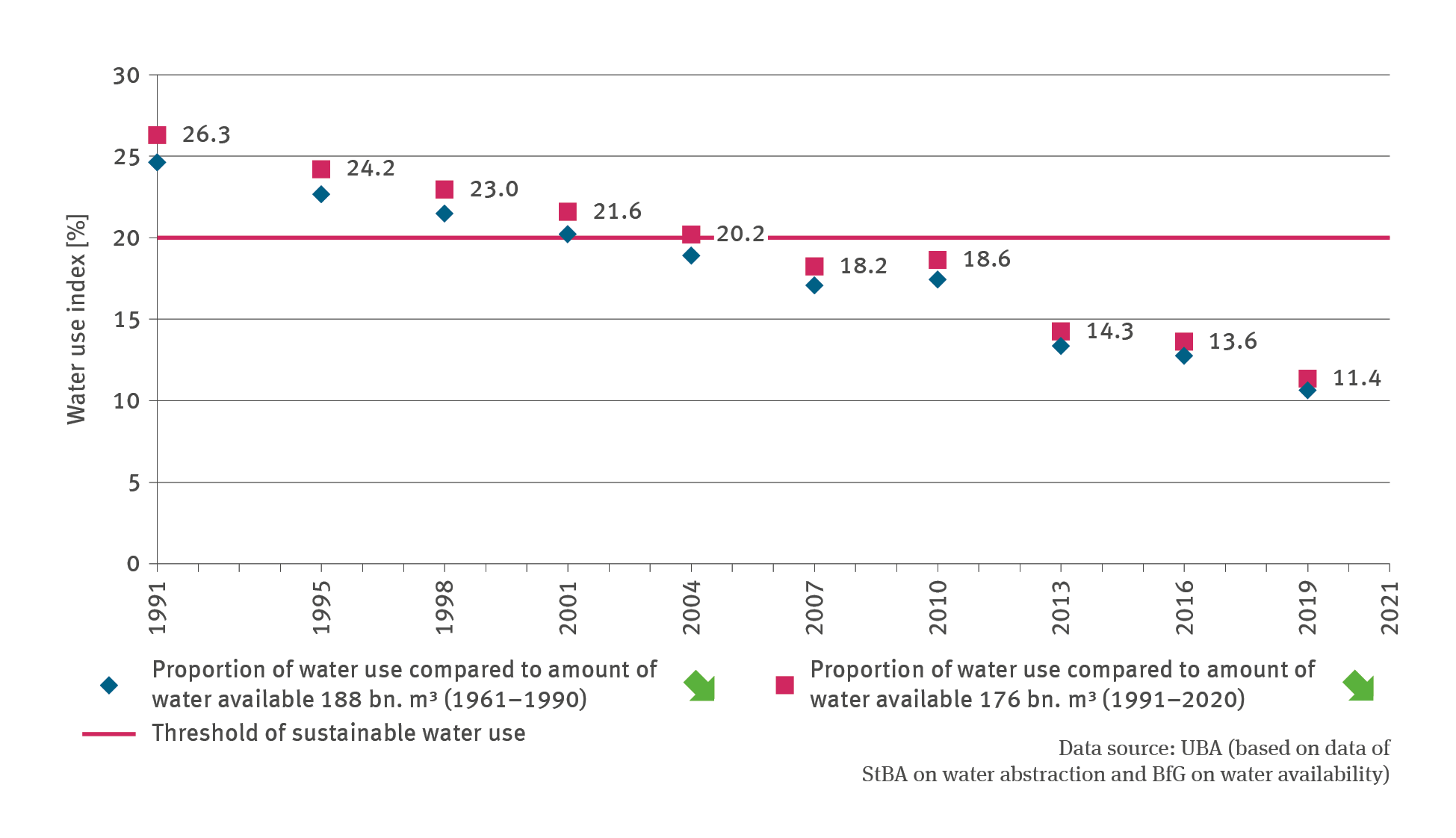
The XY scatter chart WW-R-1 ’Water use index’ shows the development of the water use index between 1991 and 2021. Two time series show the water use index as a percentual proportion of water use compared to the available water supply in the amount of 188 billion cubic metres, which is the mean of available water resources in the years of 1961 to 1990, and as a percentual proportion of water use compared to the available water supply in the amount of 176 billion cubic metres.

WW-R-1: Water use index

  • Klima
  • Wasser
  • Diagramme
Export data
PNG
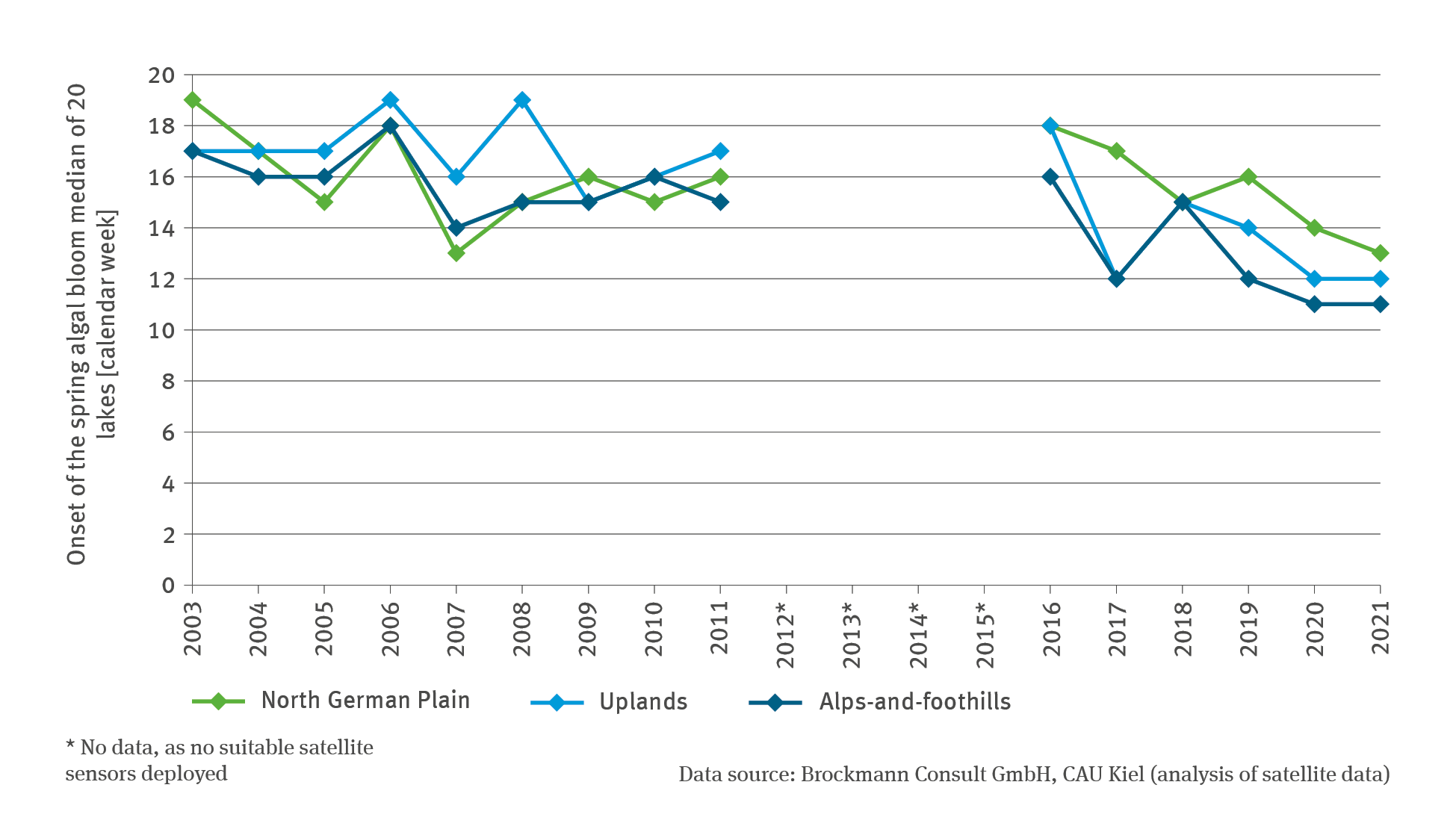
The line chart WW-I-9 ’Spring algal bloom in lakes’ shows the calendar week with the onset of spring algal bloom – for the years 2003 to 2021 and for the North German Plain, the uplands as well as the Alps-and-foothills. In each case the median is stated for 20 selected lakes. There are no data available for the years of 2012 to 2015. Depending on the region, spring algal bloom in 2003 still occurred in the calendar weeks 17 to 19, whereas in 2021, this process began as early as the calendar weeks 11 to 13.

WW-I-9: Spring algal bloom in lakes

  • Klima
  • Wasser
  • Diagramme
Export data
PNG
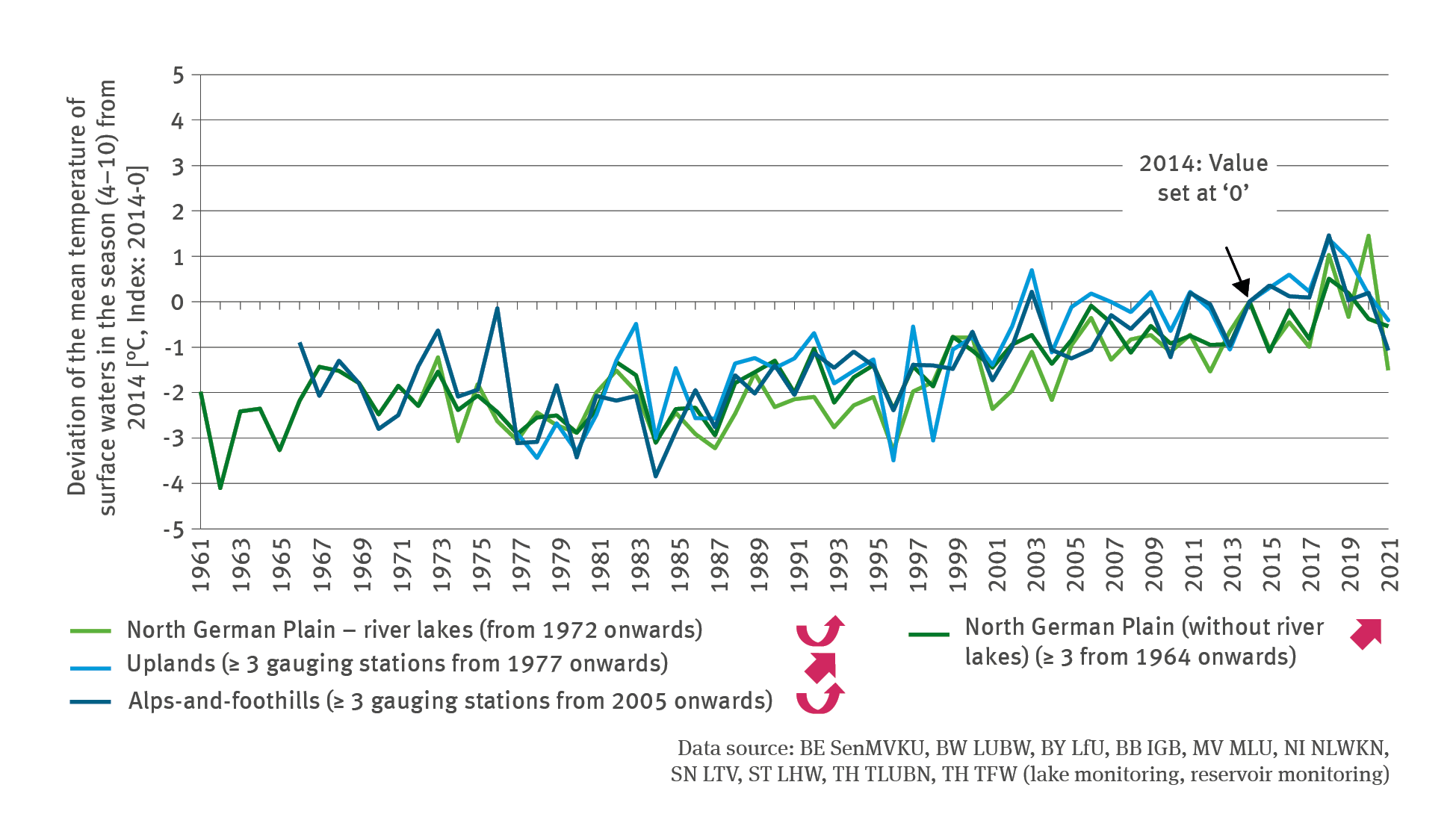
The line chart WW-I-8 ’Water temperature in lakes’ shows the annual deviation of the mean temperature of surface waters during the season, April to October, compared to the 2014 value for the watercourses in selected regions. The regions considered are the North German Plain – in one case including the river lakes, in another without the river lakes – as well as the uplands and the Alps-and-foothills.

WW-I-8: Water temperature in lakes

  • Klima
  • Wasser
  • Diagramme
Export data
PNG
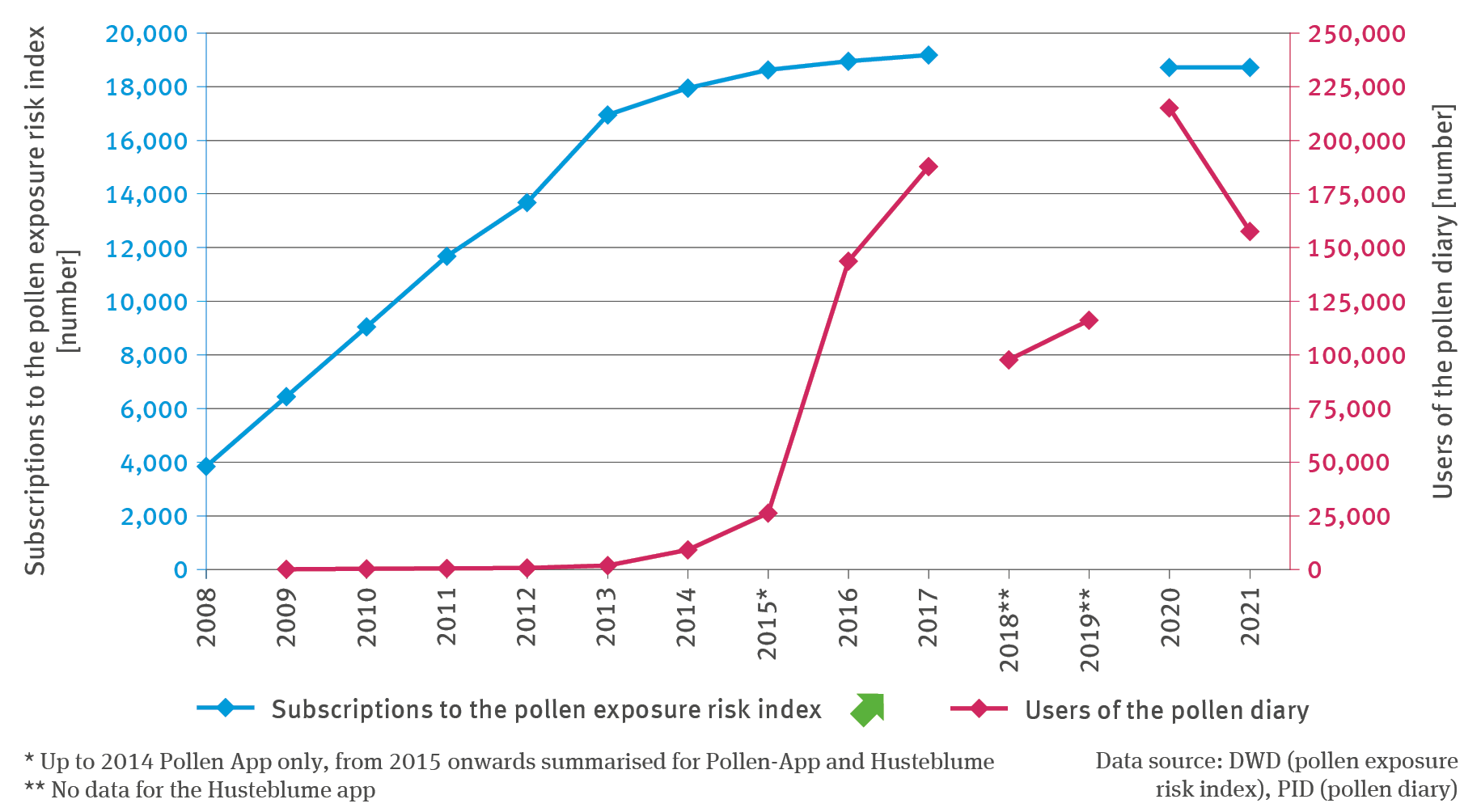
The illustration GE-R-3 ’Information on pollen’ contains a biaxial chart. The chart shows the number of subscribers to the pollen exposure risk index and the number of pollen diary users. The number of subscriptions to the pollen exposure risk index increased to roughly 19,000 from the year of 2008 to the middle of the 2010s. Up to 2014 only the Pollen app was included, from 2015 onwards the figures are summarised for subscriptions to the Pollen app and the ‘Husteblume’ app.

GE-R-3: Information on pollen

  • Klima
  • Umwelt und Gesundheit
  • Diagramme
Export data
PNG
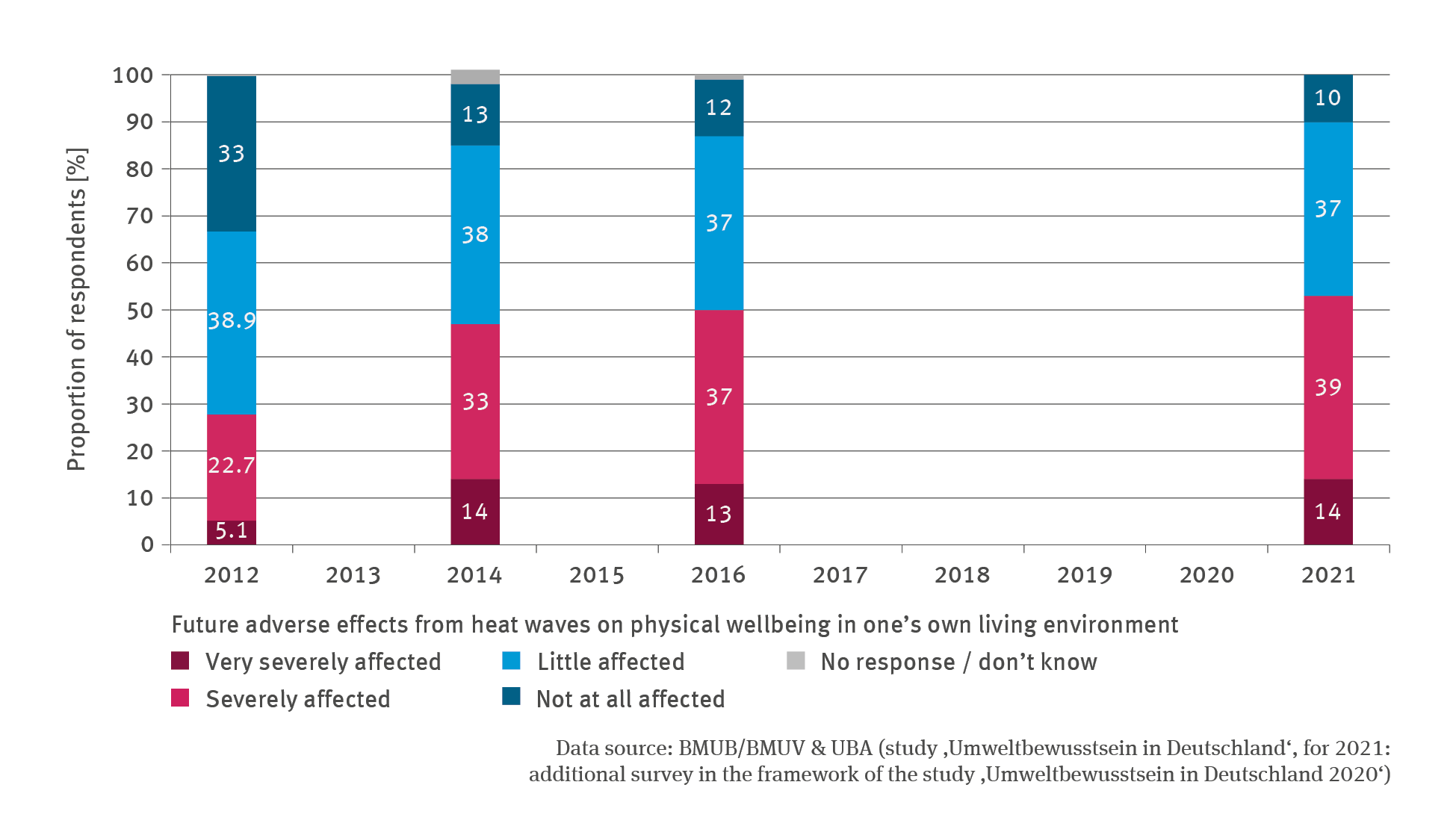
The bar chart GE-R-2 ’Public awareness of health problems caused by heatwaves’ illustrates the findings of a survey in which respondents were asked to state whether they expect that in future their physical wellbeing in their own living environment will be affected very severely, severely, little or not at all affected (by heatwaves). The survey was conducted in the years of 2012, 2014, 2016 and 2021. From 2012 to 2016 one of the options was ’don’t know’.

GE-R-2: Public awareness of health problems caused by heatwaves

  • Klima
  • Umwelt und Gesundheit
  • Diagramme
Export data
PNG
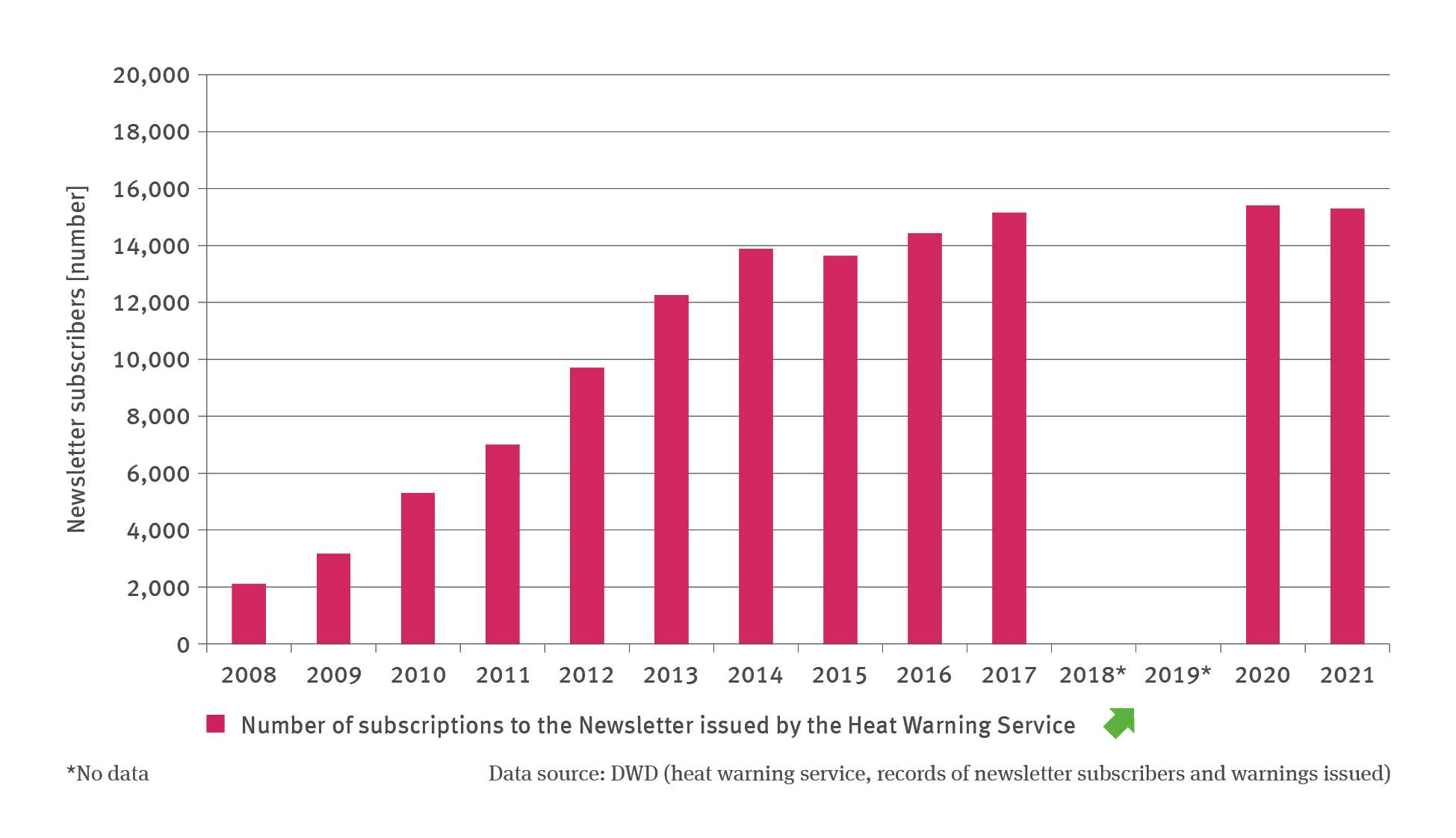
The bar chart GE-R-1 ’Heat warning service’ illustrates the annual number of newsletter subscriptions for the heat warning service provided by the GWS from 2008 onwards. The number was rising significantly and latterly amounted to just under 15,000 subscriptions. There are no data available for the years of 2018 or 2019.

GE-R-1: Heat warning service

  • Klima
  • Umwelt und Gesundheit
  • Diagramme
Export data
PNG
The line chart WW-I-7 ’Water levels in lakes’ indicates the annual deviation of the water level in lakes in two regions – the North German Plain and the Alps-and-foothills for the years 1961 to 2021 from the water level in 2014 in centimetres. The water level of the lakes in the North German Plain receded significantly by 2021 compared to 2014; ultimately the deviation amounted to –20 cm compared to 2014.

WW-I-7: Water levels in lakes

  • Klima
  • Wasser
  • Diagramme
Export data
PNG
The bar chart WW-I-6 ‘Low water* shows – for the years of 1961 to 2021 – the number of low-water days in the water-balance related winter half-year (1st October of the previous year to 31st March) and in the water-balance related summer half-year (1st April to 30th September) respectively, prevailing in Germany’s river basins. The structure of the indicator is characterised by individual pronounced low-water events which occurred latterly in the period from 2018 to 2020.

WW-I-6: Low water

  • Klima
  • Wasser
  • Diagramme
Export data
PNG

You can also search in other data portals of the German Environment Agency

Short link: www.umweltbundesamt.de/n300701en