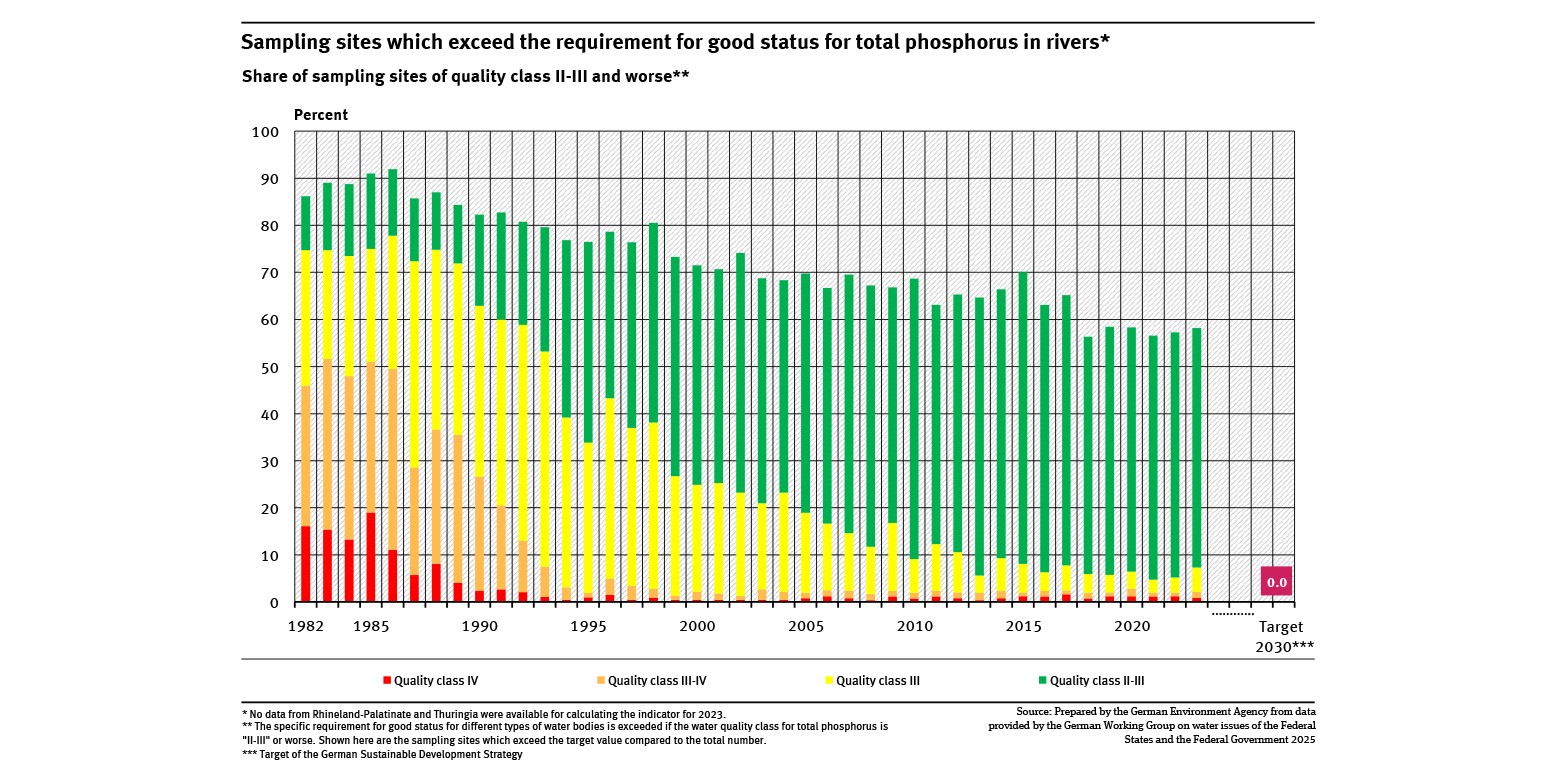
In the early 1980s, excessive phosphorus concentrations were measured at almost 90 % of sampling sites. Since 2018 this share has remained slightly below 60 %. However, if the poorer quality classes are considered, then a further improvement can be seen. Overall, the share of sampling sites where the requirement for phosphorus was exceeded has decreased. This improvement is mainly the result of introducing phosphate-free washing powders and phosphate precipitation in the larger sewage treatment plants.
There are currently shortages in the supply of precipitants (e.g. aluminum salts), which are used to remove phosphorus from sewage in wastewater treatment plants. If these chemicals are not available in sufficient quantities for wastewater treatment, this results in an increase in phosphorus concentrations in the water.
According to the European Water Framework Directive (EU Directive 2000/60/EC), all water bodies must achieve a good ecological status by 2027. In Germany almost two thirds of water bodies have concentrations of phosphorus which are too high to meet this requirement. In order to remedy this, the fertiliser ordinance is intended to induce agriculture to apply less liquid manure nor mineral fertilisers containing phosphorus to soils sufficiently supplied with phosphorus. In eutrophic areas, the requirements can be made stricter. Impact monitoring will show whether this is sufficient. Also, the waste water regulation should be changed in such a way that small purification plants remove phosphorus after the state-of-the-art. This is already happening in the bigger plants. According to Objective 6.1.a of the German Sustainable Development Strategy, the guideline values for phosphorus should be complied with by 2030 at the latest.