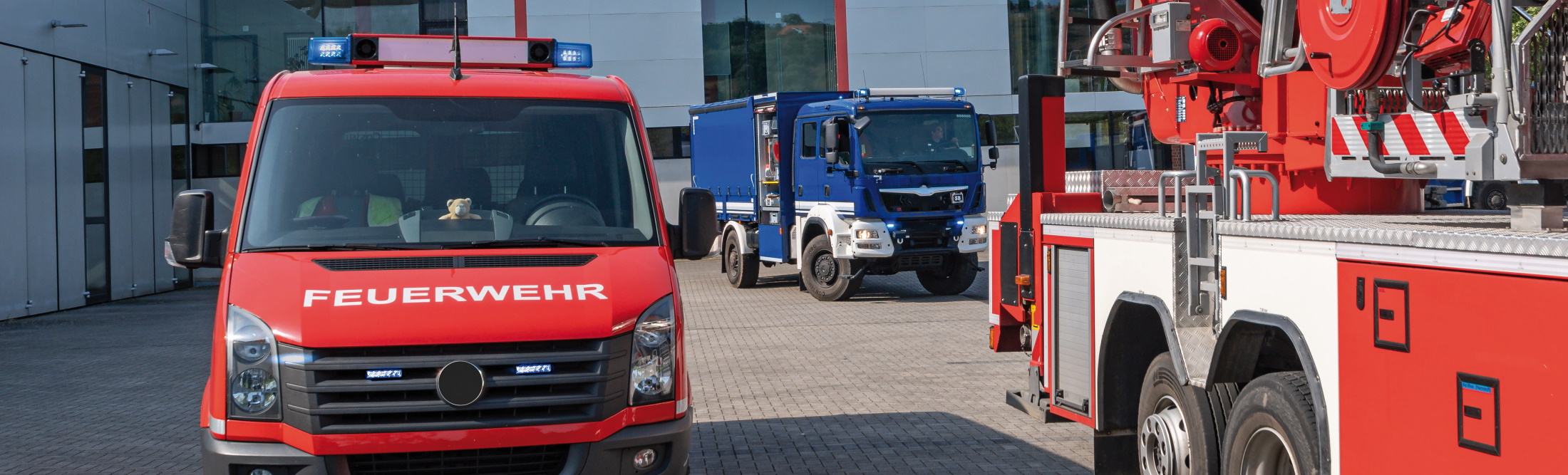
Given the increasing risk of weather-related and weather- pattern related disaster situations likely to entail increased strain on emergency relief responders, the organisations concerned are called upon to adapt their capacities and organisational structures to any new conditions evolving. A central building block is the recruitment of volunteers in order to secure an increasing or at least permanently stable pool of emergency relief responders. The increase in membership numbers is evidence of the intensified efforts to recruit more responders, at least as far as THW and fire brigades are concerned (cf. Indicator BS-R-4). There are nationwide campaigns intended to boost membership numbers in years to come, such as THW’s campaign launched in 2020 translated as ‘Your Time is NOW!’, and the BBK’s campaign for recruiting volunteers, launched in 2021, translated as ‘No matter what you can do – you can help’ and the accompanying establishment and operation of a web-based platform which is named ‘mit-dir-fuer-uns-alle.de’. Adverse circumstances such as the worldwide Covid-19 pandemic did not entail any marked decline in membership numbers. At the same time, the increase in major deployment events and their media coverage led to an increase in the public’s interest in becoming involved in civic protection. The new membership includes more and more female recruits, as well as migrant individuals and seniors.
New social and technical developments have been opening up new avenues in respect of civic protection, too. For example, during the flood events of 2013 and 2016 and during the flood disaster in the Ahr valley in mid-2021, thanks to social networks, emergency relief was organised quickly in many of the areas affected. In the light of Standard ISO 22319:2017 ‘Guidelines for planning the involvement of spontaneous volunteers (SVs)’229, 229 the conceptual framework for a coordinated incorporation of SVs is currently being further enhanced in cooperation with the deployment organisations and the Länder in order to make even more effective use of the existing willingness of volunteers – who are less interested to commit themselves to fixed structures than in the past – to get involved in providing emergency relief.
In addition, the practice of civic protection benefits from findings made in scientific research projects. Within the framework of the KlamEx project, the BBK and other partner authorities within the strategic alliance of authorities entitled ‘Adaptation to Climate Change’ analysed in what way extreme precipitation shapes and influences the deployment scenario, in what way impact factors determine the extent of damage and what kind of measures can support the risk preparedness for heavy rain in terms of civic protection and urban development. In this context, the comprehensive catalogues compiled by DWD of heavy rain events in Germany were included in the sources consulted. Going back as far as 2001 these catalogues provide valuable data on heavy and persistent rain and therefore play a part in supporting the follow-up analysis of extreme precipitation events.
With the aim to prepare their members for call-outs in the best possible way, civic protection organisations carry out regular exercises. These lay the foundation for appropriate action in extreme situations and for practising targeted crisis management. The data provided by THW demonstrate that even in years with extreme events, it is possible to carry out the requisite amount of training exercises adequately, both in terms of time and participants (cf. Indicator BS-R-3). This provides an important basis for the stability of civic protection, given that owing to climate change, it is possible that weather-related and weather-pattern related disaster events are likely to occur more frequently. According to the findings of KWRA 2021 there are adaptation potentials especially in respect of the funding, coordination and optimisation of cooperation among the variety of organisations active in civic protection. Emergency relief organisations active throughout the Federal Republic, but also fire brigades and the THW cooperate with public authorities such as the BBK, the UBA, the DWD or the BBSR on the objective to integrate their knowledge on climate change impacts and adaptation potential in the practice of civic protection. Besides, the organisations involved also reflect their own structures in this process while optimising their internal processes.
Apart from the work done by various organisations, the population’s ability to protect themselves is an important component of civic protection. The challenge is to sharpen citizens’ awareness that they should implement their own preventive and protective measures and, tailored to each target group, to enlighten the population on how to behave in a disaster scenario. The BBK’s nationwide information campaign translated as ‘Ready in case’ is one of the measures that serve this purpose. The findings of studies on environmental awareness indicate that the population’s awareness and sensibility are on the increase (cf. Indicators BS-R-1 and BS-R-2). In 2021 the proportion of respondents who felt sufficiently well informed about relevant risks from climate change impacts reached two thirds – the highest value yet. Moreover, there were more individuals than in previous years who stated that they would take precautionary measures of their own.
A comprehensive and reliable warnings infrastructure is an important building block in the scheme of the population’s self-protection. Digital warning apps such as NINA (Emergency Information and Warning App of the BBK) convey vital information to the public at times of disasters while the early warning system enables individuals in time to take the necessary precautions. The competent institutions are working continuously on improving and expanding these services. In February 2023, Cell Broadcast was taken into regular operation as a new warning system. This tool facilitates the cell-enabled broadcasting of warning messages straight to mobile phones or smartphones. Apart from digital solutions, permanently installed analogue sirens are part of Germany’s warnings infrastructure. They bridge gaps in cases when mobile technologies have become temporarily unavailable or have broken down. With its funding programme for sirens, the Federal government has been supporting since 2020 the installation of new sirens and the technical updating of existing installations.
227 - Bündnis Entwicklung Hilft 2022: WeltRisikoBericht 2022 – Fokus: Digitalisierung. Berlin, 75 S. https://weltrisikobericht.de.
228 - BBK – Bundesamt für Bevölkerungsschutz und Katastrophenhilfe 2021: Pandemie und Hochwasserkatastrophe. Magazin Bevölkerungsschutz, 04/21. Bonn, 57 S. https://www.bbk.bund.de/DE/Infothek/Magazin-Bevoelkerungsschutz/Ausgaben/magazin-2021-4/magazin-4-2021_node.html.
229 - ISO – International Organization for Standardization (Hg.) 2017: Security and resilience – Community resilience – Guidelines for planning the involvement of spontaneous volunteers. ISO 22319:2017, ICS: 03.100.01. https://www.iso.org/standard/66951.html.
229 - DIN – Deutsches Institut für Normung (Hg.) 2021: Sicherheit und Resilienz - Resilienz der Gesellschaft – Leitfaden für die Planung der Einbindung spontaner freiwilliger Helfer (ISO 22319:2017). DIN EN ISO 22319:2021-02 – Entwurf. https://www.beuth.de/de/norm-entwurf/din-en-iso-22319/332133296.