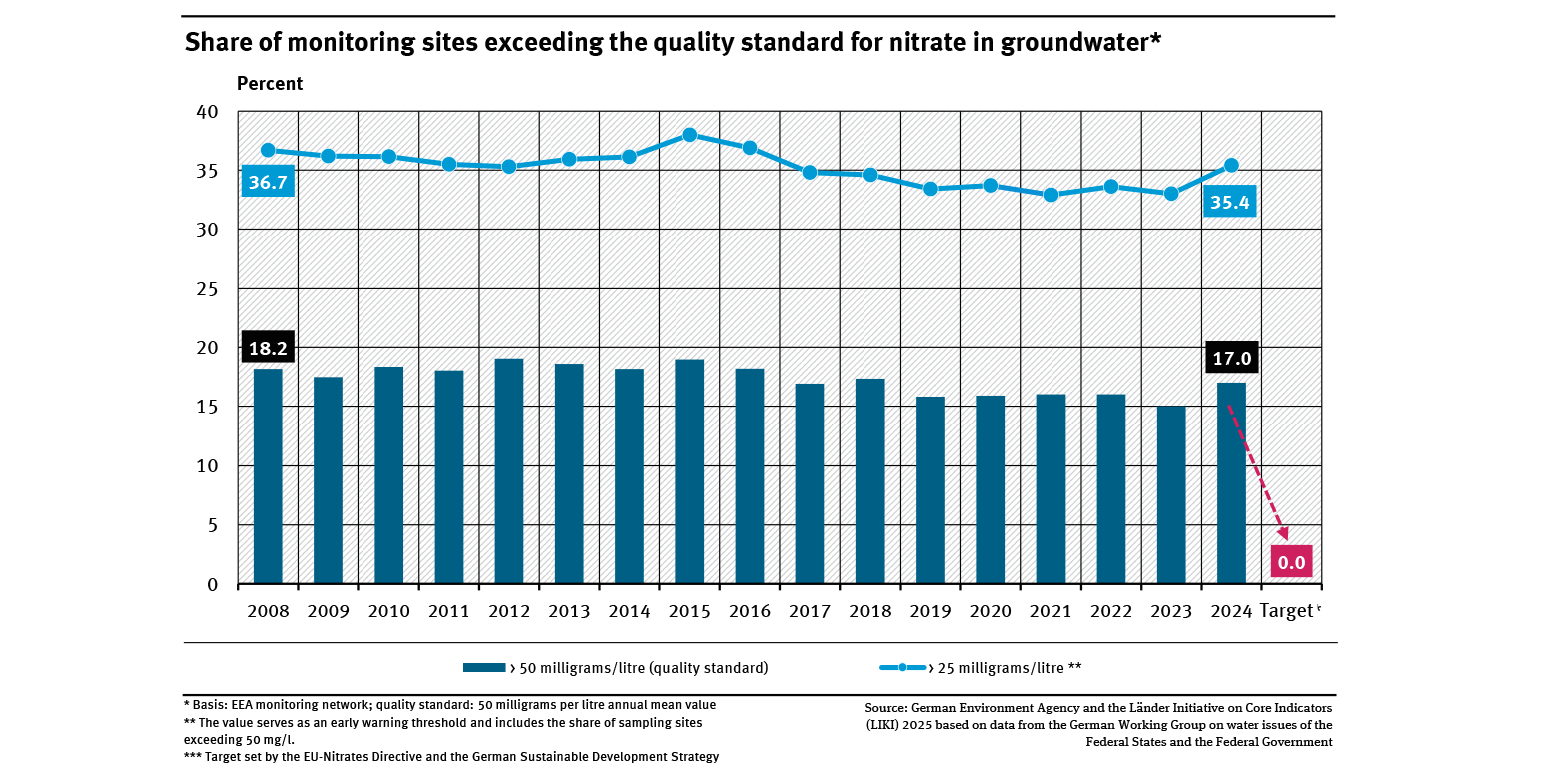
The aim of the European Nitrates Directive (EU Directive 91/676/EWG) is to prevent pollution of groundwater by agricultural nitrate inputs. Governments are obliged to develop action plans to prevent nitrate concentrations above 50 mg/l. Since 2016, compliance with the nitrate quality standard has also been a goal of the German Sustainable Development Strategy.
Since 2008, the share of monitoring sites which exceed the quality standard lies between 15 and 19 %. The share of monitoring sites with a nitrate concentration above 25 mg/l has also stagnated since 2008 at around 33–38 %. The share of monitoring points with elevated nitrate concentrations above 25 mg/l has also stagnated at around 33–38% since 2008. Nitrate pollution in groundwater therefore remains too high.
The central legal instrument for implementing the Nitrates Directive is the German Fertiliser Application Ordinance (Düngeverordnung – DüV). Revisions to the DüV allow, among other things, contaminated areas to be designated separately and stricter management requirements to be imposed there. In addition, Germany has been setting up a national monitoring program since 2019, which will enable annual assessments of nutrient pollution and the effectiveness of the measures taken under the DüV. A monitoring regulation is to form the legal basis for this impact monitoring in the future.