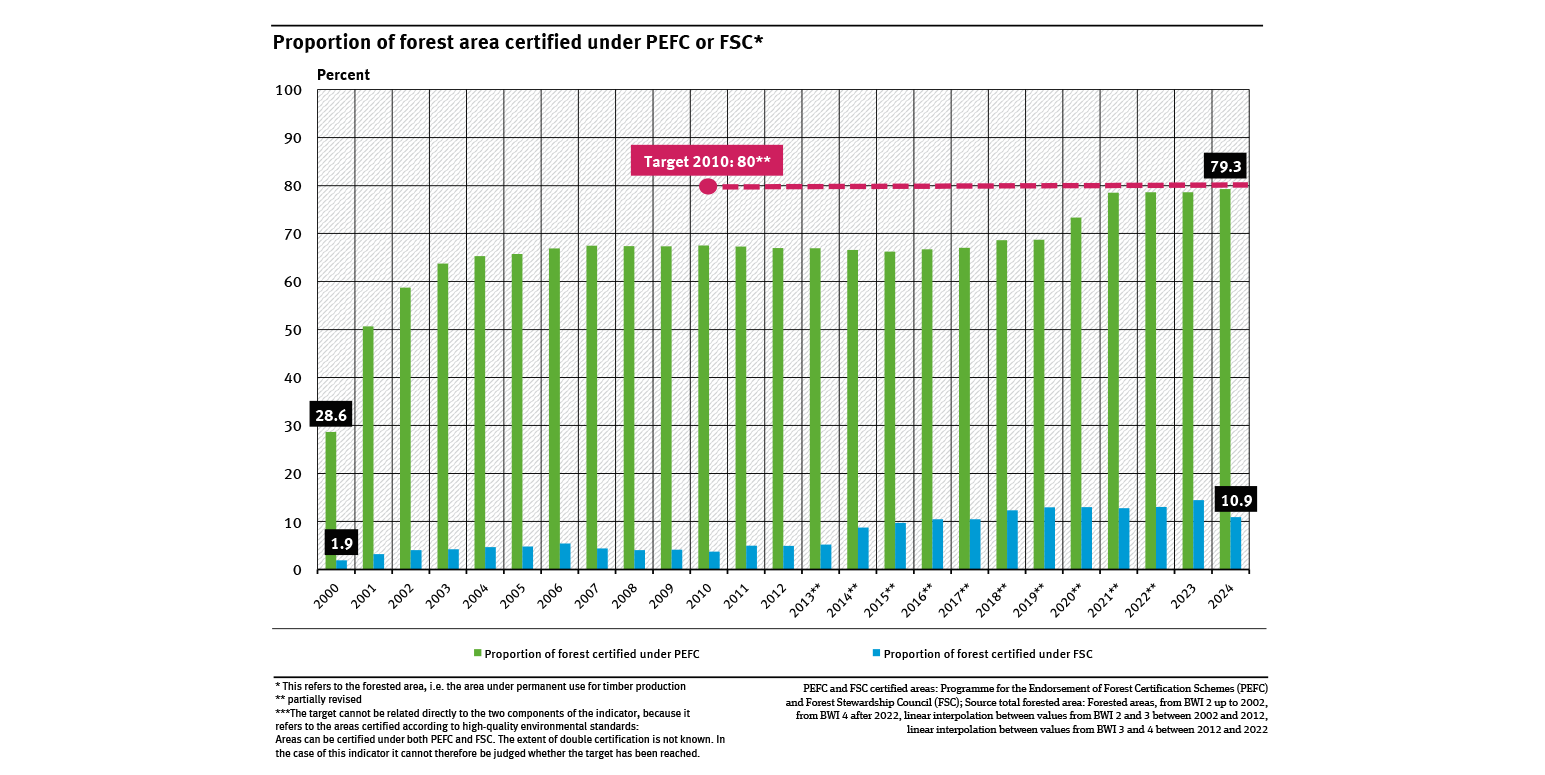
Over the last years the development of PEFC forests has stagnated at a high level. From 2006 to 2019, the value was slightly below 70 % but increased substantially in 2020 and reached 79.3 % in 2024 The sharp increase is mainly a result from the linking of the forest premium of the federal government’s Corona economic stimulus programme to certification. The proportion of FSC certified areas has developed very positively over the last few years at a lower level. Responsible for this is the certification of extensive areas by the regional State Forestry departments in recent years, particularly in Rhineland-Palatinate and Saxony. In its coalition agreement, the German government has also agreed to manage federally owned forests at the very least according to FSC or Naturland standards in the medium term. In 2024, however, there was a significant decline of almost 4 percentage points. This is mainly due to the Hessian state government's decision to withdraw from FSC certification of the state forest (over 340,000 hectares).
In the 2007 German National Biodiversity Strategy, the Federal Government set the target of increasing the proportion of areas certified according to ‘high-quality environmental standards’ to 80 % by 2010. In particular, the PEFC and FSC standards are being considered. The goal seems to have been achieved by 2020, due to the significant increase in the PEFC-certified area to more than 70 %. However, the exact value cannot be determined at present: A part of the forest areas, especially of the state forests, is certified under both systems. What is clear, however, is that policy makers should continue to promote sustainable forestry, even though it seems likely that the target has now been reached.