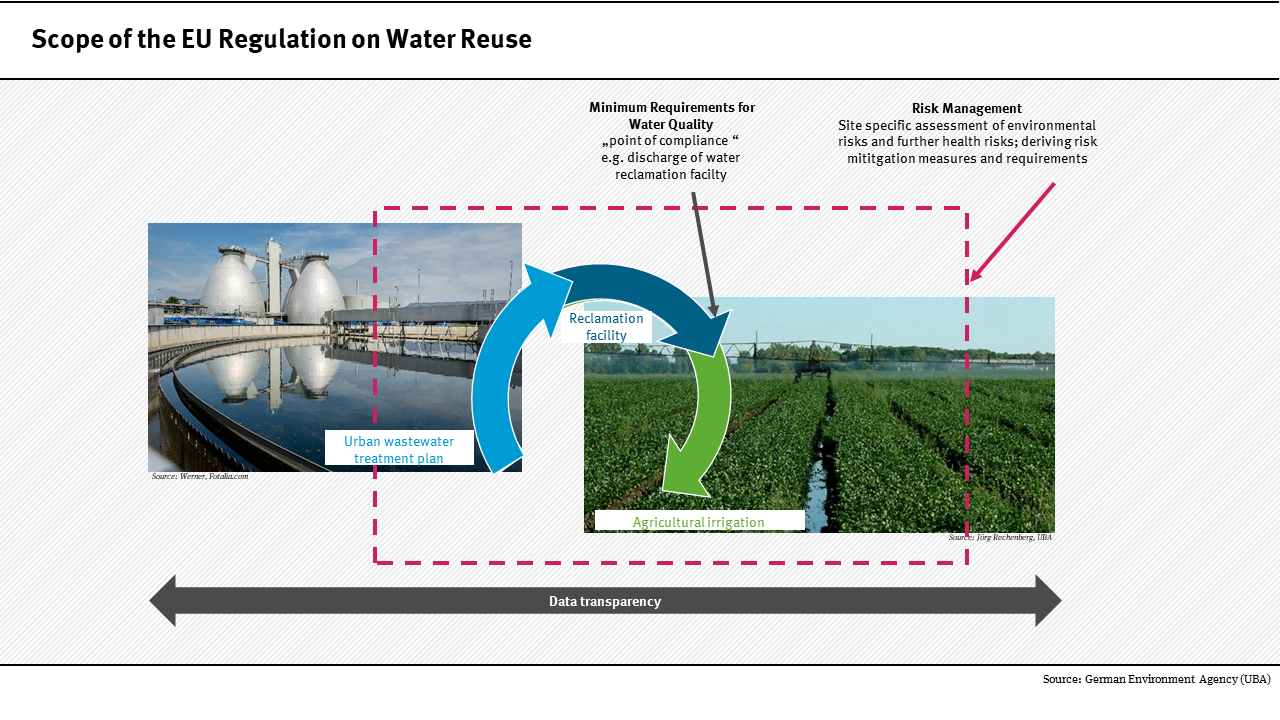
Some provisions of the EU regulation need to be adapted to the German context and to be integrated in national law, especially with regard to responsibilities and permitting procedures.
In late 2020 the German Working Group on Water Issues of the Federal States and the Federal Government (LAWA) has established a dedicated ad hoc working group to develop proposals for the national regulation and implementation of the EU regulation on water reuse. The experts on water resources management, wastewater, water legislation and soil aspects as well as experts on human, plant and animal health addressed questions related to the legal framework, potential exemptions, permitting processes, further quality requirements, the implementation of the risk management and monitoring. The working group published its recommendations in February 2022 in a final report (only German).
Further aspects related to water reuse technologies and the use of reclaimed water will be dealt with in technical standards by the DWA, the German Association for Water, Wastewater and Waste. (For the international context the association had published “DWA-Topics - Non-Potable Water Reuse - Development, Technologies and International Framework for Agricultural, Urban and Industrial Uses” in June 2019).
Recommendations of the German Environment Agency for the national implementation of the EU regulation on water reuse:
From the perspective of the German Environment Agency the minimum quality requirements and the provisions for the risk management are not precise and ambitious enough. The implementation will likely differ between and within member states.
Especially for the irrigation of food crops the quality standards should be stricter (e.g. extending the validation monitoring, filtration and turbidity threshold for all cases when food crops are irrigated) to ensure human health protection. For the protection of soils, groundwater and surface water measures are needed to limit and monitor relevant pollutants (including micro-pollutants).
-
In order to ensure that, the provisions how to address heavy metals, pesticides, disinfection by-products, pharmaceuticals, other substances of emerging concern, especially PFAS, or anti-microbial resistance in the risk assessment (Annex II of the EU regulation) shall be more precise for the national context.
- To protect drinking water resources an exemption of water reuse in water protection areas (for drinking water abstraction) is being considered.
-
At current stage there are also remaining questions in relation to the practical implementation of water reuse. Potentially high costs for administration and infrastructure related to water reuse need to be taken into consideration. Further discussions on financing opportunities and cost sharing will be needed. The new provisions of the Urban Wastewater Treatment Directive will create some synergies for water reuse.
The regulation does not preclude Member States from allowing the use of reclaimed water for other purposes, e.g. landscape irrigation, that appear suitable and safe. Considering increasing droughts Germany will assess other potential uses in the future.
When regulating and implementing water reuse as defined by the EU regulation, authorities should consider potential indirect water reuse and its resulting risks. This refers e.g. to the abstraction of surface water for agricultural irrigation without further treatment and quality control. A UBA study published in 2018 has shown that especially under low-flow conditions the percentage of treated effluent in German rivers can be high, increasing the potential presence of pathogens and pollutants (for an English article see Karakurt et al. 2019).
While water reuse can be a potential measure to address water scarcity it has to be in line with the provisions of the Water Framework Directive to prevent deterioration of the status of water bodies as well as to prevent or limit the input of pollutants into groundwater.