
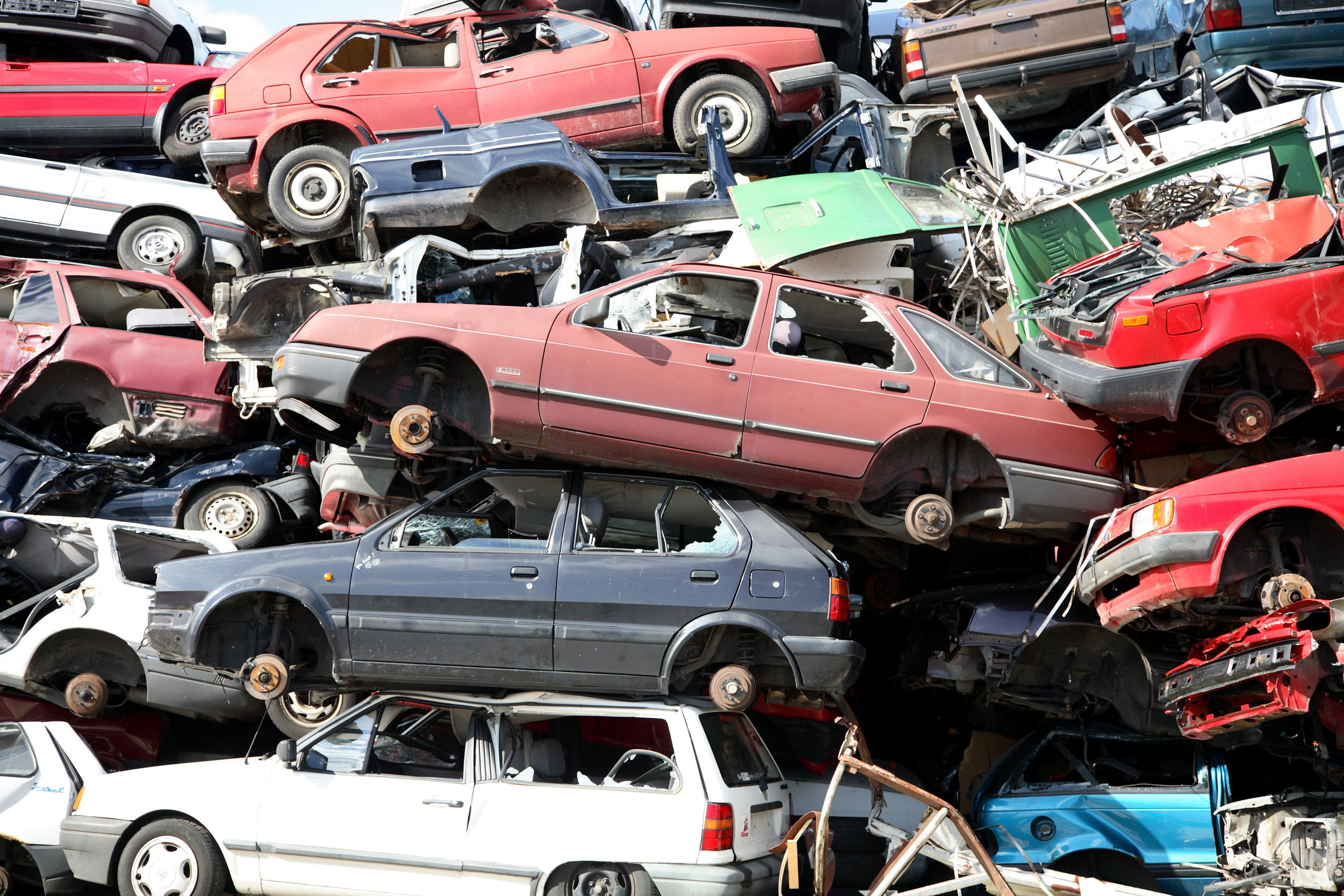
End-of-life-vehicles in Germany
Some half million cars and light utility vehicles are scrapped each year in Germany. The exact figure in 2010 was 500,193 vehicles, with a total weight of 516,128 tons. In 2009, the year of the cash for clunkers program, an unprecedented 1.78 million cars were scrapped.
Recycling
In Germany, most end-of-life-vehicles are recycled in two stages. First, the cars are dismantled at one of around 1,300 certified dismantling centres, which drain all motor oil, antifreeze and other fluids from the cars, and remove parts that contain pollutants such as lead batteries, spare parts and recyclable elements such as tires and catalytic converters. The bodies are then shredded mechanically, resulting in iron, aluminum and other metal scrap that is sold to scrap dealers, in some cases after undergoing additional processing. Scrap dealers melt down the scrap into recyclable metal. 97 percent of the metal in Germany’s end-of-life-vehicles is recycled.
The car scrapping process also generates shredding residues that need to be disposed of and that are composed of plastic, rubber, glass, residual metals, and other materials – including pollutants. 436,000 tons of such shredding residues were generated in Germany in 2010, around one third of them (138,500 tons) from car bodies.
End-of-life-vehicle recovery rates
The EOL Directive (2000/53/EC) lays down the following reuse rates for end-of-life-vehicles: 80 percent for reuse and recycling; 85 percent for reuse as a whole. These rates will rise to 85 and 95 percent respectively as of 2015. They are based on waste statistics that the Federal Statistical Office (Statistisches Bundesamt) as well as regional-state statistics agencies collect from the relevant companies, in accordance with the Environmental Statistics Act (Umweltstatistikgesetz). Using this data as a basis, the UBA determines the scrap-car recovery rate for Germany and submits the German report in this regard to the European Commission.
Germany has consistently exceeded EU recovery rates in recent years, namely with an 89.2 percent reuse/recycling rate and a 92.9 percent recovery rate in 2008. In the following year, the cash for clunkers program resulted in more than three times the normal amount of cars being scrapped – more than dismantling companies could handle over the course of that year. As a result, in 2009 Germany’s recycling and recovery rates decreased to 82.9 and 86.7 percent respectively, but in the following year rose to nearly 100 percent, for the same reason. In 2010, more end-of-life-vehicles were recovered than were handed over to dismantling companies, owing to back inventory from the cash for clunkers program. 95.5 percent and an additional 10.7 percent of total scrap weight were reused or recovered for material or energy, respectively.
Legal framework
Proper reuse or recovery of end-of-life-vehicles directly avoids a direct environmental hazard and allows for recycling. This process is governed by Directive 2000/53/EC, which in 2002 was transposed into German law via adoption of the ELV regulation. This law applies to cars (class M1 vehicles), light utility vehicles (class N1 vehicles) and three-wheel motor vehicles (excluding motor tricycles).
The ELV regulation (a) requires automakers to take back end-of-life-vehicles free of charge via a comprehensive network; (b) places restrictions on the use of mercury, cadmium, lead and hexavalent chrome in cars; (c) sets recovery rates; and (d) lays down technical requirements for end-of-life-vehicle reuse and recovery. Hence such cars may only be dismantled and scrapped by companies that have ELV regulation certification. The agency known as Gemeinsame Stelle Altfahrzeuge issues a list of all such authorized providers.