
Drought and heat stress
As a result of climate change, precipitation in Germany is increasingly shifting from summer to the winter months. By 2050, a reduction in precipitation of up to 40 percent is expected in the summer months. For autumn and winter, an increase of up to 30 percent is forecast. The changing precipitation amounts and the increasingly uneven distribution of precipitation across the seasons pose a risk to forest ecosystems.
Drought stress
Drought is considered one of the main abiotic stress factors for forestry. It can severely affect the vitality of trees. Although mature trees rarely die from the direct effects of drought, it can increase their sensitivity to other stressors, such as forest fire, windthrow, and pest infestation.
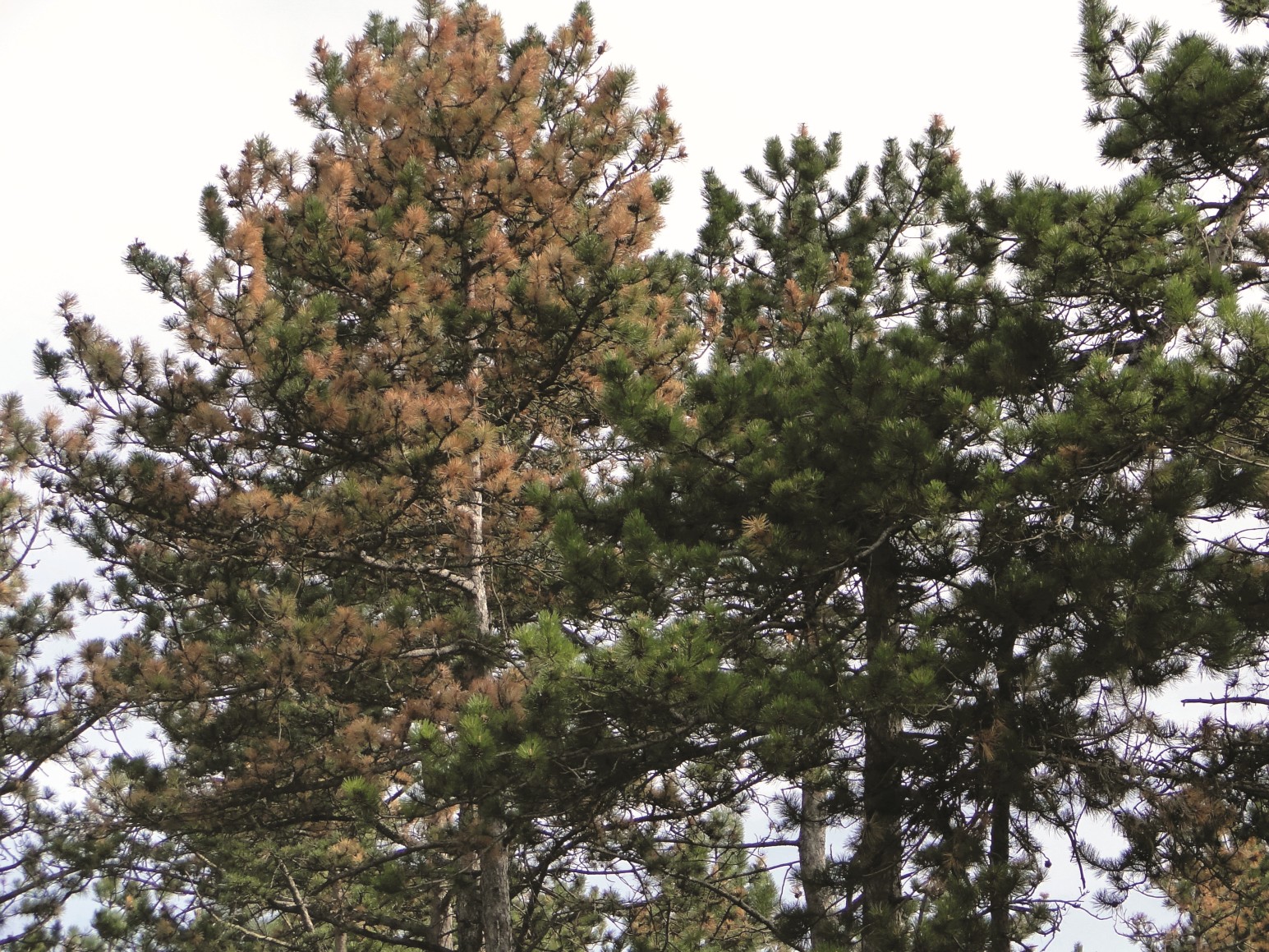
If trees are supplied with too little water, the pressure with which the water is transported from the plant roots to the tree crown drops. An initial symptom of this pressure drop is seen in drooping leaves. To prevent further drying and the associated drop in pressure, the trees close the stomata of their leaves. This causes them to lose less water, but at the same time they can absorb less carbon dioxide. This limits the performance of photosynthesis and thus the buildup of important plant substances. At the same time, this means that the storage of carbon decreases. If the drought stress persists, trees shed their leaves, fruit or even entire branches, and their crowns become thinner. The prolonged drought in the 2018 and 2019 growing seasons caused widespread premature leaf drop. According to the most recent 2019 Forest Damage Report from the Federal Ministry of Food and Agriculture, the percentage of trees with significant crown defoliation increased from 29 percent in 2018 to 36 percent. Only about one-fifth of the trees showed no damage. Crown defoliation increased significantly, especially among deciduous trees. The crown condition of conifers showed no trend. Increased dying of trees was observed.
If the canopy of the trees becomes thinner, the forest microclimate also changes, as the cooling effect of a dense leaf canopy diminishes. This affects the trees and the animal and plant species that live in the understory and soil, too. Heat-loving species could benefit and displace other species adapted to cooler conditions. If cleared areas result from wildfires or removal of diseased and dead trees, drying may increase because the affected areas are exposed to increased solar radiation. This can further reduce water availability in the soil. In addition, the removal of dead wood is accompanied by the loss of nutrients and humus, which negatively affects water storage in the forest floor. If trees do not have enough water available, this lowers their evaporative capacity and growth. This also results in a reduced uptake of carbon dioxide, so that carbon storage decreases. Drier climatic conditions can thus increase the risk of forests losing part of their function as carbon sinks.
For all deciduous trees and conifers, very young trees are susceptible to drought. Their root system is not yet sufficiently developed to tap water from deeper soil layers. The probability that young trees will die from drought is therefore significantly increased. As adult trees, however, they differ in their sensitivity to drought. For example, spruce and european beech are considered more sensitive to drought compared to oak and pine. For spruce (Picea abies) in particular, drought is a decisive factor. For a long time, spruce was considered the ideal, high-yielding tree species due to its undemanding nature, robustness and ease of propagation, and with a share of 25 percent, it is the most common tree species in Germany, along with pine (23 percent), copper beech (16 percent) and oak (11 percent). Due to its mostly shallow root system, spruce is very sensitive to drought and can be damaged much more easily by dryness in the topsoil. Its growth is severely restricted as a result and, in extreme cases, can lead to death. In addition, spruce has also been grown on sites that do not meet its requirements for more cool and moist climatic conditions. As a result of these climate effects, forestry has experienced particularly high yield losses in spruce stands in recent years. One reason for this is that dry periods reduce the flow of resin, which spruce trees use to defend themselves against bark beetles and other pests. This makes it easier for them to penetrate the bark and wood. Other tree species also experienced drought stress and damage in dry years such as 2003. European beech (Fagus sylvatica) suffered from growth collapses that persisted into the following year, especially on sites with poor water supply. In many places, the crowns of mostly older beech trees died or the branches did not have sufficient foliage. Scots pine (Pinus sylvestris) has the lowest water demand compared to the native tree species. Since it usually develops a deep taproot, it can fetch water from deep soil layers. Nevertheless, it too may show more severe failures as a result of dry years. Oaks (including Quercus robur) show drought damage to leaves (discoloration and necrosis) and increased root development in response to drought stress.
Heat stress
Average annual temperatures in Germany have already risen more than the global average, and by 2019 they had already risen by 1.6 degrees Celsius. By 2050, climate model calculations predict that summer temperatures will be 1.5 to 2.5 degrees warmer than in 1990, and winter temperatures 1.5 to 3 degrees Celsius. In general, plant life processes run faster as temperatures rise and can result in higher yields with increased growth. However, high temperature extremes can also lead to acute heat damage in trees, such as beech and spruce, both of which are characterized by comparatively thin bark. In the case of very high direct solar radiation, the bark can heat up to 50 degrees Celsius. Since directly under the bark lies the tree's cambium, which controls cell growth in the trunk (wood cells for water and nutrient transport, bast cells for assimilate transport), damage to the cambium is inevitable as a result of high solar radiation. Damage to the cambium can impair water transport, causing drought stress or exacerbating it. In addition to beech and spruce, thin-barked maples, lime trees, ashes, and alder are also at risk. If the trunk is damaged by strong sunlight, this can also be an entry point for harmful fungi.
Indicators from monitoring on DAS: Tree species composition in forest nature reserves - case study | Endangered spruce stands | Incremental growth in timber | Forest condition