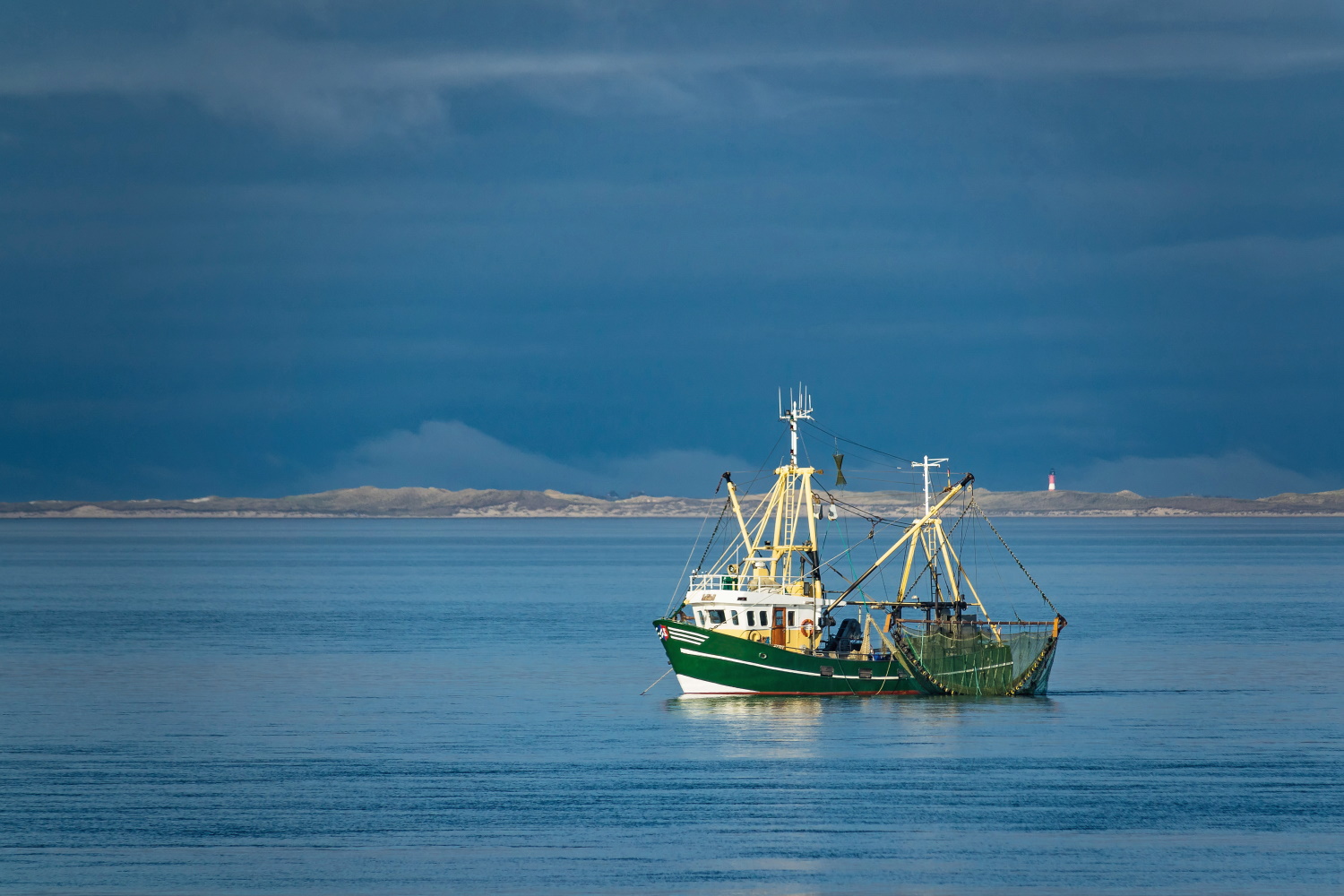
In fisheries, the adaptation to climate change can be implemented in two ways: on one hand increased protection of fish stocks; and on the other, adaptation of enterprises to changed production conditions. For the protection of fish stocks, a distinct reduction of anthropogenic pressures is crucial. This means primarily that fishing activities are curtailed. However, it also means that any other burdens such as the input of pollutants or eutrophication as well as revitalisation measures in inland waters are reduced.
In deep-sea fisheries, fishing quotas dictate where and how much fish is permitted to be caught. The quotas result from a political negotiation process at European level. As mentioned above, the fishing opportunities in the North Sea and the North-East Atlantic are the outcome of international negotiations, above all with the United Kingdom and Norway. On an annual basis, the International Council for the Exploration of the Sea (ICES) publishes scientific recommendations – prior to the determination of fishing quotas – on the question how high these quotas should be for specific stocks in order to safeguard conditions for their sustainable reproduction. Scientists working at the Thünen Institute (TI) of Sea Fisheries and Baltic Sea Fisheries are among the members of the scientific advisory team. Their research involves marine ecosystems, thus allowing these scientists to obtain important insights which form the basis of scientific recommendations. The political responsibility for Germany’s deep-sea fisheries is in the remit of the Federal Ministry of Food and Agriculture (BMEL). Consequently, the BMEL represents Germany in negotiations on fishing quotas. The principle of Maximum Sustainable Yield (MSY) and the precautionary principle have constituted the core objective for fish stock management since 2013. Overall, the sustainability of fisheries has improved, especially in the North-East Atlantic. However, the fact remains that not in all cases the scientific recommendations on the allocation of quotas are adopted; as a result, many fish stocks have so far not been able to recover from the impacts of overfishing. This is true, in particular, for the Black Sea and the Baltic Sea. In addition, there are problems with data deficits and climate change impacts, for instance, regarding the availability of fish species available as prey.
In view of the critical situation regarding Baltic Sea fisheries, the BMEL launched a commission charged with providing a mission statement in November 2020 for the future of Germany’s Baltic Sea fisheries. The commission is tasked to develop a model for sustainable and future-proof Baltic Sea fisheries and to propose concrete measures for the implementation of relevant principles and proposals83. The back story to this is the persistently critical stock situation regarding cod and herring and the consequential loss of important fishing opportunities. The BMEL considers that the tradition of Baltic Sea fisheries requires reorientation in order to keep it going. To this end, the TI for Sea Fisheries and Coastal Fisheries in the North Sea and the Baltic Sea is conducting research on the structural change required.
The BMEL addresses deep-sea fisheries, inland fisheries and aquaculture with its ‘Agenda – adaptation of agriculture and forestry as well as fisheries and aquaculture to climate change’ (AMK)84 and the associated programme of measures85. Politically speaking, the latter are in the remit of individual Länder. However, the BMEL intends its Agenda to promote explicitly a closer cooperation between Federal and Länder governments. The Agenda is part and parcel of the DAS Adaptation III Action Plan (APA III); for instance it is promoting new breeding objectives such as the adaptation to higher temperatures or the reduction of health risks arising from changes in pressures from parasites and pathogens. Furthermore, there are ongoing discussions on shading as a potential adaptation measure for inland waters and aquaculture facilities. The adaptation to climate change of deep-sea fisheries and the inland fishing sector is to be supported nationwide by means of the transfer of scientific knowledge to practical applications; and a national information and data portal is to be installed and managed at both Federal and Länder level. It is also proposed to establish a permanent task force with representatives from Federal and Länder authorities in order to review the regulative and funding policy aspects of framework conditions for adaptation to climate change, and to develop proposals regarding implementation.
Given that freshwater fisheries are in the Länder’s remit, several Länder operate scientific institutes which, among other aspects, look into the impacts of climate change on fish stocks in watercourses and also deal with the inland fishing sector in general. However, it must be said that the endeavours to develop a nationwide overview of this subject are still in their infancy. The AMK (see above) may provide a starting point for intensifying cooperation in this field.
Ultimately, it is up to fishing operators on the coast and inland to prepare for any changes in production conditions, to deal with them appropriately and to make adequate in-house decisions for adaptation measures. This may affect fishing methods, timings and (to a limited extent) fishing locations, as well as the target species and the management of aquaculture facilities and pond farming. Nevertheless, it is expected that the public purse will be willing and able to provide favourable framework conditions in this respect.
82 - Bundesregierung (Hg.) 2021: Mehr Fortschritt wagen. Bündnis für Freiheit, Gerechtigkeit und Nachhaltigkeit. Koalitionsvertrag 2021 – 2025 zwischen der Sozialdemokratischen Partei Deutschlands (SPD), BÜNDNIS 90 / DIE GRÜNEN und den Freien Demokraten (FDP). https://www.bundesregierung.de/resource/blob/974430/1990812/04221173eef9a6720059cc353d759a2b/2021-12-10-koav2021-data.pdf
82 - Deutscher Bundestag (Hg.) 2022: Antwort der Bundesregierung auf die Kleine Anfrage der Abgeordneten Stephan Protschka, Peter Felser, Frank Rinck, weiterer Abgeordneter und der Fraktion der AfD. Erhalt der Fischerei an Deutschlands Küsten. https://dserver.bundestag.de/btd/20/007/2000788.pdf
83 - BMEL – Bundesministerium für Ernährung und Landwirtschaft / Leitbildkommission zur Zukunft der Ostseefischerei: https://www.bmel.de/DE/themen/fischerei/leitbildkommission-ostseefischerei.html
84 - BMEL (Hg.) 2019: Agenda Anpassung von Land- und Forstwirtschaft sowie Fischerei und Aquakultur an den Klimawandel. https://www.bmel.de/SharedDocs/Downloads/DE/_Landwirtschaft/AMK-12-04-19-Agenda-Anpassung-Klimawandel.pdf
85 - BMEL (Hg.) 2020: Maßnahmenprogramm zur Umsetzung der Agenda Anpassung von Land- und Forstwirtschaft sowie Fischerei und Aquakultur an den Klimawandel. https://www.bmel.de/SharedDocs/Downloads/DE/_Landwirtschaft/Klimaschutz/ma%C3%9Fnahmenprogramm-klimaanpassung.html