Direkt zum Inhalt Direkt zum Hauptmenü Direkt zur Fußzeile

CASRI Strategic Research & Innovation Agenda (SRIA)

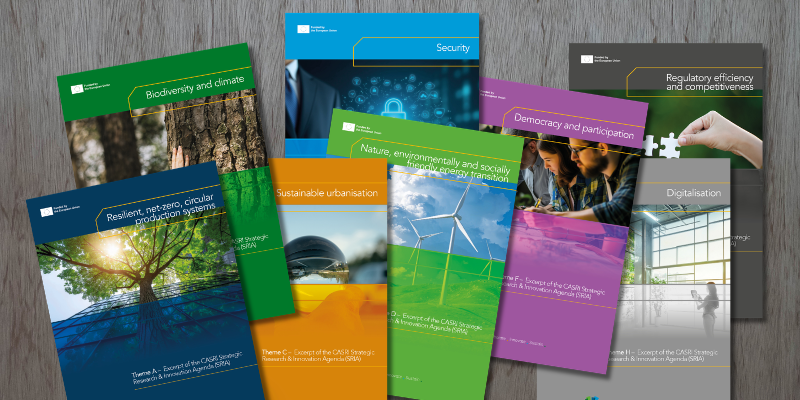
The cover pages of the different excerpts of the SRIA’s themes are shown.
The cover of the CASRI Strategic Research and Innovation Agenda (SRIA) excerpts.
Quelle: CASRI

The CASRI Strategic Research and Innovation Agenda (SRIA) is a strategic working result of the project, developed in close connection with the EPA Network Interest Group on Sustainability Research and Solutions (IG EPAS).

Inhaltsverzeichnis

SRIA Objectives, Positioning And Targeted End-Users

Europe is facing interlinked environmental, economic, technological and geopolitical pressures. Sustainability transformation therefore remains essential to Europe’s long-term resilience, competitiveness and security. Sustained access to resources, resilient production systems and supply chains, climate-resilient infrastructure, healthy populations, functioning ecosystems, effective regulation and the societal capacity to manage transformation all depend on robust and actionable knowledge. Against this background, European Environmental Protection Agencies (EPAs) and EPA-like sustainability expert organisations have worked with actors across Europe through the project CASRI – Collaborative Action coordinating and enhancing systemic, actionable and transversal Sustainability Research and Innovation – to co-create this Strategic Research and Innovation Agenda (SRIA), which have been developed in close connection with the EPA Network Interest Group on Sustainability Research and Solutions (IG EPAS). The CASRI SRIA consolidates transnational knowledge needs identified and further developed through the CASRI co-design process, providing a basis for further prioritisation, programming, collaboration and implementation. It is not a fixed research programme or a formally agreed policy position of European EPAs. Its topics and priority levels reflect the evidence, participants and timeframe of the CASRI process and are intended to be further developed with funders, policymakers, researchers and implementation actors. The SRIA addresses European and national funders, programme owners and partnerships seeking opportunities for coordinated programming and investment, as well as research organisations, businesses, public authorities, cities, regions, civil society and EPAs developing collaborative R&I and implementation activities. Through the SRIA, CASRI invites these actors to jointly develop and apply systemic, transversal and actionable knowledge for a sustainable, competitive, democratic, resilient and liveable Europe.

SRIA Content and Topic Prioritisation

The CASRI SRIA comprises 8 interconnected themes and 20 transnational Research and Innovation topics. For each topic, it describes expected impacts, background and rationale, the systemic, transversal and actionable knowledge needs, and the significance and added value of further Research and Innovation, including links and gaps in relation to existing initiatives. The topics were developed to different levels of detail according to the interest and evidence emerging through the co-design process.

A. Resilient, net-zero, circular production systems

Abstract:

European industrial systems must transition towards sustainable, resilient, and circular models to address climate change, geopolitical instability, supply chain disruptions, and resource scarcity. CASRI aligns with European Research and Innovation priorities, promoting resource security, reduced external dependencies, technology sovereignty, and inclusive governance. Its Strategic Research and Innovation Agenda (SRIA) addresses gaps in existing initiatives by emphasising human, institutional, and regional dimensions, including cross-border coordination, multi-actor policy implementation, and societal needs. By integrating resource security, equity, and innovation, CASRI supports systemic industrial transformation and resilient production systems. Its priorities contribute to UN Sustainable Development Goals 7, 8, 9, 12, and 13, supporting clean energy, economic growth, industrial innovation, responsible production, and climate action.

Download excerpt A

B. Biodiversity and climate

Abstract:

Climate change and biodiversity loss are deeply interconnected crises that reinforce ecosystem degradation, threaten livelihoods, and undermine environmental resilience. Both challenges must be addressed jointly through integrated policies and coordinated transnational strategies that maximise synergies between climate mitigation, biodiversity conservation, and nature restoration while managing trade-offs related to resource extraction and bioenergy. Integrated strategies can generate multiple benefits; for example, climate mitigation measures such as reforestation can support biodiversity, while nature restoration efforts can contribute to long-term climate resilience and other sustainable solutions. A nature-centred approach integrating climate and biodiversity objectives into policy and economic decision-making can strengthen ecosystem resilience, support sustainable development, and prevent the externalisation of environmental impacts across borders and value chains. This integrated approach contributes directly to SDGs 13, 14, and 15, while supporting broader goals related to food security, clean water, energy, sustainable cities, and responsible consumption (SDGs 2, 6, 7, 11, 12).

Download excerpt B

C. Sustainable urbanisation

Abstract:

Sustainable urbanisation seeks to balance economic development, social well-being, and environmental sustainability by transforming cities into drivers of innovation and systemic change. Growing urban populations, increasing resource demands, climate risks, and persistent social inequalities create complex challenges that require integrated technological, institutional, and governance solutions. Innovation in energy systems, mobility, housing, land use, and environmental management can improve resource efficiency, reduce emissions, strengthen climate resilience, and enhance quality of life. Effective implementation depends on integrated cross-sectoral planning, coherent regulatory frameworks, inclusive governance, citizen participation, and sustainable financing. Cities must also address pressures arising from infrastructure development, land consumption, pollution, and competing demands for resources. At the same time, measures to improve urban sustainability must avoid unintended consequences, including gentrification, social exclusion, and unequal access to housing, services, and green spaces. By connecting environmental objectives with social and economic priorities, sustainable urbanisation contributes directly to SDG 11 and supports SDGs 3, 6, 7, 9, 12, 13, 15, and 17.

Download excerpt C

D. Nature, Environmentally and Socially Friendly Energy Transition

Abstract:

A nature-, environmentally- and socially friendly energy transition must reconcile climate neutrality, biodiversity protection, energy security, competitiveness, and social justice. Renewable energy deployment and industrial decarbonisation offer significant opportunities but also create challenges related to land use, ecosystem integrity, affordability, and public acceptance. Addressing these requires coherent multi-level governance, stakeholder participation, cross-border cooperation, and evidence-based assessment of alternative transition pathways to identify synergies and manage trade-offs. Research and innovation can support inclusive decision-making, strengthen environmental monitoring, and improve coordination between policy, science, and practice. A just and nature-compatible transition can contribute to climate mitigation, biodiversity conservation, industrial resilience, energy sovereignty, and social inclusion, supporting key European policy priorities and SDGs 7, 9, 10, 11, 13, 15, 16, and 17.

Download excerpt D

E. Security

Abstract:

European industrial systems must transition towards sustainable, resilient, and circular models to address climate change, geopolitical instability, supply chain disruptions, and resource scarcity. CASRI aligns with European Research and Innovation priorities, promoting resource security, reduced external dependencies, technology sovereignty, and inclusive governance. Its Strategic Research and Innovation Agenda (SRIA) addresses gaps in existing initiatives by emphasising human, institutional, and regional dimensions, including cross-border coordination, multi-actor policy implementation, and societal needs. By integrating resource security, equity, and innovation, CASRI supports systemic industrial transformation and resilient production systems. Its priorities contribute to UN Sustainable Development Goals 7, 8, 9, 12, and 13, supporting clean energy, economic growth, industrial innovation, responsible production, and climate action.

Download excerpt E

F. Democracy and participation

Abstract:

Environmental security is an increasingly important dimension of sustainable development and effective environmental governance, relying on both trustworthy environmental data systems and socially inclusive climate adaptation. Two interconnected challenges are central: ensuring the security, integrity, and interoperability of environmental data, and addressing social vulnerabilities arising from climate change and adaptation measures. Rapid digitalisation, artificial intelligence, and expanding sensor networks generate growing volumes of environmental data while introducing new security risks. Simultaneously, climate impacts disproportionately affect vulnerable populations, highlighting inequalities and weaknesses in adaptation governance. Research and innovation can address these challenges by strengthening secure environmental data infrastructures, improving monitoring systems, and facilitating trusted cross-border data exchange and cooperation. In parallel, improved understanding of social vulnerabilities can support more equitable adaptation strategies, reduce maladaptation risks, and ensure that climate measures respond to diverse societal needs. Effective governance frameworks, supported by European and international policy initiatives, are essential to translating these advances into practice. Integrating technological security with social resilience can strengthen institutional capacity, evidence-based decision-making, public trust, and inclusive sustainability transitions. This theme therefore contributes to the implementation of the European Green Deal and EU Adaptation Strategy, supporting particularly SDGs 9, 10, 11, 13, and 16, with emphasis on trustworthy institutions, climate resilience, and reduced inequalities.

Download excerpt F (Download coming soon)

G. Regulatory efficiency and competitiveness

Abstract:

Europe faces the challenge of strengthening competitiveness and reducing regulatory burdens while maintaining environmental ambition and delivering the objectives of the European Green Deal and European Climate Law. Thereby it runs the risk that environmental ambition is treated as a cost to be cut rather than a goal to be delivered more efficiently. Geopolitical pressures, economic uncertainty, fragmented policies, and administrative complexity highlight the need for smarter, more coherent, and adaptive regulation, alongside a broader understanding of competitiveness based on long-term resilience, resource sufficiency, and social justice. Research and innovation can support this transformation through improved impact assessments, digital tools and artificial intelligence, multi-level governance, stakeholder participation, and real-world experimentation. Environmental Protection Agencies can play a convening role and build internal capacity to wield these tools while safeguarding environmental integrity. More effective regulatory frameworks can reduce uncertainty, facilitate sustainable investment, and accelerate innovation while addressing implementation and enforcement gaps. At the same time, redefining competitiveness around sustainability, resilience, and fairness can help align economic objectives with environmental and societal needs. Together, these approaches can strengthen institutional effectiveness, public trust, and policy coherence, positioning Europe to advance its green transition while maintaining economic competitiveness. This theme contributes particularly to SDGs 3, 8, 9, 12, 13, 14, 15, 16, and 17.

Download excerpt G

H. Digitalisation

Abstract coming soon

Download excerpt H (Download coming soon)

CASRI SRIA Co-design Process

The SRIA was developed through a bottom-up co-design process involving EPAs and EPA-like organisations as National Contacts who invited National Key Stakeholders and European experts with backgrounds in knowledge production, funding, implementation, politics and use. Around 600 national knowledge needs were identified, clustered and consolidated into 20 transnational Research and Innovation topics, which were subsequently discussed, prioritised and further elaborated through surveys, online exchanges and workshops. The resulting agenda therefore combines national implementation experience with transnational analysis and European dialogue.

DOWNLOAD THE FULL DOCUMENT OF THE SRIA

Associated content

Dokumente

Schlagworte

Kurzlink: https://www.uba.de/n309219de