
Skip to main content Skip to main menu Skip to footer

Paris Agreement

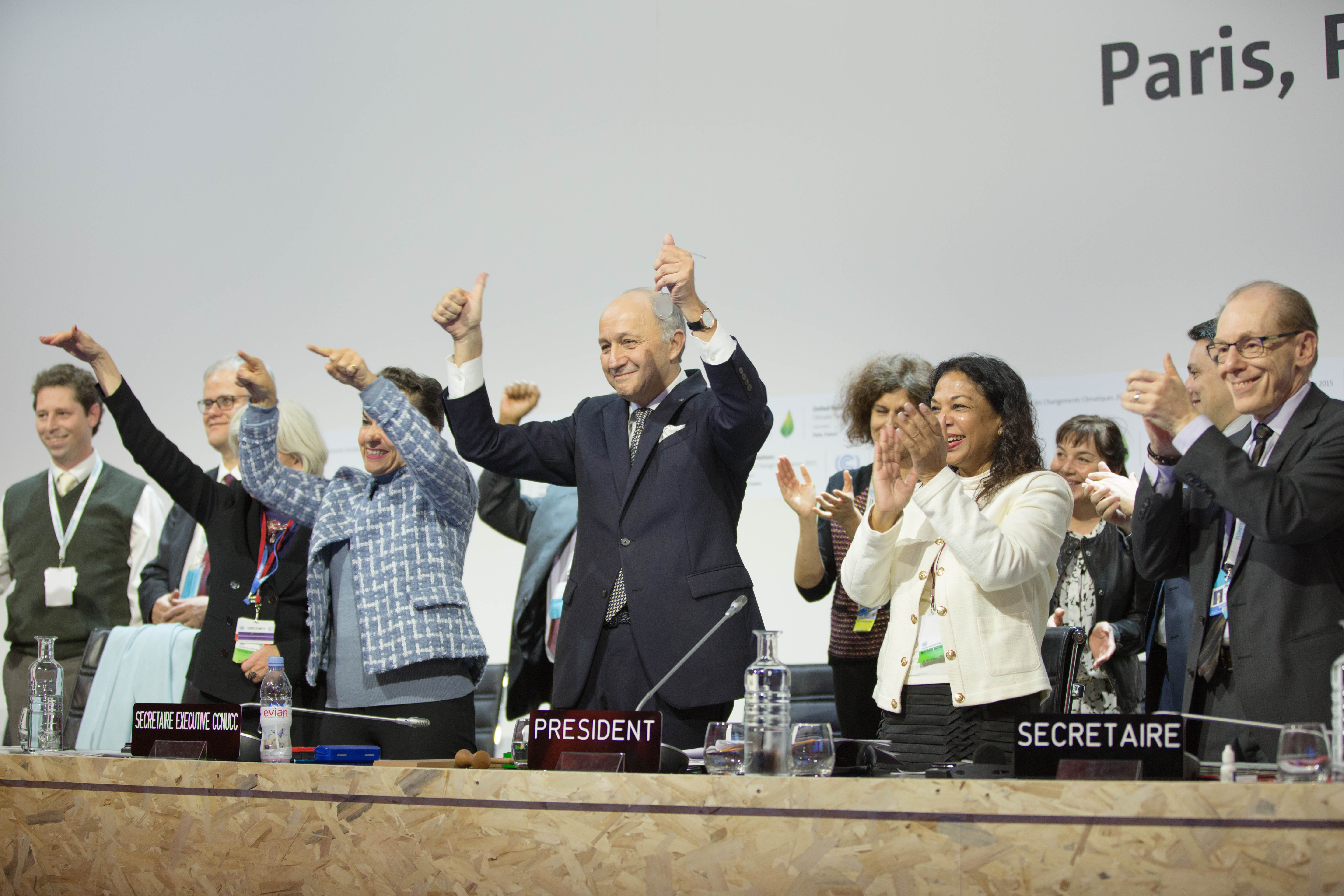
Happy faces at COP21 in Paris: The Paris Agreement is adopted!
Source: James Dowson / UN Climate Change

The Paris Agreement was adopted at the 21st Session of the Conference of the Parties of the United Nations Framework Convention on Climate Change (COP 21) in December 2015 in Paris and entered into force in November 2016. The Parties agreed to limit global warming to well below 2 °C and to pursue efforts to limit the temperature increase to 1.5 °C compared with pre-industrial levels.

Table of contents

Objectives of the Paris Agreement (PA)

At the Climate Conference in Paris (COP 21) in 2015, the international community agreed for the first time, under international law, to limit global warming to well below 2 °C compared with pre-industrial levels. Furthermore, countries strive to limit the temperature increase to 1.5 °Cin order to prevent the most severe foreseeable consequences of climate change. Global greenhouse gas emissions must peak as soon as possible, followed by a drastic reduction in emissions. Furthermore, greenhouse gas emissions neutrality must be achieved in the second half of the 21st century. To this end, the first step is to drastically reduce greenhouse gas emissions by decarbonising our economy and lifestyle. In addition, natural carbon sinks, such as forests and peatlands, which remove and store carbon from the atmosphere, are to be preserved and strengthened. Further objectives include strengthening countries’ capacity to cope with the impacts of climate change (adaptation) and aligning financial flows with low-emission and climate-resilient development.

From Adoption to Entry into Force

For the Paris Agreement to enter into force, it had to be ratified by at least 55 states accounting for at least 55 per cent of global greenhouse gas emissions. These two conditions were met on 5 October 2016, following ratification by the European Union and seven of its Member States, including Germany. Thirty days later, on 4 November 2016, the Agreement formally entered into force. Following the United States’ withdrawal, which took effect on 27 January 2026, the Paris Agreement now has 194 Parties.

Rulebook for the Paris Agreement

To meet the Paris Agreement’s targets, monitor progress and, above all, ensure its implementation, a rulebook was adopted at the Climate Change Conference in Katowice (COP24 in 2018). It contains 

detailed requirements on:

  • the content of Nationally Determined Contributions (NDCs), 
    • transparency regarding the scope and methods for reporting on greenhouse gas emissions and climate action, 
    • the modalities of the Global Stocktake
    • the implementing rules for market-based cooperation mechanisms, which were largely finalised at COP26 in Glasgow in 2021.

Nationally Determined Contributions (NDCs)

The Agreement provides all Parties with a clear framework for implementing the necessary climate action. To this end, countries are required to submit new and increasingly ambitious Nationally Determined Contributions every five years, which should contribute to achieving the long-term goal and become increasingly ambitious over time. Parties were last called upon to submit new NDCs in 2025. The UNEP Emissions Gap Report shows that, taken together, the climate targets set out in the NDCs are not yet sufficient to limit global warming to 1.5°C. It is therefore particularly important to continue setting more ambitious targets and implementing them.

Countries are free to set their own targets. The only specific requirements relate to how and when they must submit their NDCs.

The information that each country must provide in relation to these NDCs was agreed in the Rulebook (see above). Progress in reducing greenhouse gas emissions, as set out in the NDCs, is regularly reviewed. There are no penalty mechanisms for failing to meet the targets set by the Parties themselves. Attempts to establish such mechanisms in an agreement have failed, for example, in Copenhagen (COP 15 in 2009).

Global Stocktake

The Global Stocktake  is conducted every five years, two years before the submission of new NDCs, to assess whether taken as a whole, the objectives of the Paris Agreement are being met. This Global Stocktake is also intended to drive stronger implementation and greater ambition at national level, as well as cooperation at international level. The first Global Stocktake was completed in 2023, with preparations beginning as early as 2021. It resulted in a comprehensive decision. The decision highlights the lack of collective progress on climate action, emphasises the urgency of stronger action, and identifies areas where further progress is needed. The outcome of the Global Stocktake is to be reflected in the new NDCs submitted in 2025. The second global stocktake will begin in 2026 and is due to be completed in 2028. In 2018, an initial assessment of efforts was carried out as part of the Talanoa Dialogue, which emphasised the urgency of taking action to ensure more effective climate action.

Transparency

The Rulebook (see above) sets out the details of the Enhanced Transparency Framework (ETF) established under Article 13 of the Paris Agreement and establishes the reporting standards. Under this framework, all participating countries are required to provide information on their climate policies and their national emissions. This information is published in biennial transparency reports, which enable the comparison of progress. The guidelines apply to industrialised, developing and emerging economies alike. However, developing countries that lack the necessary capacity and resources, particularly Least Developed Countries (LDCs) and Small Island Developing States (SIDS), are granted greater flexibility in terms of reporting and support, given their specific circumstances. Reporting on greenhouse gas emissions is based on the 2006 guidelines of the Intergovernmental Panel on Climate Change (IPCC).

Capacity-building and cooperation

The Paris Agreement applies to all Parties. However, depending on the issue, different obligations apply to different countries. In particular, developed countries are committed to supporting developing countries in climate action and adaptation to climate change. The international community should support the poorest and most vulnerable countries including the least developed countries to cope with the loss and damage caused by climate change. Forms of support include, for example, financial resources for mitigation and adaptation, technology transfer, capacity-building, and the sharing and exchange of experience and knowledge.

Market-based mechanisms

Market mechanisms are an important instrument for international cooperation under the Paris Agreement. They enable the transfer of emission reductions (or carbon removals) between countries and the international crediting of climate action projects. The aim is to help achieve climate targets cost-effectively and to raise the overall level of ambition. In addition to reducing emissions or increasing carbon dioxide sequestration (for example, through the rewetting of peatlands or afforestation), these mechanisms are also intended to contribute to sustainable development and to the financing of adaptation measures. It is not only countries that are expected to take action; private actors, such as airlines, may also be eligible to purchase such emission reduction credits. A robust crediting system that reliably prevents double-counting and other risks to environmental integrity is essential in this regard. As not all countries aim to use market mechanisms in climate action, these cooperation instruments also include an international forum for exchanging experiences on other climate action approaches: the ‘Glasgow Committee for Non-Market Approaches’. Due to the complexity of these instruments, the adoption of the implementing rules was delayed until COP29 in Baku in 2024. A central element is the “Paris Agreement Crediting Mechanism” established under Article 6.4 of the Paris Agreement, which enables the implementation of climate change mitigation projects under the supervision of an international supervisory body and in accordance with established methodologies and guidelines.

Differences to the Kyoto Protocol

Negotiated under the UNFCCC in 1997, the Kyoto Protocol was the world’s first legally binding international treaty on climate change mitigation. It entered into force in 2005. The Kyoto Protocol placed a legal obligation on participating industrialised countries – including the European Union and its Member States – to reduce their emissions, while developing countries participated on a voluntary basis. While these industrialised countries accounted for around 60 per cent of global emissions in 1990, their share has since fallen to around one third. All Parties to the Paris Agreement are required to develop their own NDCs and measures to implement them. The Kyoto Protocol set out binding targets for reducing greenhouse gas emissions and followed a top-down approach, under which climate action targets were set centrally. The Paris Agreement focuses on self-determined emission reductions, adaptation to climate change and mobilising finance for national climate action, and is thus based on a bottom-up approach combined with a globally agreed temperature target.

Associated content

Links

Publications

Tags

Short link: https://www.uba.de/n89763en