
Skip to main content Skip to main menu Skip to footer

International Climate Policy

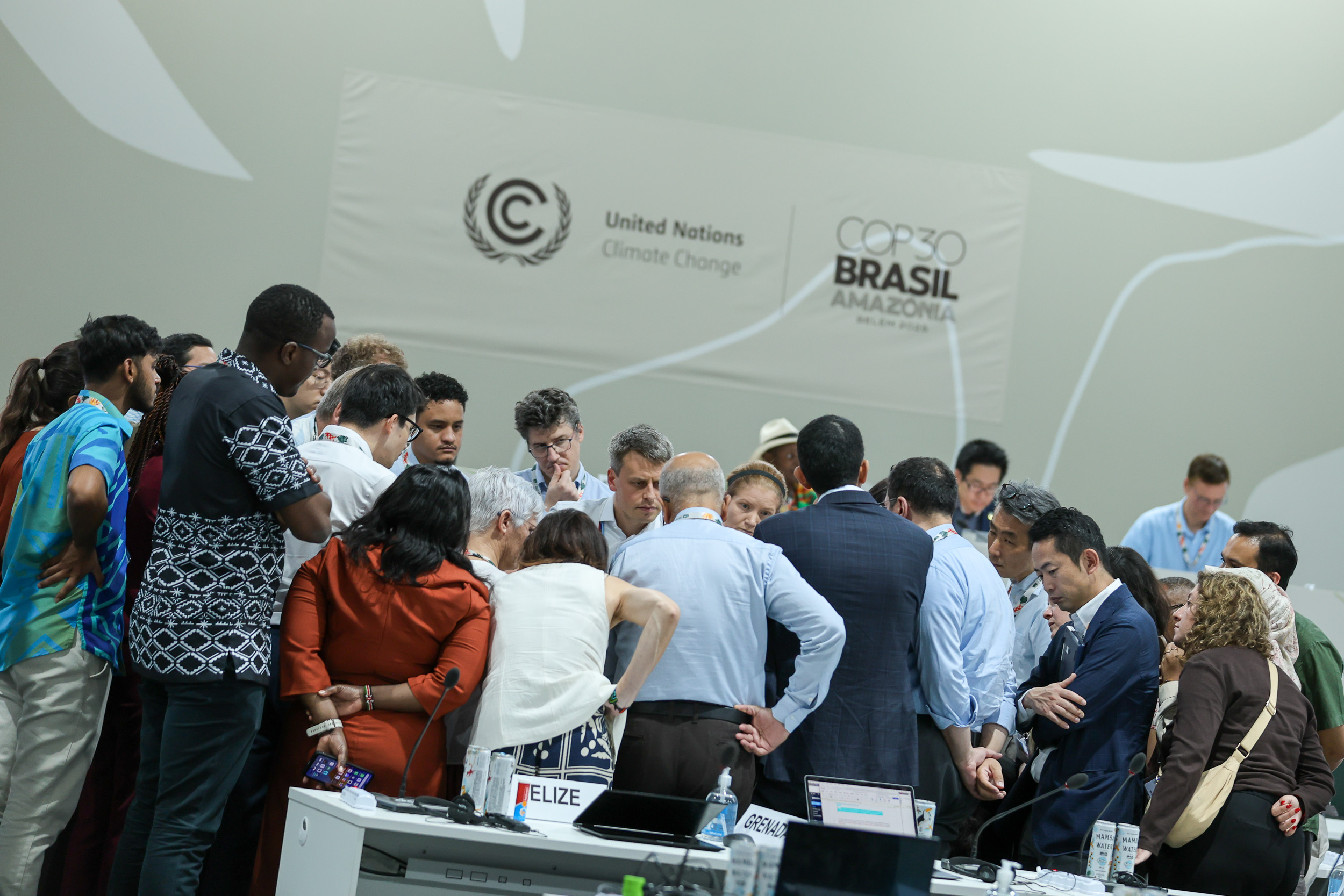
Delegates from various countries are putting their heads together to discuss in a huddle at COP30 in Brazil.
Delegates hold discussion in a huddle at COP30 in Brazil.
Source: IISD/ENB | Mike Muzurakis

Climate change is a global challenge that can only be addressed through international cooperation. Climate policy at the international level focuses on developing strategies and measures to protect the climate by reducing greenhouse gas emissions, adapting to the consequences of climate change, and financing these measures.

Table of contents

International Climate Policy

Climate change does not stop at national borders. Given its causes and consequences, it is a global challenge that requires international solutions and cooperation among all nations. International climate policy therefore encompasses political measures and agreements designed to limit climate change and address its unavoidable consequences.

The focus is on three areas of action: First, greenhouse gas emissions must be avoided or reduced (mitigation). Second, societies and ecosystems must adapt to the consequences of climate change that can no longer be avoided (adaptation). In addition, solutions must be found for loss and damage that cannot be prevented despite mitigation and adaptation efforts. Third, the financing of the necessary measures is a central and internationally controversial issue.

The overarching goal of international cooperation is to prevent a disruption of the climate system that poses a danger to people and ecosystems. The increasing emissions of greenhouse gases caused by human activity, particularly since the beginning of industrialization, intensify the ⁠greenhouse effect⁠ and are the main cause of global warming. Halting global warming and mitigating climate change and its consequences requires a significant reduction in greenhouse gas emissions worldwide—in the short term, as well as in the coming years and decades.

The International Climate Regime

The central foundation of international climate policy under international law is the United Nations Framework Convention on Climate Change (UNFCCC)and the Paris AgreementThe UNFCCC was adopted in 1992 and provides the framework for international climate negotiations. Today, the UNFCCC has 198 member states. The Paris Agreement, adopted in 2015, commits the current 194 member states to making their own nationally determined contributionsto climate action. The EU participates in both treaties as a regional economic organization. As a result, nearly all countries in the world have committed to the goals and principles of these international agreements.

Concrete international agreements are often difficult to reach due to differing economic interests, levels of development, and political priorities. Decisions at UN climate conferences are generally made by consensus. While this can slow down negotiations, it lends the agreements broad international legitimacy and therefore a high degree of binding force.

In addition to the Framework Convention on Climate Change and the Paris Agreement, there are other international political efforts to further advance climate action in industrialized, emerging, and developing countries. They differ primarily in their areas of focus and membership.

Temperature and Emissions Targets

Since the adoption of the Paris Agreement, the international community’s efforts for climate action have been united around a common policy goal: to limit global warming to well below 2 °C and pursuing efforts to limit the temperature increase to 1.5 °C, compared to pre-industrial levels. This goal is a scientifically grounded (see the IPCC`s Special Report on Global Warming of 1.5 °C ) and politically established threshold; exceeding it is expected to result in dangerous climate change that is no longer sustainable for people and the environment.

From the beginning of the 20th century through 2025, the global average temperature has already risen by approximately 1.4 °C. According to the Intergovernmental Panel on Climate Change (IPCC), if the measures to reduce greenhouse gases implemented through 2020 were to continue, average global warming of 3.2 °C would be expected by the year 2100. This would have devastating consequences for people and ecosystems around the world, but especially for the poorest people in emerging and developing countries. To stabilize the climate at a level considered just barely “tolerable”, global greenhouse gas emissions must be drastically reduced both immediately and over the long term.

The Intergovernmental Panel on Climate Change’s Sixth Assessment Report, published in 2023, provides key findings on the necessary reduction of greenhouse gas emissions. For long-term climate stabilization—in which global warming would not exceed 1.5 °C, or would exceed it only slightly and to a limited extent, with a 50 percent probability—a reduction of 43 and 60% in global greenhouse gas emissions by 2030 and 2035, respectively, compared to 2019 levels would be necessary. For emission pathways that have a 50% probability of meeting the 1.5 °C target, the year of peak global greenhouse gas emissions falls between 2020 and 2025. This means that global greenhouse gas emissions must peak before 2025 and the trend must be downward from that point onward (IPCC 2023).

The remaining CO₂ budgets after 2019 corresponding to the 1.5°C and 2°C pathways are 510 (330–710) gigatons (Gt) of CO₂ and 890 (640–1,160) Gt of CO₂, respectively. In 2024, a new record high of global greenhouse gas emissions was reached at 57.7 GtCO₂ equivalent (eq) (UNEP 2025). According to the United Nations Environment Programme, the gap between current measures and what would be necessary to keep the long-term goal of 1.5 °C within reach by 2035 is 30 GtCO₂eq annually. Closing this gap requires global, immediate, and ambitious efforts that go beyond what countries have implemented so far in terms of greenhouse gas emission reductions or have committed to by 2035.

Associated content

Links

Publications

Related contents

Related publications

Tags

Short link: https://www.uba.de/n12757en