Stefan Bernickel’s farm, Gramzow (Brandenburg)
Farmer Stefan Bernickel manages a ‘sponge field’ that retains water in the soil and reduces erosion. Thanks to soil-conserving tillage and a climate-resilient crop rotation, the farm is better equipped to cope with drought and heavy rainfall.
The family-run farm is situated in one of the regions of Germany with the lowest rainfall. Long periods of drought are followed by heavy rainfall events, during which water on conventionally ploughed soils often runs off the surface or washes away valuable topsoil. In 2021, the farm’s management practices were therefore fundamentally overhauled. The aim is to develop the soil so that it can absorb and store rainfall, and make moisture available to the crops when rainwater is scarce.
Since 2024, the farm has stopped using the plough and cultivator for crop production and has adopted the soil-conserving strip-till method for sowing. With strip-till seeding, only narrow strips of soil are disturbed, leaving more than 80% of the soil surface intact. The farm also uses a climate-adapted crop rotation, supplemented by chickpeas, peas, grain maize and, in the future, sunflowers. This preserves a protective layer of mulch that shades the soil, slows its warming and reduces evaporation.
Soil biology is continuously monitored and analysed, including by counting the number of earthworms per spadeful. According to the farm, the earthworm population has risen from one to two to ten to 20 worms per spadeful. The earthworms’ burrows facilitate water penetration into the soil and help to channel it into the ground even during heavy rainfall.
Scientific partners are supporting the transition to the regenerative farming system and will carry out a comprehensive evaluation of the results by 2028. The transition has been largely financed through reduced operating costs: thanks to the drastic reduction in labour and machinery hours and the savings on diesel fuel, the transition effectively pays for itself.
Since summer 2026, the State of Brandenburg has recognised the farm as an official demonstration farm for conservation tillage. It now officially serves as a hub for knowledge transfer between agricultural holdings. A training room on the farm, as well as collaborations with research institutions and agricultural networks, are designed to facilitate exchange with other farms, experts and the public.
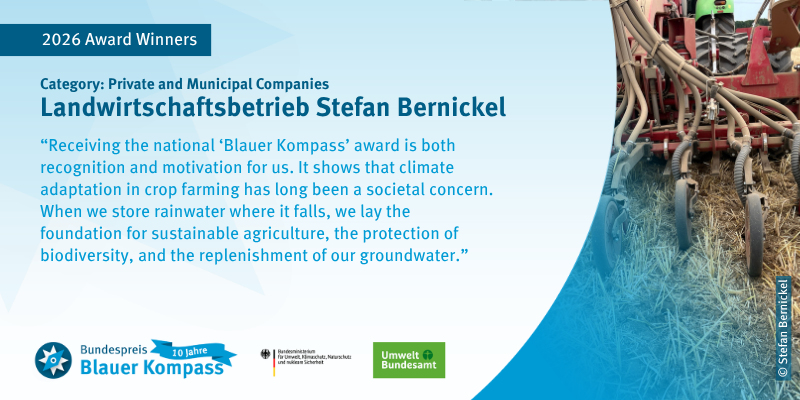
Quote: “Receiving the national ‘Blauer Kompass’ award is both recognition and motivation for us. It shows that climate adaptation in crop farming has long been a societal concern. When we store rainwater where it falls, we lay the foundation for sustainable agriculture, the protection of biodiversity, and the replenishment of our groundwater.”
Biographical film (in German)
Organiser: Stefan Bernickel Farm
Location: Municipality of Gramzow, Uckermark District (Federal State of Brandenburg)
Project start: July 2024
Partners: Julius Kühn Institute, Leibniz Institute for Agricultural Engineering and Bioeconomy, Leibniz Centre for Agricultural Landscape Research, Brandenburg State Farmers’ Association, Horsch, SeedForward, OmniCult, Deutsche Saatveredelung AG (German plant breeding and seed company), Rapool
Contact: Stefan Bernickel, landwirt.bernickel@gmail.com
Website: https://www.landwirt-bernickel.de/
Further information (in German)