Skip to main content Skip to main menu Skip to footer

Indicator: Sustainable consumption

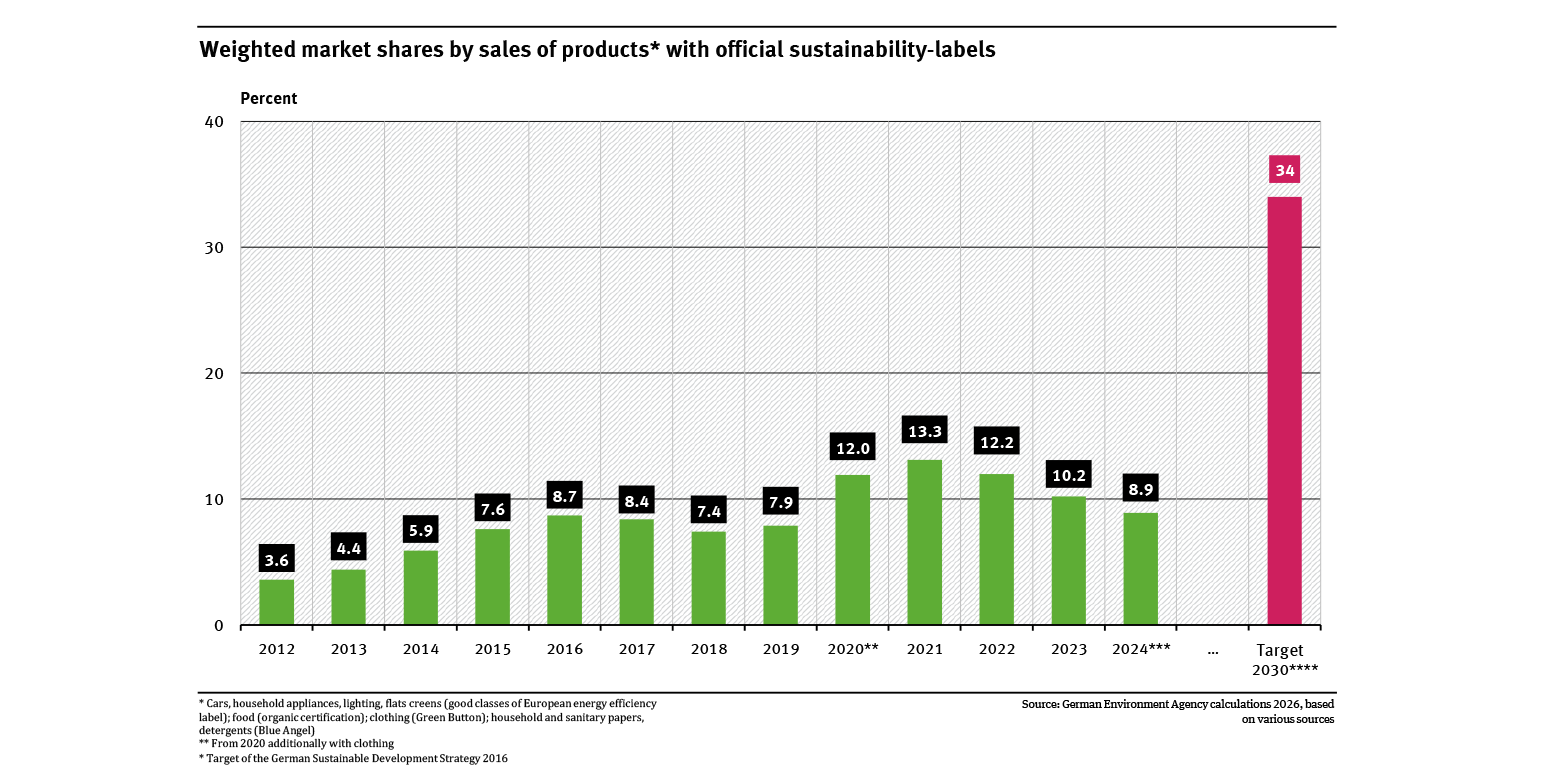
A graph shows the market shares of products with official eco-labelling. Between 2012 and 2021 this figure rose from 3.6% to 13.1%. After, it fell to 8.9 in 2024. Target is 34% in 2030.
Weighted market shares by sales of products with official eco-labels
Source: German Environment Agency
Figure as PDF (439.42 kB)

Table of contents

At a glance

  • In the sector of products with official eco-labels, 8.9% of turnover was generated with particularly environmentally friendly and socially responsible products in 2024.
  • The Federal Government has set the target of increasing the market share of these products to 34% by 2030.
  • More efforts are needed to achieve this goal, particularly in the food, clothing and mobility sectors.

Environmental importance

Private households can encourage sustainable consumption both directly and indirectly. On the one hand energy-efficient vehicles or well-insulated homes need less energy and produce fewer greenhouse gas emissions. On the other hand, by preferring appropriate products, consumers indirectly influence the emissions and social sustainability of the production.

The indicator records the market shares of products with eco-labelling that sets stringent sustainability standards. Up to now, only state-regulated eco-labelling has been considered: Energy labelling (cars, household appliances, lighting and televisions), organic labelling (food), Green Button label (clothing) and the Blue Angel label (sanitary tissues, washing and cleaning products). With this indicator it is possible to ascertain whether conventional products are being replaced by environmentally friendly and socially responsible versions. Sustainable consumption is all about replacing non-sustainable consumer habits with sustainable ones.

Assessing the development

In 2024, environmentally friendly and socially responsible products accounted for an 8.9% market share in the product groups surveyed. This means the indicator is moving in the opposite direction of the target. This is primarily due to the market share of energy-efficient passenger cars. After peaking in 2021, the market share of A+ passenger cars declined in subsequent years. In 2024, the new passenger car CO2 label with new requirements was introduced, which prevents direct comparability with previous years.

Passenger cars with the best label (A) had a market share of 15.7% in 2024. Little has changed in the organic food sector over the past 5 years (6 to 7% market share). For large household appliances, significant shifts toward more efficient categories have been observed again since the introduction of the new efficiency categories. For sanitary paper products, market shares in private households have fallen by over 10 percentage points over the past 10 years to just 6.7%. Market shares vary significantly across different product categories: By 2024, 79.5% of washing machines sold had already been rated in the highest efficiency category, A. Refrigerators, freezers, and dishwashers only come close to this level when categories A through D are combined. For electric ranges and ovens, however, as well as for air conditioners, high energy efficiency remains a niche issue.

To achieve the sustainability strategy’s goal of a 34% market share by 2030, the very low demand for environmentally friendly and socially responsible products must be revitalized.

Methodology

To calculate the indicator, particularly environmentally and socially relevant product groups for which market data are available were identified in each consumer area. Since the market volumes for individual product groups vary greatly, the market shares were weighted by the volume of sales for the respective market as a whole. This guarantees that the indicator is not distorted by high market shares in small niche markets.

More detailed information: 'Grüne' Produkte: Marktzahlen (in German only).

Related contents

Tags

Short link: https://www.uba.de/n47336en