Welcome to the new issue of ‘The Latest from UBA’!
Whether in local authorities, schools or the healthcare system – there are already some fantastic projects underway in many parts of Germany to help us be better prepared for the effects of climate change, such as heatwaves and heavy rainfall. In this newsletter, we highlight six of them. We also look at, amongst other things, how the chemical industry in Europe can be made more sustainable, how the Energy Disclosure in the EU could be modernized, and how land consumption can be reduced.
We hope you find it an interesting read
Your UBA Press and Public Relations team
The ‘Blauer Kompass’ national award recognises individuals who take a hands-on approach to climate adaptation
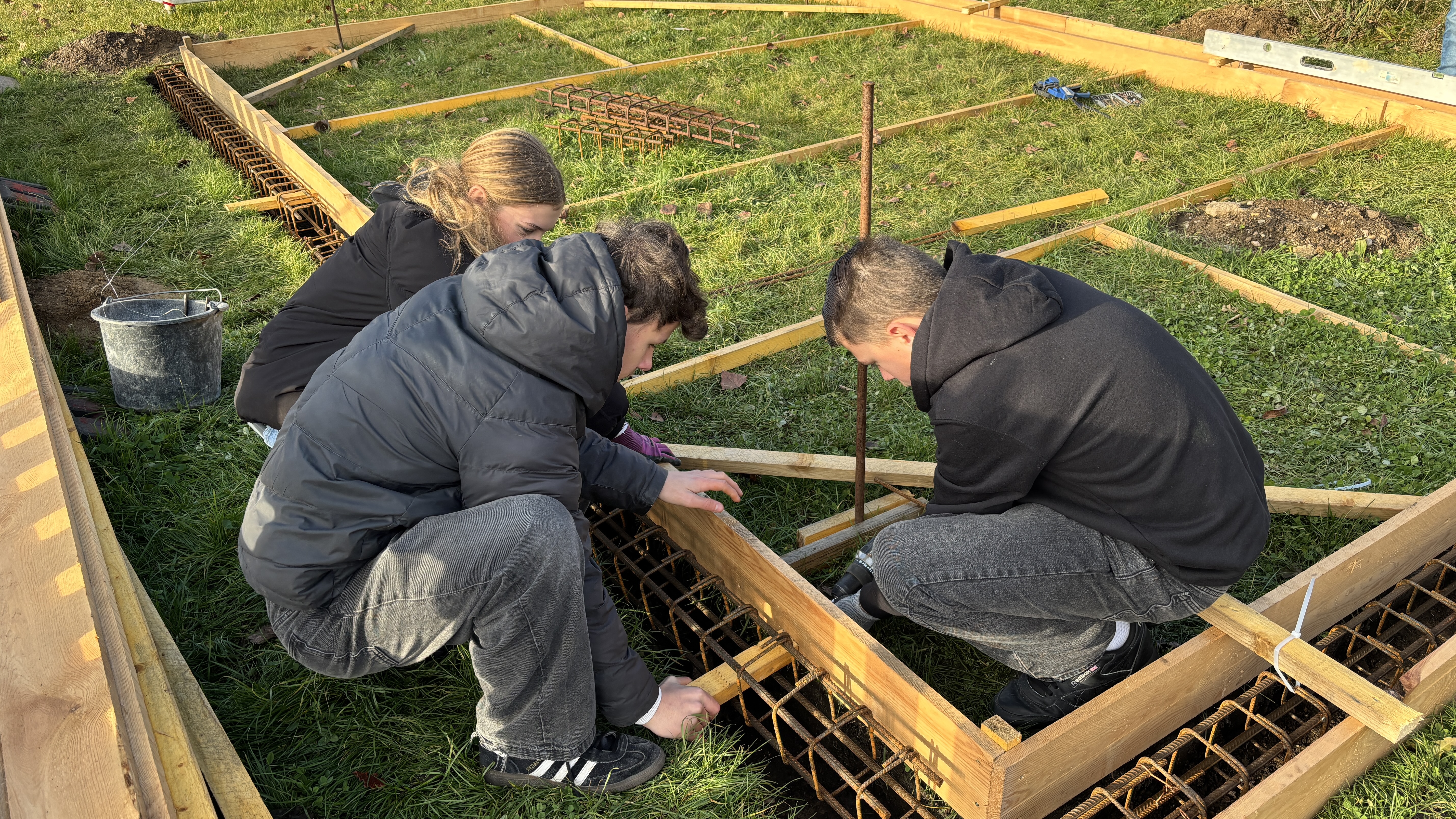
Pupils in the city of Halle (Saale) are building a facility for climate-adapted food production
Source: Sankt Mauritius-Sekundarschule
Climate protection aims to stop our planet from excessive warming. However, its consequences are now unstoppable and manifest themselves in heatwaves and flooding caused by heavy rainfall. So we need both climate protection and adaptation measures to ensure that Germany remains a good place to live and that health, the economy and prosperity are protected as effectively as possible. On the path towards a climate-resilient society, everyone can get involved and make a valuable contribution, for example in local communities, educational institutions, agriculture and the healthcare sector.
The winners of the 2026 ‘Blauer Kompass’ Federal Award demonstrate how this can be achieved through outstanding projects on climate prevention and adaptation to the consequences of climate change. To mark its 10th anniversary, the joint competition organised by the Federal Ministry for the Environment (BMUKN) and the German Environment Agency (UBA) set a new record for participation with 488 entries.
Take the district of Fulda, for example: the early warning system it developed alerts towns, local authorities, residents and local fire brigades to heavy rainfall.
Example: Stefan Bernickel’s farm: He has made his field in the arid Uckermark region north of Berlin climate-resilient, through soil cultivation methods that promote water retention.
Example: The Catholic University of Applied Sciences in Munich: A new teaching module specifically prepares midwives for the health implications of climate change for pregnant women and newborns.
Take the NaturGut Ophoven e.V. support association in Leverkusen: its interactive exhibition ‘Die MutReiferei’ responds to the fear many children and young people feel about climate change by promoting courage as a key skill for living with climate change in the future.
Example: St Mauritius Secondary School in Halle (Saale): Together with pupils, a greenhouse for climate-adapted food production was created, combining fish farming and crop cultivation. Thanks to a water cycle, rainwater harvesting and solar energy, it operates efficiently and is largely energy self-sufficient, whilst being independent of synthetic fertilisers and pesticides.
Example: Olof Palme Comprehensive School in Hiddenhausen: Using proceeds from a charity run, pupils created a traditional orchard meadow and a ‘climate forest’ with more than 5,000 trees and shrubs, which also serve as living learning environments, for example in biology lessons.
Watch the videos about the winners and be inspired!
Discussion paper for the thematic conference “„Spotlights 2026: Shaping the Chemical Transition Together”
Europe’s chemical industry is vital to the economy and society. Throughout their life cycle, chemicals contribute to environmental pollution, biodiversity loss and health risks. Against the backdrop of the crisis facing Europe’s chemical industry, the German Environment Agency outlines a vision for a greenhouse gas-neutral, fossil-free and circular chemical industry. Key pathways include…
Please make a note of 25 and 26 February 2027. On these dates, an international workshop will be held with representatives from research, industry and public authorities, at which the results of the UBA project ‘Round Robin test in preparation for the consolidation of tests for ready biodegradability in accordance with OECD guidelines’ (project code: 3724657090) will be presented.
Energy Disclosure ensures market transparency and enables consumers to make informed purchasing decisions. A study commissioned by UBA has developed proposals on how energy disclosure for electricity, gas, hydrogen, heating, and cooling could be reformed in the EU.
On behalf of the Federal Ministry for Economic Affairs and Energy, the Working Group on Renewable Energy Statistics (AGEE-Stat) takes stock of the use of renewable energy and annually prepares an official estimate of the development of renewable energies for the previous year. This background paper describes the initial findings for the electricity, heat and transport sectors, supplemented by…
Within the Research Project: Criteria for the Sustainable Provision and Climate Friendly Integration of Electricity-Based Energy Sources
Life cycle analyses (LCA) were conducted for 56 production pathways for hydrogen (green, blue, turquoise), ammonia, methane, methanol, dimethyl ether (DME) and Fischer-Tropsch products, supplemented by 12 target scenarios for optimized future technologies.
In most cases, the electricity-based production paths have significant climate advantages over fossil references – provided that the entire…
Regulatory opportunities for extensive electrification in mobile machinery and equipment, recreational craft, and powered two-wheelers
Many small and medium-sized non-road mobile machines (NRMM) can be electrified by 2050 from a technical point of view. For large machines with high power requirements, however, limitations remain. The study therefore recommends a combination of electrification, targeted regulatory incentives, and the use of renewable fuels for applications that are difficult to electrify. Specific regulatory…
The HBM4EU network brought together more than 100 partner institutions from EU member states as well as Norway, Iceland, Israel, and Switzerland. The 17 work packages strengthened the interface between science and policy, for example by prioritizing substances and translating research findings into policy processes. The laboratory network and the prioritization procedures were considered…
As part of the project, an assessment of strategies to reduce land consumption was conducted for selected countries. Among other things, the study examined which national targets and instruments exist in other countries, what progress has been made in implementing them, and whether there are obstacles to effective land-conservation policies. Furthermore, the study examined the role played at the…
How should we deal with the multitude of PFAS in soil, air, and water? What joint research is being conducted on human biomonitoring? The National Institute for Public Health and the Environment (RIVM) traveled from Bilthoven, near Utrecht, to Dessau to discuss these questions with experts from the German Environment Agency (UBA).
The monetization of environmental effects allows for their aggregation and comparison and thereby facilitates the integration of these effects into political, managerial and financial decision making. Potential use cases include strategic decision making, benefit-cost-analyses, regulatory impact assessments, policy development, risk assessments, reporting and public relations.
fact sheet
13
Imprint
Umweltbundesamt Präsidialbereich / Presse- und Öffentlichkeitsarbeit, Internet; Pressesprecher Wörlitzer Platz 1 06844 Dessau-Roßlau E-Mail: buergerservice@uba.de