Young people are becoming increasingly pessimistic about the future

New findings from the Federal Environment Agency’s (UBA) “Future? Ask Young People!” survey series show that environmental and climate protection is continuing to lose importance among 14- to 22-year-olds in Germany. Only around a third now consider the issue to be “very important”. In 2021, this figure was still half of those surveyed. At the same time, the outlook for the future of the environment and climate remains negative, with only a quarter of those surveyed expressing optimism. The majority of young people also take a pessimistic view of the future of German society as a whole. At 73 per cent of those surveyed, this proportion is significantly higher than in previous years.
“The growing pessimism among young people should give us pause for thought,” says UBA President Dirk Messner. “Our task is, and always will be, to offer the next generation a future worth living by leaving them a planet in good condition. A key factor in achieving this is to involve young people even more closely in environmental policy. They are quite rightly calling for this.”
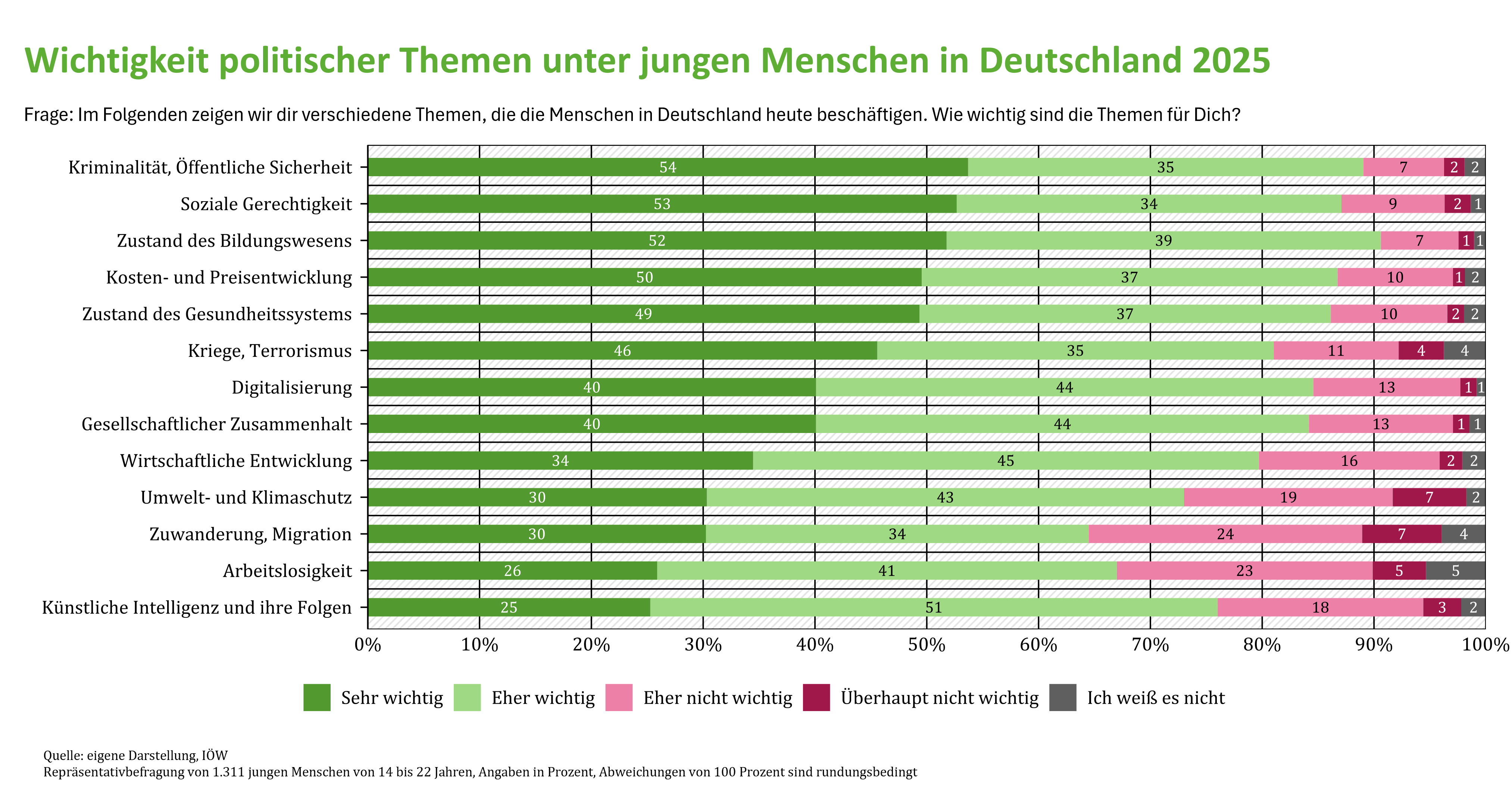
Environmental and climate protection is an important issue for 73 per cent of respondents, according to the latest youth survey by the Federal Environment Agency. However, the proportion of young people who rate the issue as “very important” has fallen from 50 per cent to 30 per cent since 2021. Furthermore, it is given lower priority compared with other political issues. The top issues for young people are crime and public safety (rated ‘very important’ by 54 per cent) and social justice (rated ‘very important’ by 53 per cent). In light of the various social crises, environmental and climate protection appears to be taking a further back seat.
The outlook for the future of the environment and climate is similarly negative to previous years, with 69 per cent of respondents feeling pessimistic. Meanwhile, 73 per cent of young people now view Germany’s social future with pessimism, compared with 54 per cent in 2021. The outlook for their personal future has also become more negative. Although only 30 per cent are pessimistic in this regard, this represents an increase of 11 percentage points compared with 2021.
Young people’s political interest is high overall. 88 per cent of those surveyed consider it very important to live in a democracy, and 69 per cent think it is a good thing that the European Union exists. At the same time, 78 per cent of young people criticise the fact that social inequalities in Germany are too great.
With regard to satisfaction with key players in relation to environmental and climate protection, it is clear that only 26 per cent of respondents believe the German government is doing enough – 69 per cent believe it is not doing enough. The situation is similar when it comes to industry and business, as well as to individuals: only 30 per cent consider the commitment of both groups to be sufficient. Seventy per cent of those surveyed would like to see greater political attention paid to young people’s demands on climate issues.
Sustainable consumption, such as buying organic food or fairly produced goods, is part of everyday life for many respondents. Many young people are also actively involved in civil society to promote environmental and climate protection, for example by supporting online petitions or taking part in demonstrations. However, when compared over time, sustainable everyday behaviour and engagement with environmental and climate issues have, in some respects, been on the decline since 2021.
In the study series “Future? Ask Young People!”, young people aged between 14 and 22 have been surveyed every two years since 2017 on their environmental awareness, attitudes towards the environment and expectations of politicians. The latest representative survey took place in December 2025 and involved 1,311 people aged between 14 and 22. It was conducted as a supplementary survey as part of the 2026 Environmental Awareness Study and was carried out by the Institute for Ecological Economic Research (IÖW) in cooperation with Verian on behalf of the Federal Environment Agency.
Associated content