The German Environment Agency (UBA) is launching umwelt.info, a new internet portal where the public can easily access information and data on the environment and nature conservation. In future, all publicly available information and data relating to environmental protection and nature conservation in Germany will be available here.
Supermarkets play a key role when it comes to making our food system more sustainable and environmentally friendly. A new study commissioned by the UBA has investigated how sustainable the German food retail sector actually is. The new UBA scrollytelling “Breams – the trend setters” shows the work of the Environmental Specimen Bank and how fish can be used to understand the pollution of our environment.
We hope you find it an interesting read
The Press Office of the German Environment Agency
Digital milestone in environmental protection and nature conservation – the new umwelt.info portal
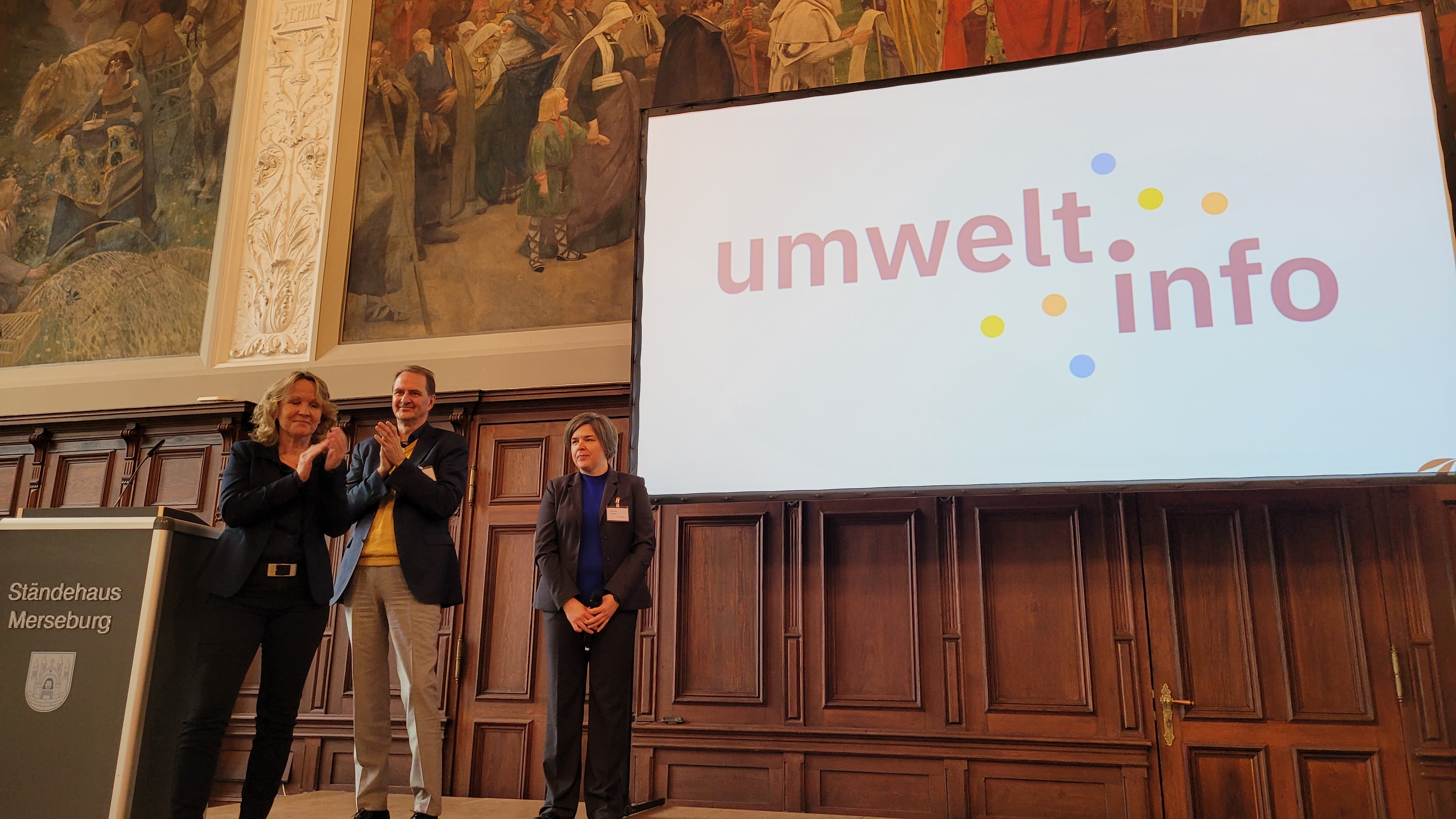
Federal Environment Minister Steffi Lemke, UBA President Dirk Messner and Anja Reineke - umwelt.info
Federal Environment Minister Steffi Lemke, UBA President Dirk Messner and Anja Reineke, Head of umwelt.info at UBA, at the official launch of the umwelt.info portal on January 27, 2025 in the Ständehaus Merseburg.
Source: Martin Stallmann / Umweltbundesamt
Nowadays, it is still difficult to find environmental information. Data and facts on topics like forests, soils and water bodies are distributed across various sources and with varying quality. Public access to reliable and recent data is of crucial importance in an increasingly digitalized word. This fundamental access is also an important basis for a sustainable development.
From now on, environmental information should be easier to find for citizens, students, researchers, members of administration and companies. The portal umwelt.info was launched on 27 January 2025 by the national centre for environmental and nature conservation information located at the UBA. For the first time, data on environmental protection and nature conservation from all over Germany will be centrally available and accessible. The portal umwelt.info offers relevant nature and environmental information for experts and non-experts alike.
Furthermore, the portal offers a wide range of functions. The main function is a search engine, which searches only indexed data sources based on their metadata. In the future, all publicly available information and data on nature and environmental protection can be found on umwelt.info. The origins of each data set are displayed prominently, as well as for example how the data may be used. This user-friendly design aims to create an easy access to existing information.
The portal umwelt.info thus enables the further usage of available information and data on environmental and nature conservation for various fields of application. Furthermore, target group-specific presented editorial content amplifies the broad focus of the portal.
Revenue from European and national emissions trading in Germany totalled around 18.5 billion euros in 2024. This means that proceeds from these two key climate protection instruments was once again slightly higher than in the previous year.
In 2023, greenhouse gas emissions in Germany fell by 10.3 per cent compared to 2022. This is shown by the results of the calculations submitted by the German Environment Agency (UBA) to the European Commission on 15 January 2025.
New German adaptation strategy to strengthen climate resilience
With the German Strategy for Adaptation to Climate Change 2024 (DAS 2024), the German Federal Government is for the first time adopting measurable targets to make infrastructure, buildings, agriculture and forestry and other sectors climate resilient. In future, progress in achieving the targets will be measured in the DAS monitoring system at the UBA. read more (in German)
Distributing the electricity grid costs of the energy transition fairly
With the German Strategy for Adaptation to Climate Change 2024 (DAS 2024), the German Federal Government is for the first time adopting measurable targets to make infrastructure, buildings, agriculture and forestry and other sectors climate resilient. In future, progress in achieving the targets will be measured in the DAS monitoring system at the UBA. read more aElectricity customers in regions that are contributing particularly strongly to the expansion of renewable energies in Germany should not at the same time be burdened by high costs for the expansion of the distribution grid. The Federal Network Agency has already achieved a partial harmonisation; a short study commissioned by the UBA also proposes uniform grid fees across Germany. read more (in German)
Health
ALISE: German Study on Environmental Health among Children and Young People
The ALISE (Aligned Study for Environmental Health) study is the German contribution to the European research project PARC and analyses the exposure of children and young people in Germany to pollutants from the environment. In PARC, data from 20 European countries is being analysed to determine the chemical exposure of the population in Europe and to advise policy makers. read more (in German)
Chemicals
Technical solutions to reduce the environmental impact of biocides
Insecticides or green deposit removers are frequently sprayed outdoors. The extent to which the chemicals are carried by drift into areas that should not actually be treated depends in particular on the equipment used. The right choice of equipment can reduce the impact on the environment and make the use of products more effective.read more (In Geman)
Improving the disposal of medicines
The pollution of the environment by medicinal products is a growing problem. Environmentally responsible disposal helps to reduce their entry into the environment. The new internet portal “Human Medicinal Products and the Environment” provides information and recommendations for pharmaceutical and medical professionals and consumers, as well as teaching materials for continuing medical/pharmaceutical education. read more (in German)
Poster: Correct disposal of old medicines
To protect people and the environment, it is important to dispose of medicines that are no longer needed and have expired in an environmentally friendly manner. Different disposal methods are recommended in German districts and towns. This poster offers the opportunity to quickly add the correct regional disposal information by hand and display it on site for information purposes. read more (in german)
Transport
More active mobility at schools made easy
More movement instead of traffic jams in the parents' taxi: The “Walking- and cycling-friendly schools” project organised by Verkehrsclub Deutschland (VCD) shows how the independent mobility of children and young people can be strengthened. Over 1150 participants have been reached at 44 events throughout Germany. The publications accompanying the project show how active mobility can be promoted in and around schools. read more (in German)
The transport of passengers and freight generates greenhouse gases (GHG) – not only through the actual transport activities, but also as a result of the processes at the individual locations or through services. On behalf of the UBA, a guideline has been produced which provides information for the standardised calculation and reporting of GHG emissions along transport chains.
Mobility Lab 2025 - Mobility in small and medium-sized towns
The German Environment Agency has commissioned the nexus Institute to work with local people in Niesky, in Saxony, and Gotha, in Thuringia, to investigate how mobility in small and medium-sized towns can be designed in a sustainable and future-oriented way. Citizen participation is helping to work out what is needed for attractive mobility that is geared towards the needs of citizens. read more (in German)
EMW online seminar on the EMW annual theme 2025 “Mobility for All”
The National Coordination Office of European Mobility Week (EMW) at the German Environment Agency is inviting interested municipalities and other EMW stakeholders to the third EMW online seminar this year on 25 March 2025. This time, the virtual meeting will focus on the official annual theme of this year's EMW “Mobility for All”. read more (in German)
Sustainability in supermarkets has many facets. It ranges from resource-conserving food production and environmentally friendly packaging to the avoidance of food waste.
Terminology and definitions as a basis for the derivation of possible ecodesign requirements
In connection with the planned implementation of the EU Textile Strategy, the aim of the project was to identify relevant terms relating to aspects of the material efficiency of clothing textiles and, if necessary, to specify them. These terms are to be used as a basis for the derivation of possible Ecodesign requirements.
Texte
79
Reusable quota for beverages far from legal target
In the current reporting year 2022, the reusable quota of 33.5 per cent continued to fall well short of the legal target of 70 per cent. Since 2022, the mandatory deposit has applied to almost all beverage segments, which is having an impact on the annual survey of the proportion of beverages in reusable packaging. read more (in German)
Der Trend ist positiv. Insgesamt wurden von den dualen Systemen 2023 im Vergleich zum Vorjahr mehr Verpackungen recycelt. Das gaben das Umweltbundesamt (UBA) und die Zentrale Stelle Verpackungsregister (ZSVR) am 21. Januar 2025 auf einer gemeinsamen Pressekonferenz bekannt. Die strikte Mülltrennung ist die zentrale Voraussetzung, um das Recycling weiter auszubauen.
Water
German nationwide water data with the UBA app
The quality of our water bodies plays a key role for the environment, human health and quality of life. In Germany, extensive data on the condition of water bodies is collected by various authorities at federal and state level. For many people, access to this information is not always easy to find. The “Water Compass” makes this easier. read more (in German)
New scrollytelling: Breams – the trend setters
How clean are Germany's rivers? The UBA scrollytelling “Breams – the trend setters” shows the work of the Environmental Specimen Bank and how fish can contribute to understanding pollution. For decades, the Environmental Specimen Bank has been analysing bream from German waters for environmental toxins and thus supporting the protection of people and nature. read more (in German)
Soil / Land
Soil as a carbon store and carbon sink
Soils contain huge reserves of organic carbon. Under the influence of climate change and unsustainable land use, this can increasingly be released into the atmosphere as carbon dioxide (CO2). This must be prevented. The Soil Protection Commission at the UBA (KBU) has now published recommendations on this topic. read more (in German)
Digitalisation
SIEC: Visualising the unnecessary energy consumption of servers
A “Server Idle Energy Coefficient” (SIEC) is currently being developed in a UBA research project. SIEC focuses on the servers in the data centre. The aim is to develop and establish a key figure that can be used to recognise and prevent or reduce unnecessary energy consumption by servers with low workloads. read more (in German)
UBA news
Climate protection you can touch: Win the “climate scale” hands-on tool
Climate protection in everyday life – what's important? The climate scale, the new hands-on tool from the Competence Centre for Sustainable Consumption (KNK) and the German Environment Agency (UBA), provides an answer to this question and makes abstract climate protection knowledge tangible – whether at information stands, in workshops or in schools. The climate scale is available now. There are also ten complete sets of 35 containers to be won. read more (in German)