
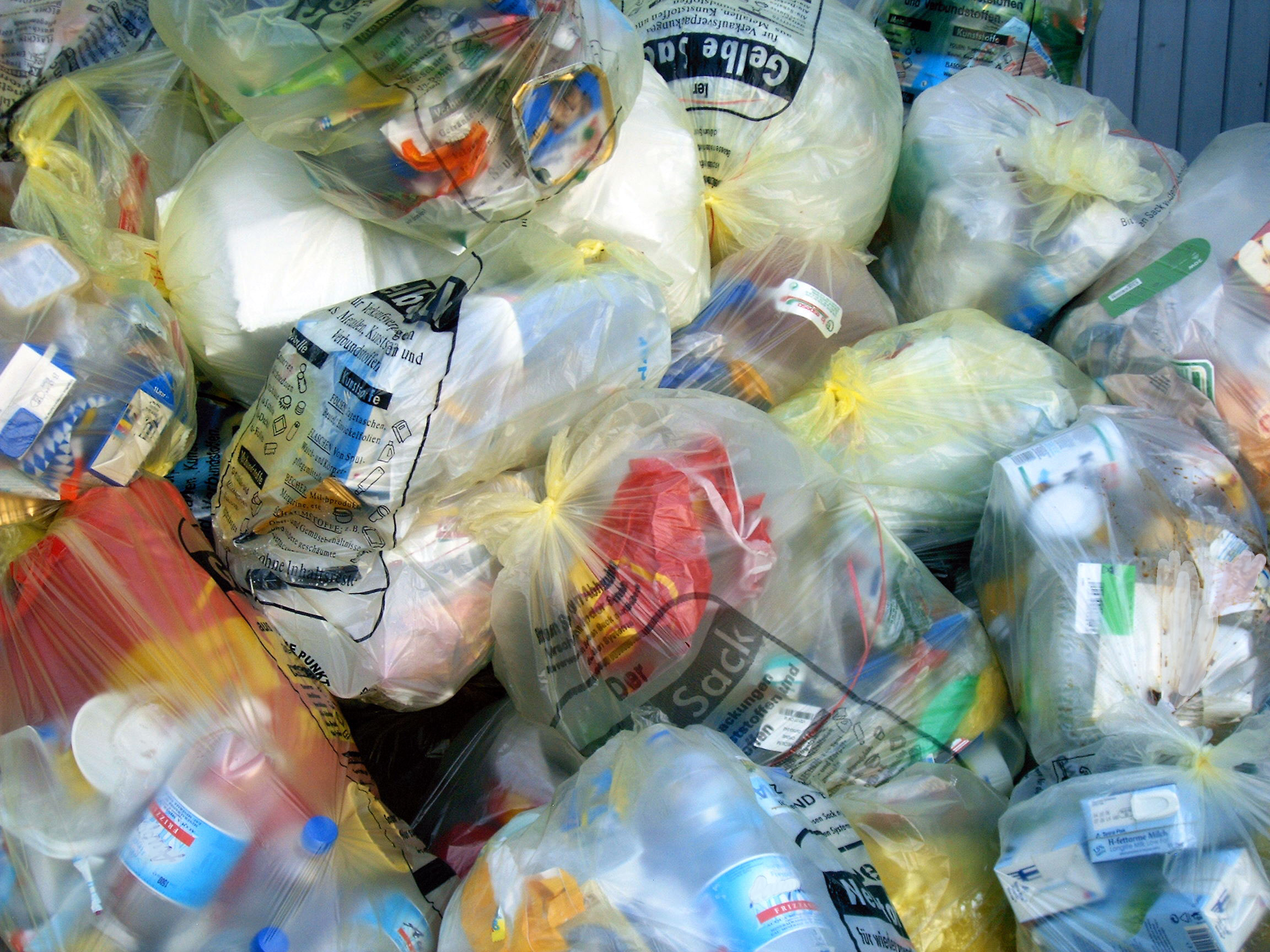
Packaging in Germany
16,6 million tons of packaging waste were generated in Germany in 2012 alone; this figure breaks down as follows for the various types of packaging: paper and cardboard: 7.3 million tons; plastic and glass: 2.8 million tons each; wood: 2.7 million tons.
Recycling
Just as there are many different kinds of packaging, there are also many ways to recycle it. For example, virtually all light packaging is placed in yellow bags or containers by consumers themselves. This waste is collected by companies (under the statutory “dual systems”) and brought to sorting facilities, where the packaging is sorted for recycling according to type, as follows: tinplate, aluminum, beverage containers, and the various types of plastic (PE, PP, PET, PS). Mixed plastic waste is to some extent further processed for material or energy recovery. Residuals from sorting get incinerated with recovery of energy.
Certain types of packaging require a return deposit, whereby reusable beverage containers remain in circulation until the bottling company retires them, e.g. because they are damaged or very worn. Via return deposits non-reuseable plastic beverage containers are extremely well recycable e.g. bottle-to-bottle or for fabric manufacturing purposes. After being collected in containers glass, jars and bottles are melted down to make new jars and bottles.
Transport packaging such as palettes, boxes and barrels are often reused and recirculated. If they are damaged, in the interest of ensuring safe transport they are either repaired or recycled.
Legal framework
Packaging allows products to be transported safely from point A to point B (transport packaging) and contains goods that the packaging protects (sales packaging). Partly packaging is not necessarily needed, but used for product display purposes (secondary packaging, e.g. folded boxes around toothpaste tubes or perfume bottles). Both, the manufacturing and the transport of such packaging, cause environmental pollution.
In the interest of stemming the rising tide of packaging, Germany enacted the Packaging Ordinance (Verpackungsverordnung) in 1991, and in 1994, the EU adopted the Packaging Directive. The German regulation was harmonized with the EU directive by an enactment of a new version of the packaging ordinance in 1998. Since then, the Packaging Ordinance has been amended seven times in order to harmonize it with changes in the EU law and to adapt it to current requirements.
The Packaging Ordinance was Germany’s first law to assign the task of waste management of packaging and packaging product stewardship to packaging producers. Since recycling rates were no longer ambitious and considerable problems regarding a fair and transparent competition remained, the Packaging Ordinance needed to be replaced. On 1 January 2019, the Packaging Act (Verpackungsgesetz – VerpackG) entered into force, replacing the Packaging Ordinance. It contains new, more ambitious recycling rates and further important regulations for a more transparent and fairer economic competition. Like before, for sales packaging and repackaging typically accumulating with private consumers, packaging producers and distributors have to participate financially in one or several schemes (Duale Systeme) to ensure the collection and recovery of the packaging on full-coverage basis. Now, those producers also have to register with the Central Agency Packaging Register (Stiftung Zentrale Stelle Verpackungsregister) before they place packaging on the market. In order to provide transparency about the full-coverage participation in a dual system, the producers and the dual systems have to report to the Central Agency Packaging Register the packaging masses, materials, participation periods and company names. In case of violations of the law, the federal states may impose administrative fines.
