Skip to main content Skip to main menu Skip to footer

Indicator: Organic farming

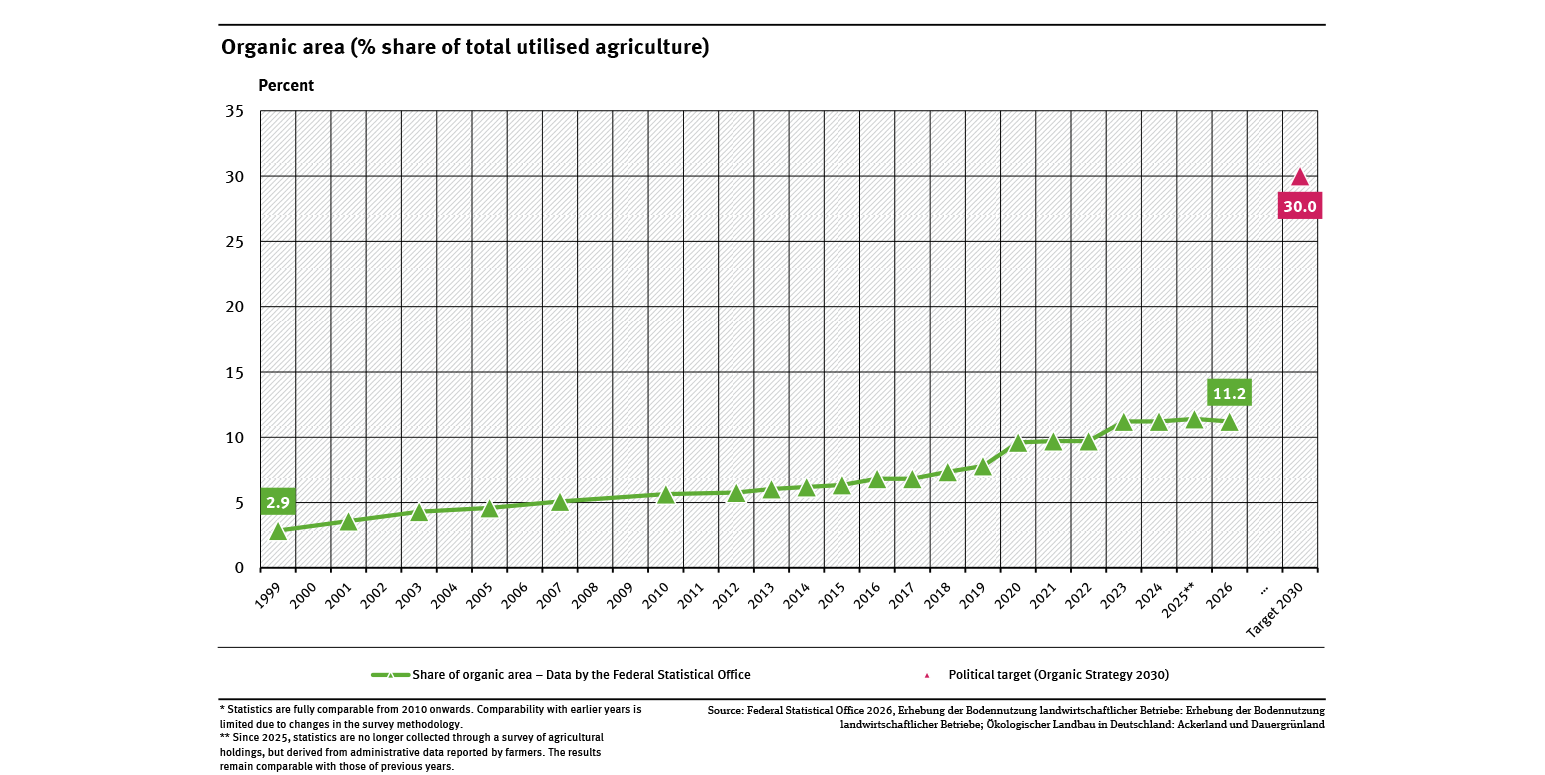
A graph shows the increase in the share of organic area within Germany’s total utilised agricultural land, based on data from the Federal Statistical Office and the BMLEH. It also shows the 30 percent target of the German Sustainable Development Strategy.
Organic area (% share of total utilised agriculture)
Source: Federal Statistical Office of Germany

Table of contents

At a glance

  • According to the German Federal Statistical Office, the share of organic area within Germany’s total utilised agricultural land increased from 2.9 % to 11.4 % from 1999 to 2025.
  • The German Sustainable Development Strategy aims to increase the share of organically farmed land to 30 % by 2030.
  • Based on the growth rate of recent years, this target is not expected to be achieved.

Environmental importance

Organic farming is a sustainable form of agricultural management that is beneficial to the environment. The aim is to achieve nutrient cycles that are as closed as possible and to operate in harmony with nature.

Organic farming avoids the use of mineral nitrogen fertilisers and relies on more diverse and extended crop rotations (including intermediate crops and perennial crops). In addition, avoiding synthetic pesticides enhances biodiversity on agricultural land. Livestock are kept under species-specific conditions, thereby promoting animal welfare and public acceptance. Organic agriculture therefore plays a pioneering role in promoting sustainable land management.

Assessing the development

The share of organic area increased from 2.9 % to 11.4 % between 1999 and 2025, showing a slight but steady increase during the reporting period. The German Sustainable Development Strategy has set a target of increasing the share of organic area to 30 % of the total agricultural land by 2030. This new target is set out in the 2022 Indicators Report (in German only). However, Germany is still a long way from achieving this target: even if the organic area continued to grow at the rate seen in previous years, the target would not be reached by 2030. It is therefore important to identify factors hindering the growth of organic farming and to take effective measures to overcome them. Planning certainty and ongoing financial support are needed to increase farmers’ willingness to make a permanent switch to organic farming. Through its Organic Strategy 2030, the Federal Government has formulated measures aimed at providing the conditions necessary to achieve this target.

Methodology

The German Federal Statistical Office conducts the so-called main survey of land use (Bodennutzungshaupterhebung) to determine the area under organic farming at national and Länder levels. The survey includes information on the organic area managed by farms with an acreage of more than five hectares and that are subject to the control procedure of EU legislation on organic farming. To calculate the share of organic area, this data is compared to the total utilised agricultural land in Germany, which is also assessed from farms greater than five hectares.

More detailed information: ‘Ökologischer Landbau‘ (in German only).

Tags

Short link: https://www.uba.de/n16560en