
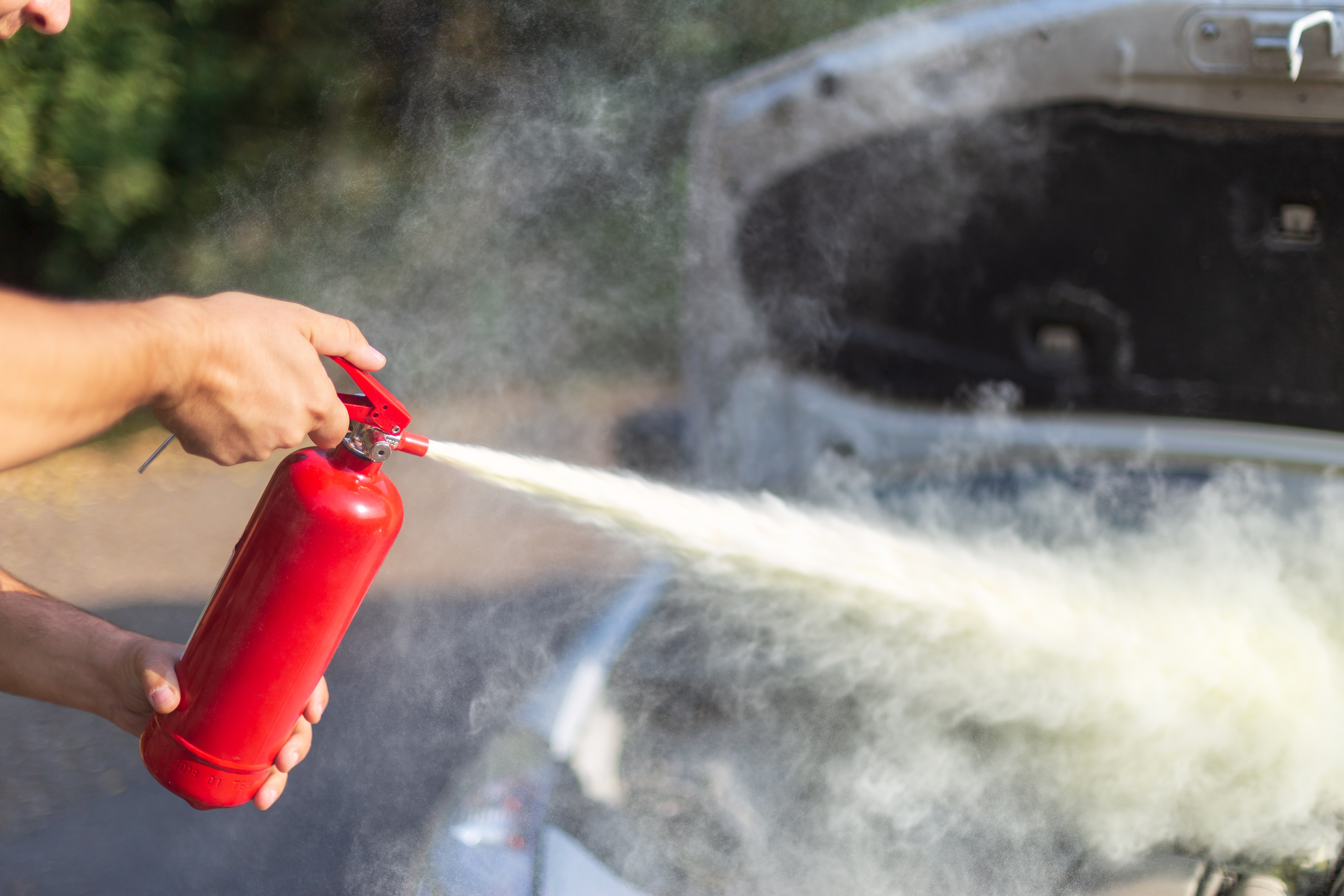
Poly- and perfluorinated alkyl substances in firefighting foams – a problem for human and the environment
Firefighting foams containing PFAS are frequently used to successfully combat fires, particularly Class B fires (fires involving flammable liquids). Whilst the benefits of these foams are undisputed, they are accompanied by the long-term consequences for human health and the environment:
- PFAS in firefighting foams are extremely persistent. When AFFF (aqueous film-forming foam) seeps into the ground, the soil becomes contaminated with PFAS. Over time, PFAS migrate into the underlying groundwater. It can take weeks to decades before these persistent substances become detectable in the groundwater. Cleaning up the groundwater and excavating the contaminated soil are complex and costly processes.
- The use of AFFF firefighting foams has already led to the closure of drinking water wells. Some lakes have already had to be closed due to increased PFAS levels, and the consumption of fish from such lakes has already been prohibited by the authorities. One example of this is Lake Lambertus, near Düsseldorf Airport.
- According to a survey in North Rhine-Westphalia, PFAS contamination in soil and groundwater in almost two-thirds of known cases of damage can be attributed to the use of firefighting foams containing PFAS.
To reduce the environmental risks posed by PFAS-containing firefighting foams, the German Environment Agency recommends the following guidelines:
- Replace PFAS-containing firefighting foams with effective fluorine-free alternatives or alternative techniques.
Where this is not possible, the following applies: - Avoid firefighting foams containing PFAS, i.e. limit the use of fluorinated firefighting foams to fires where no effective alternatives yet exist.
Where their use is unavoidable, the following applies: - Collect contaminated water and dispose of it properly.
What are the limit values for PFAS in firefighting foams?
Perfluorooctanoic acid (PFOA), its salts and PFOA-related compounds (e.g. compounds that can degrade to PFOA) have been included in Annex A of the POP Regulation 2019/1021, subject to a number of temporary exemptions. The limit values are a maximum of 0.025 mg/kg for PFOA or its salts and a maximum of 1 mg/kg for PFOA-related compounds. Firefighting foam intended for use on Class B fires, which was already filled into the system before 4 July 2020, may contain concentrations of PFOA or its salts of no more than 1 mg/kg and concentrations of PFOA-related compounds of no more than 10 mg/kg until 3 August 2028. Firefighting equipment that has been cleaned in accordance with best available techniques and filled with a fluorine-free firefighting foam may contain no more than 10 mg/kg of the total of all PFOA compounds.
Perfluorocarboxylic acids with nine to fourteen carbon atoms (C9–C14 PFCAs), their salts and C9–C14 PFCA-related substances must no longer be manufactured or placed on the market. If they are used as a component of another substance, in a mixture or in an article, limit values of 0.025 mg/kg apply to the sum of C9–C14 PFCAs and their salts, and 0.26 mg/kg to the sum of C9–C14 -PFCA-related substances.
Perfluorohexanesulfonic acid (PFHxS), its salts and PFHxS-related compounds may be present as unintentional trace impurities in concentrated firefighting foam mixtures at a maximum concentration of 0.1 mg/kg.
Perfluorooctanesulfonic acid (PFOS), its salts and PFOS-related compounds may be present as unintentional trace compounds at a maximum of 0.025 mg/kg, and PFOS-related compounds at a maximum of 1 mg/kg.
Perfluorohexanoic acid (PFHxA), its salts and PFHxA-related compounds may no longer be placed on the market or used in certain areas (e.g. in consumer textiles, cosmetics, food contact material, some firefighting foam applications) at concentrations of 0.025 mg/kg or more for the sum of PFHxA and its salts, or 1 mg/kg or more for the sum of PFHxA-related compounds. This includes the use of firefighting foams and firefighting foam concentrates for training and testing purposes (excluding functional tests where releases are contained) and for public fire services (excluding fires at Seveso III establishments). From 10 October 2029, the limit values will also apply to firefighting foams and firefighting foam concentrates used in civil aviation (including civil airports).
To prevent the substitution of PFAS present in firefighting foams with similarly harmful PFAS, the European Chemicals Agency has drawn up a proposal to restrict all firefighting foams containing PFAS. The restriction came into force in October 2025 (Entry 82, Annex XVII of the REACH Regulation) and regulates all uses of PFAS-containing firefighting foams that were not already covered by other restrictions. Following transitional periods, firefighting foams with a total PFAS concentration of at least 1 mg/L may neither be placed on the market nor used. The transitional periods vary between one and ten years, depending on the use and sector. In addition, from 23 October 2026, requirements will apply to the use of these firefighting foams (e.g. a management plan specific to the site of use or the labelling of firefighting foams containing a PFAS concentration of at least 1 mg/L).
When should PFAS-containing firefighting foams never be used?
PFAS-containing foams should never be used during training exercises. Special PFAS-free training foams are available on the market for practising in the event of an emergency.
PFAS are used in firefighting foams to create a thin, heat-resistant film of water on the surface of the fire. However, this water film cannot be formed in all types of fire. For this reason, there are various areas of application in which conventional protein-based or multi-purpose foaming agents are successfully used for firefighting, e.g.
- for Class A fires, paper storage facilities, wood-processing and textile industries;
- for fires involving end-of-life tyres, heating oil, domestic waste landfills, waste sorting or incineration plants;
- where there is experience or evidence of effective firefighting using these foaming agents;
- where fixed installations are designed for this purpose or the fire safety plan provides for it
Furthermore, various fluorine-free products have been available on the market for some time now; these have been tested in accordance with industry standards and can be used in fire situations where PFAS-containing firefighting foams were previously used. Accordingly, it is very important to assess whether fluorinated firefighting foams are the appropriate choice in terms of performance and environmental risk in the event of a fire, or whether fluorine-free firefighting foams are the better alternative.
What should be taken into account if the use of PFAS-containing firefighting foams is unavoidable?
The first step is to assess whether PFAS-containing firefighting foams are necessary for successful firefighting. For certain applications, conventional protein-based or multi-purpose foaming agents can be used successfully. Awareness amongst those responsible needs to be further improved in this regard. The use of PFAS-containing firefighting foams should be avoided during trainings and tests. However, if the use of PFAS-containing firefighting foams is unavoidable, care must be taken to ensure proper disposal. In plants and stationary industrial facilities, suitable extinguishing water retention systems must be provided and used. In mobile applications, extinguishing water must, as far as possible, be contained, collected and disposed of. In cases of doubt, the necessary measures must be agreed with the relevant environmental authorities.
Why is the use of PFAS-containing firefighting foams such a cause for environmental concern?
When PFAS-containing firefighting foams are used in an uncontrolled manner, PFAS enter surface water or, through seepage into the soil, reach groundwater. PFAS can also enter groundwater via bank filtration (through the riverbed and riverbanks) from contaminated water bodies. Neither biotic processes (bacteria) nor abiotic processes (water, air, light) can contribute to the degradation of PFAS. Consequently, these chemicals persist in the environment for a very long time and are distributed globally via rivers, oceans and the air. Further information on the properties of concern associated with PFAS.