There is a need to improve the quality of the air in many towns and cities in Germany. In this respect, bringing measurement processes that are specified throughout Europe into doubt doesn't help – emissions of airborne pollutants must be reduced. The topic of this newsletter is the importance of this for our health. Road traffic was also the focus of our 2017 greenhouse gas balance: emissions of climate-damaging gases in the transport sector increased once again, and more cars, lorries and HGVs travelled on German roads than they did in the year before. A transport revolution is urgently necessary, especially in towns and cities. This is also the topic of our “kommunal mobil 2018” conference (2018 Municipal Mobility conference), which we wish to present in this newsletter.
Wishing you informative reading
The UBA press office
Air Quality: Nitrogen dioxide presents a serious health threat
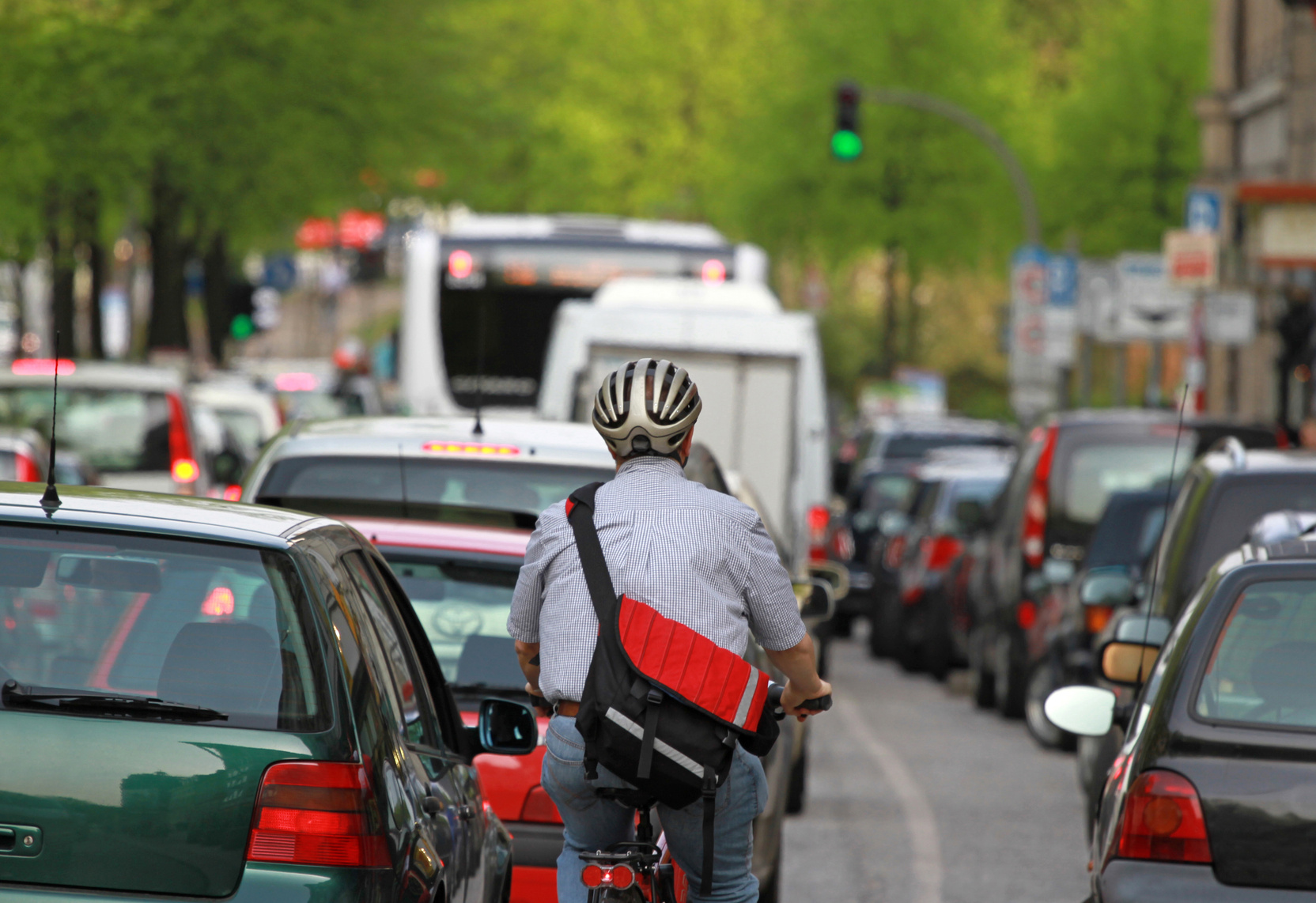
Diesel cars are a significant source of nitrogen dioxide.
Source: Kara / Fotolia.com
In many towns and cities in Germany, concentrations of nitrogen dioxide in ambient air are excessively high. This topic has gained considerable attention following the ruling of the German Federal Administrative Court in February 2018, which permits city councils and municipalities to impose bans on diesel powered personal vehicles in order to comply with the EU air quality limit values. A recent study commissioned by the UBA confirms that the current nitrogen dioxide concentrations are associated with adverse health effects: in this respect, according to the statistical assessment for the year 2014, about 6,000 premature deaths, or expressed otherwise, about 50,000 years of life are lost due to premature mortality caused by cardiovascular diseases which are attributable to nitrogen dioxide exposure. In addition to this, an association with diseases such as diabetes, high blood pressure, stroke, chronic obstructive pulmonary disease and asthma was identified in a systematic literature search. In 2014, approximately 14 percent of all asthma cases could be attributed to nitrogen dioxide.
The results of the study were questioned by the media, particularly in the context of the debate about diesel driving bans. Despite the critiques and the well-known and transparently presented limitations of the study, we can still confirm that the results are scientifically plausible. The applied method for calculating the burden of disease attributable to environmental factors was developed by the World Health Organization (WHO) and is used by several scientific institutions. The underlying epidemiological studies take into account so-called confounders, such as smoking and obesity, in the mathematical models, which can, of course, also contribute to the development of diseases or premature deaths. These risks may cause a greater burden to health than nitrogen dioxide in ambient air, although they are in the responsibility of each individual. The task of environmental policy is to protect the population against the health risks posed by air pollution – after all, everyone breathes air and our air should be healthy and clean for everyone, from the baby to the asthmatic patient who already suffers from respiratory problems. Therefore, the goal must be to finally achieve compliance with the EU air quality limit values for nitrogen dioxide – which have been in force for eight years – in every town and city in Germany.
Survey: Use now for superior products and consumer information
The EU is revising the requirements surrounding product configuration and information for several groups of products. For this purpose, the EU Commission has initiated a public consultation to gather your opinion on questions surrounding refrigerators, dishwashers, washing machines, TV sets, computers and lights. The online survey is available for you to complete until 7th May 2018. online survey
A research report commissioned by the UBA has analysed a range of options for designing the EU Innovation Fund (IF), a financing instrument created under the EU Emissions Trading System to support demonstration projects for low-carbon innovation in the power sector and industry. From 2019 onwards, this fund will use revenues from auctioning emissions trading allowances for this purpose.
Measuring the environmental performance of data processing centres
Apps, the internet, hardware and software: all rely on data processing centres to work. What is the environmental performance of the data processing centres in Germany like, however? The UBA has presented a method which enables the energy and resource efficiency of a data processing centre to be assessed for the first time. read more (in German)
The stationary installations in Germany that take part in the emissions trading system emitted around 438 million tonnes of carbon dioxide equivalents.
UBA brochure: Environment and Agriculture
At least half of the land in Germany is used for agricultural purposes. This means that agriculture is the biggest single user of land in Germany and a key source of environmental pollution – although it is also affected by the consequences of climate change, for instance. In its “Umwelt und Landwirtschaft 2018” (Environment and Agriculture 2018) brochure, the UBA has collated facts on the agricultural sector. read more (in German)
New waste sorting system to increase the recycling levels of plastic
Although waste packaging is collected separately in Germany, it remains a mix of a variety of plastics and metals. With the help of the Environmental Innovation Programme in Gernsheim, Hesse, a waste sorting system has been created which uses superior sorting technology so that more plastic packaging can be recycled into new products in the future rather than incinerated for the purpose of power generation. read more (in German)
Glass production to become more resource-efficient
Used glass has been recycled into new glass products for many years in Germany. Until now, however, the fine grains of waste glass that arise during the recycling process have been sent to landfill sites. With the support of the Environmental Innovation Programme, this is set to change. read more (in German)
Blue Angel label for air conditioning systems
Air conditioning systems aren't just responsible for high greenhouse gas emissions because they use a lot of electricity: the refrigerants that they use also have a negative impact on our climate. A manufacturer of an especially environmentally friendly system has now been awarded the Blue Angel label. read more (in German)
Environment at municipal level
2018 Municipal Mobility Conference
“Rethinking streets and public squares – shaping the transport revolution together”: such is the theme of this year’s (the sixth) Municipal Mobility conference of the UBA and the Deutsches Institut für Urbanistik (German Institute for Urban Studies). It is taking place on 7th and 8th June 2018 at the UBA Dessau-Roßlau with the collaboration of the Deutscher Städtetag (Association of German Cities). read more (in German)
The use of treated wastewater, e.g. for agricultural irrigation, can alleviate pressures on water resources. At the same time it poses risks as treated wastewater can contain pathogens and chemicals. By May 2018 the European Commission wants to publish a regulatory proposal for requirements. UBA President Krautzberger and EU Parliamentarian Wölken invited for a discussion on 22 March in Brussels.
Neonicotinoids: Risk to bees confirmed
When used outdoors, the application of the insecticides Imidacloprid, Clothianidin and Thiamethoxam as granulates and seed treatment products has been found to be harmful to wild bees and bumblebees. This was confirmed by the European Food Safety Authority (EFSA) in its risk assessment dating from 28.02.2018. Applications with sugar beet and winter cereals that remain approved have also been classified as harmful. read more (in German)
REACH candidates list extended, change for Bisphenol A
On 15.1.2018, the European Chemicals Agency (ECHA) added seven substances of very high concern to its REACH candidates list and updated its entry for Bisphenol A (BPA). In addition to its reproductive toxicity, BPA is now considered to be a substance of very high concern due to its harmful impact on the hormone systems of people and environmental organisms. read more (in German)
Law & legislation
UBA study: The superior implementation of environmental law
The sound implementation of environmental law is indispensable for its effectiveness. The support that those responsible for the implementation of environmental law aspire to receive has been demonstrated in a study that was completed on behalf of the UBA: they don't necessarily want to see changes to the law, but in addition to the sufficient equipment, they also want a superior level of exchange and cooperation between the authorities as well as superior information for implementing authorities, the operators of systems and the general public. read more (in German)
Report: Land tax reform can reduce the use of land
Plots suitable for development in inner city areas often lie empty because of speculation surrounding increasing land prices. This increases the pressure to build on areas outside built-up areas. According to a report, if the land tax were reformed so that it was aligned to the value of the land only, this would provide an incentive to build on plots in higher value inner city areas more rapidly. read more (in German)
The course of these streams is often straightened, changed and deepened to drain their floodplains and make them usable for agriculture.
Water management at a glance: Information platform launched
In the form of succinct text, images and videos, the new UBA “Wasserwirtschaft in Deutschland” (Water management in Germany) information platform provides a rapid overview with compact information in text and video format. It also serves as an introduction to the brochure of the same name that contains detailed information on pollution and the state of our waterways as well as steps for protecting our waterways. read more (in German)
Your opinion matters: The state of the North Sea and the Baltic Sea
Many plant and animals and their habitats in the German waters of the North Sea and the Baltic Sea are in a poor state. The negative impact of fishing, food waste, harmful substances, rubbish and underwater noise is considerable. This was the conclusion reached by the current assessment for the EU Marine Strategy Framework Directive (MSFD). Your opinion is required: You can add your comment about the drafts until 31st August 2018. read more (in German)
Within the frame of this project, a structured system for evaluating the risks and opportunities of linking emissions trading schemes was developed. To this end, economic, ecological and political objectives for linking were identified, relations and interdependencies were investigated and assessment criteria and indicators were defined. The report also includes an overview on economic models that…
Within the project „bioassay-based test strategy to determine risk potentials of migration waters“ the German Environment Agency (UBA) and the Association for Pipe Systems Inside Buildings (VRH) had the common aim to develop a test strategy based on established bioassays. This in vitro test strategy detects cytotoxicity, genotoxicity and estrogenic like activity of migration waters.
On September 5th 2017, the expert forum "Effective reduction of food waste - achieving more together" took place in Berlin. The forum aimed to set an impulse to discuss and further develop ideas and approaches for the prevention of food waste and losses through scientific preparation and an interactive exchange with stakeholders from the entire food value chain. This report presents the status quo…
Development of an indicator based on land use changes and soil values
Given that land and soils are increasingly threatened by degradation, this project investigated how SDG target 15.3, which strives to achieve a land degradation neutral world by 2030, can be implemented. The report suggests necessary steps towards the implementation of Land Degradation Neutrality (LDN) at the national level, gives an overview of land and soil degradation and existing monitoring…
Der zunehmende Einsatz von Klimageräten ist mit negativen Auswirkungen auf die Umwelt verbunden, insbesondere durch Beiträge zum Treibhauseffekt. Die Schaffung von Vergabekriterien für Klimageräte für das Umweltzeichen „Blauer Engel“ soll dazu beitragen, die Verbreitung von umweltfreundlichen Klimageräten mit natürlichen Kältemitteln (Treibhauspotenzial = 5) zu befördern. Als Grundlage erfolgte…
Design recommendations for the successor instrument to the NER 300 in Phase 4 of the EU ETS
This report analyses a range of options for designing the EU Innovation Fund (IF), a financing instrument created under the EU Emissions Trading System (ETS) to support technological breakthrough for low-carbon innovations in the power sector and industry. The report combines a look at lessons learned from the IF’s predecessor mechanism “NER 300” with insights from the respective emission…