
Owing to their regional isolation from both other ecosystems and industrial influences, the polar regions are ideal locations for conducting environmental research and detecting chemicals. Compared to the Arctic, however, the Antarctic ecosystem is less affected by human activity. The polar regions have often been described as sinks for transported chemicals. The extent to which the low yet simultaneously rising temperatures in the polar regions influence the release and accumulation of chemicals in organisms within the Arctic and Antarctic food chains – for example, through the deposition of snow and the melting of sea ice and glaciers – is still a matter of debate.
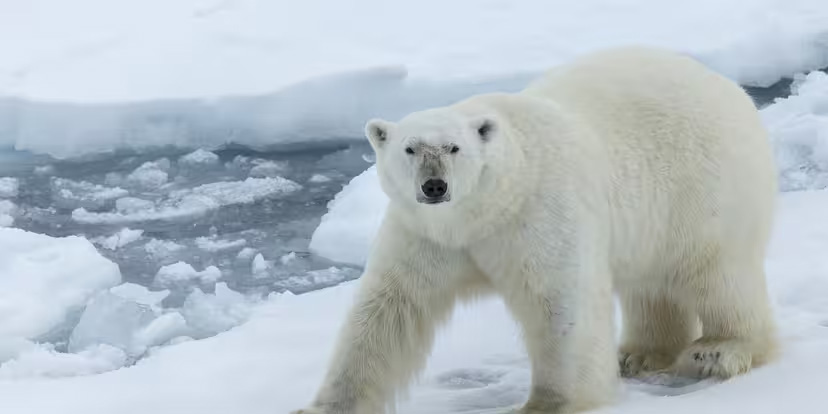
PFAS reach the polar regions over long distances – both via the oceans and through atmospheric currents. Due to their significant industrial importance, persistence, bioaccumulation and toxic effects, the intensively studied PFAS—perfluorooctane sulfonic acid (PFOS) and perfluorooctanoic acid (PFOA)—are of great interest. The presence of long-chain PFCs (C ≥ 8) – such as PFOS and PFOA – in polar ecosystems has therefore been under investigation for several decades. In 2008, PFAS were detected in human blood samples from Arctic regions, which sparked further debate. A wide range of long-chain PFAS compounds and their degradation products have since been detected in water bodies, sediments and environmental organisms – in both the Arctic and the Antarctic. Studies also report their accumulation along the polar food chains, right up to polar bears and penguins (Dietz et al. 20081, Ke Gao et al. 20202).
Short-chain PFAS developed in recent years, such as perfluorobutanoic acid (PFBA) and perfluorobutanesulfonic acid (PFBS), have now also been detected in the polar regions. In Antarctica, measurements of these substances already show a similarly widespread distribution to that observed in the Arctic. PFBA, PFBS and other short-chain PFAS have been detected in water bodies, in snow samples and also in environmental organisms – such as algae and seabirds. However, whilst the presence of short-chain PFAS in the Arctic has been documented by numerous studies (AMAP 2017), only a few studies have been conducted in Antarctica to date. In particular, there have so far been only isolated studies on their bioaccumulation in the food chain. These do, however, confirm the previous assumption that organisms at the top of the food chain, such as the giant petrel, have higher PFAS concentrations in their blood than penguin species lower down the food chain (Roscales et al. 20193). As the concentrations of newer short-chain PFAS that have been detected are already within a comparable range to those of long-chain PFAS – some of which are regulated – these require close monitoring in polar ecosystems (Casal et al. 20174).
Effective and proactive measures are needed for the polar regions to reduce the risk posed by persistent chemicals such as PFAS to the fragile ecosystems of the Arctic and Antarctic. The challenge will lie in minimising the risk posed by PFAS in conjunction with other stressors – such as rising temperatures at the poles due to climate change. Given their global prevalence, further environmentally relevant PFAS should be regulated globally through the Stockholm Convention and the Strategic Approach to International Chemicals Management (SAICM). To assess the extent of contamination, additional PFAS should be included in monitoring programmes, particularly in Antarctica. The development of environmentally friendly alternatives is also a necessary step. In addition to measures at global level, national and regional regulatory frameworks should be expanded to include the parameters ‘long-range transport via ocean and atmospheric currents’. To protect the polar regions from pollutants, Canada, for example, has already integrated the consideration of long-range atmospheric transport into its national persistence and bioaccumulation regulatory framework for chemicals.
In a recent review article, the German Federal Environment Agency has compiled all evidence of PFAS, both in the Arctic and in the Antarctic, and discussed possible courses of action and future prospects (Xie et al. 20225).
Literaturquellen:
1 Dietz R, Bossi R, Rigét F.F., Sonne C., Born E.W. (2008). Increasing perfluoroalkyl contaminants in East Greenland polar bears (Ursus maritimus): A new toxic threat to the arctic bears. Environmental Science and Technology, Volume 42, Issue 7 (1) 2701-2707.
2 Gao K., Miao X., Fu J., Chen Y., Li H., Pan W., Fu J., Zhang Q., Zhang A., Jiang G. (2020). Occurrence and trophic transfer of per- and polyfluoroalkyl substances in an Antarctic ecosystem. Environmental Pollution, Volume 257, 1-9.
3 Roscales J.L., Vicente A., Ryan P.G., Gonzales-Solis J., Jiménez B. (2019). Spatial and interspecies heterogeneity in concentrations of perfluoroalkyl substances (PAASs) in Seabirds of the Southern Ocean. Environmental Science and Technology, Volume 53, 9855-9865.
4 Casal P. Zhang Y. Martin J.W., Pizarro M., Jiménez B., Dachs J. (2017). Role of snow deposition of perfluoroalkylated substances at Coastal Livingston Island (Maritime Antarctica). Environmental Science and Technology, Volume 51, 8460-8470.
5 Zhiyong Xie, Peng Zhang, Zilan Wu, Shuang Zhang, Lijia Wei, Lijie Mi, Anette Kuester, Juergen Gandrass, Ralf Ebinghaus, Ruiqiang Yang, Zhen Wang, Wenying Mi (2022). Legacy and emerging organic contaminants in the polar regions. Science of The Total Environment, Volume 835.