Skip to main content Skip to main menu Skip to footer

Indicator: Global environmental footprint of consumption

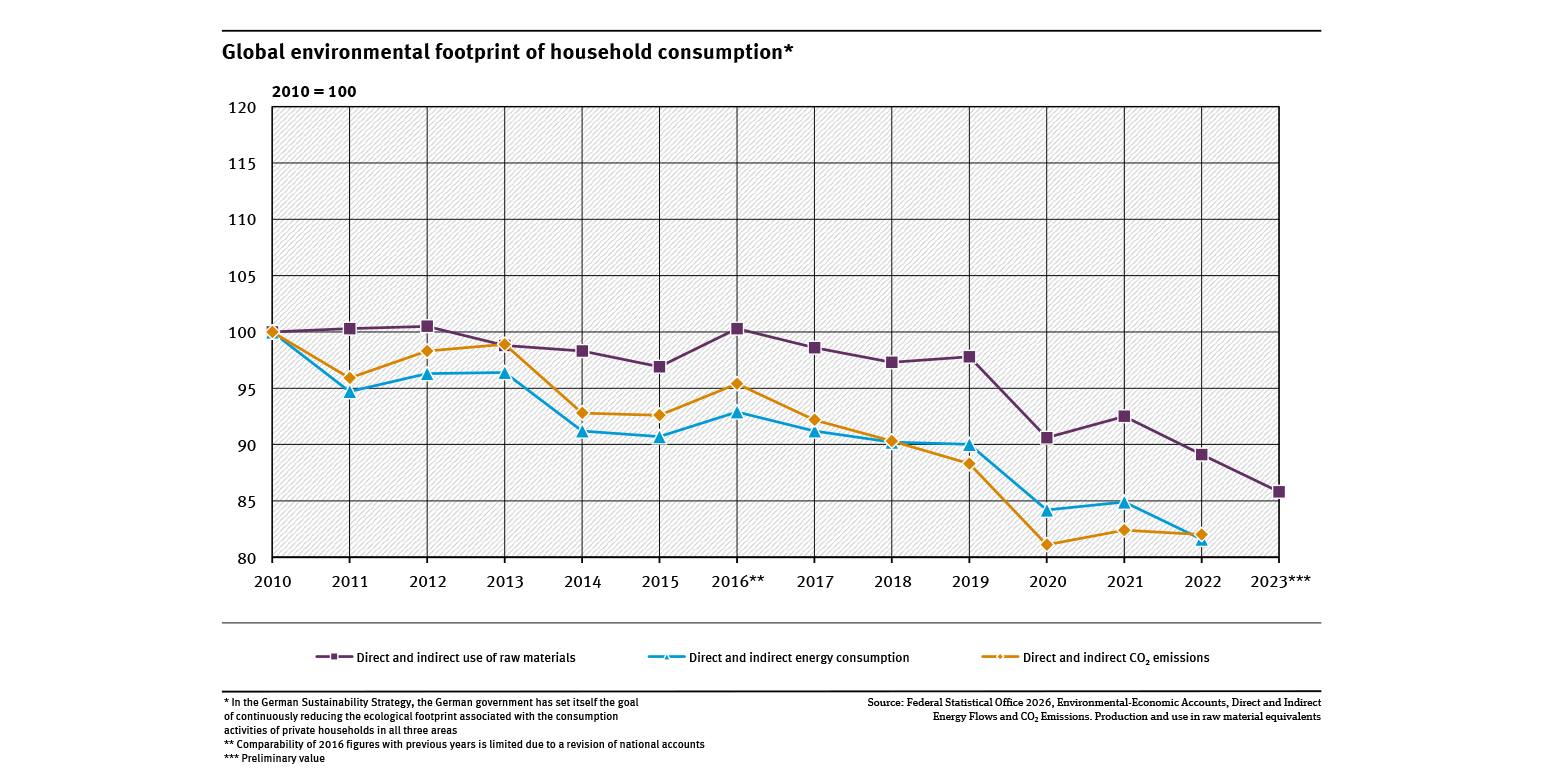
A graph shows the global environmental footprint of household consumption, represented by the indicator’s energy consumption, CO₂ emissions and raw material use. The indicators show the environmental footprint generated by the consumption activities of private households in Germany and abroad.
Global environmental footprint of household consumption
Source: Statistisches Bundesamt
Figure as PDF (155.98 kB)

Table of contents

At a glance

  • Compared with 2010, energy consumption by private households and associated carbon dioxide emissions decreased overall.
  • Raw material use decreased to 85.8 % compared to 2010.
  • In its Sustainability Strategy the German government sets the goal of reducing the global environmental footprint of private household consumption in all three areas.

Environmental importance

Through their consumption activities, private households significantly contribute to the environmental impact caused by the German economy as a whole. A distinction is made between direct and indirect use of environmental resources, as well as direct and indirect emissions.

Direct resource use or direct emissions respectively result, for example, through energy consumption within private households (e.g. heating) or are directly related with consumption activities such as when fuel is used for driving. By contrast, CO₂ emissions, energy consumption and raw material use resulting from the production of consumer goods are labelled indirect. These can either occur in Germany or abroad. For indirect CO₂ emissions and energy consumption, the terms CO₂ or energy content of consumer goods apply. A significant part of the indirect environmental impact of our consumption is generated abroad through the import of goods or so-called intermediate inputs.

In its sustainability strategy, the German government set the goal of continuously reducing the global environmental footprint of private household consumption in all three areas.

Assessing the development

Direct and indirect energy consumption by private households has declined by 16.9 % since 2010. Around 55 % of energy indirectly consumed by private households is generated during the production of goods.

There is a similar trend in CO₂ emissions. Overall, CO₂ emissions from private household consumption in 2022 were 18.0 % lower than in 2010. CO₂ emissions from private households amounted to a total of 537 million tonnes in 2022.

The use of raw materials has decreased by 14.2 % since 2010. Usage of abiotic materials (ores, fossil fuels and other minerals) has decreased by 12.1 % since 2010 and there has been a 7.1 % decrease in biomass. In total, approximately 555 million tonnes of raw materials were used for private household consumption in 2022.

A review of the three sub-indicators shows that, on average over the last six years, all three indicators have developed in the desired direction.

Methodology

Data on the global environmental footprint of private households are calculated from a number of different sources in the environmental economic accounts by the Federal Statistical Office using environmentally extended input-output analysis. The determination of indirect environmental impacts is particularly challenging, which is why new data for the indicator always comes with a delay. The Federal Statistical Office developed the basis of this indicator on behalf of the German Environment Agency as part of the research project "Global Environmental Consumption by Production, Consumption and Imports" and is described in a method manual.

More detailed information 'Einkommen, Konsum, Energienutzung, Emissionen privater Haushalte' (in German only).

Tags

Short link: https://www.uba.de/n85702en