
Sample preparation
Depending on the type of sample, different sample preparation steps are required to extract the substances to be measured from the sample.
For water and air samples containing very low concentrations, the substances to be analysed are first concentrated using a special collector. The collector is then extracted using a solvent, and the resulting extract is subjected to further analysis.
In the case of solid sample materials such as sewage sludge, soil, sediments, suspended solids, dust, plants and animal tissue, extraction with a solvent is often followed by one or more clean-up steps. This may be necessary because samples contain a variety of substances specific to them, known as matrix components. Examples include humic substances in soil or proteins in blood. Such components can interfere with the analysis and must therefore be largely removed.
Analysis
For analysis, the prepared mixture of substances is separated into its individual components using a chromatographic method. Liquid chromatography is frequently used for PFAS; however, gas chromatography may also be used for volatile PFAS. After separation, the substances are detected using a mass-selective detector.
To determine the concentration, the detector’s sensitivity to that specific substance must first be established. The large number of PFAS in use and the numerous precursor compounds make it difficult to measure all theoretically possible compounds. Furthermore, analytical standards are not available for all substances. Alternatively, so-called ‘screening methods’ can help to check for the presence of a larger number of substances by comparing results against a database. In addition, as yet unknown substances can be identified using the structural information contained in the mass spectra. Alternatively, a sum parameter can be used to quantify the contamination.
Sum parameters
In aqueous samples, the AOF (adsorbable organic fluorine compounds) is used as the sum parameter. The PFAS are first adsorbed onto a collector and the fluorine released during thermal digestion is quantified. The EOF (extractable organic fluorinated compounds) is used for solid samples. Following sample extraction, the fluorine released after thermal digestion is quantified.
In the ‘TOP Assay’, unknown precursor compounds are chemically oxidised to known PFAS. A comparison of the untreated and treated samples indicates the quantity of precursor compounds present.
Quality assurance
Determining the concentration of low-level substances places high demands on chemical analysis. Care must be taken to ensure that the substances to be measured are not introduced into the samples by the reagents and solvents used, or during sampling or sample transport, thereby causing so-called ‘blank values’. The accuracy of the analysis is ensured using reference materials with known concentrations and through participation in interlaboratory tests. In an interlaboratory test, identical samples are analysed in several laboratories and the results are compared.
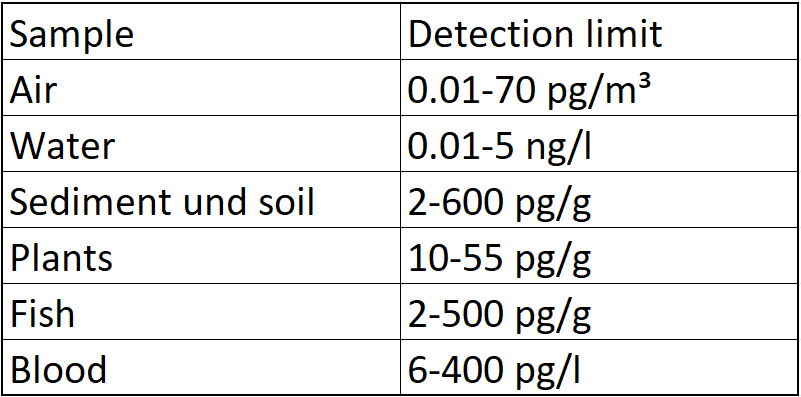
Limits of detection
The limit of detection is the lowest possible concentration at which a substance or compound can still be detected in a sample. This value is substance-specific, i.e. it depends on the properties of the compound being measured. For this reason, ranges are given in the table. Other factors influencing the limit of detection include sample preparation and the magnitude of the blank values. The following table shows that limits of detection can vary considerably depending on the sample type.
Literature
Nakayama et al., Worldwide trends in tracing poly- and perfluoroalkyl substances (PFAS) in the environment; https://doi.org/10.1016/j.trac.2019.02.011
Göckener et al., Exploring unknown per- and polyfluoroalkyl substances in the German environment – The total oxidizable precursor assay as helpful tool in
research and regulation; https://doi.org/10.1016/j.scitotenv.2021.146825
Simon et al., Quantification and characterization of PFASs in suspended particulate matter (SPM) of German rivers using EOF, dTOPA, (non-)target HRMS; http://dx.doi.org/10.1016/j.scitotenv.2023.163753
Wellmitz et al., Long-term trend data for PFAS in soils from German ecosystems, including TOP assay; http://dx.doi.org/10.1016/j.scitotenv.2023.164586