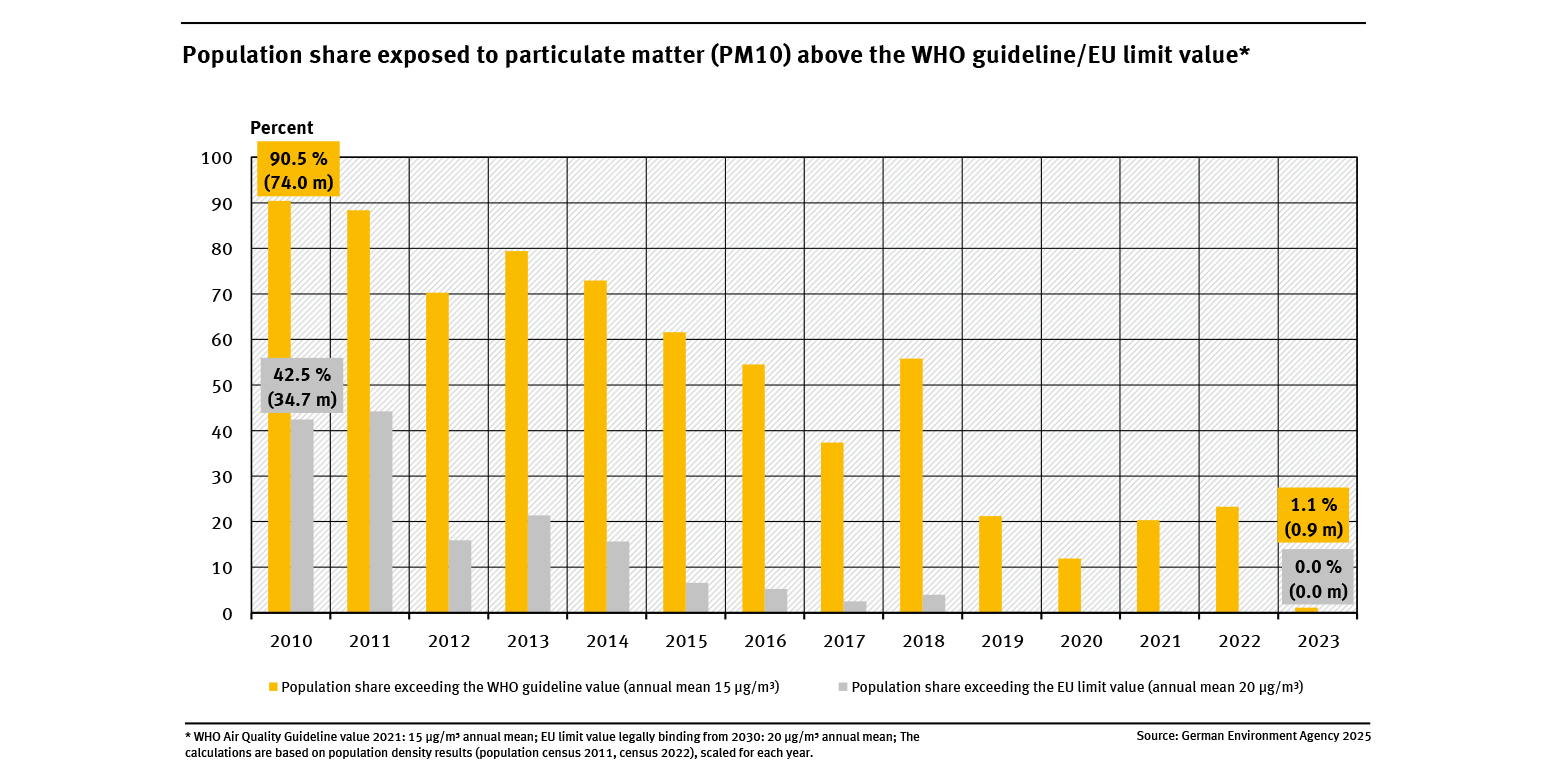
Throughout the entire observation period, a significant share of the German population was exposed to PM10 concentrations exceeding the WHO guideline value, which is 15 µg/m³ as an annual average. However, the number of people affected in Germany dropped significantly—from around 74 million in 2010 to 0.9 million in 2023. At the same time, the number of people exposed to PM10 concentrations above the EU limit value (20 µg/m³ annual average), which will become legally binding in 2030, decreased from 34.7 million in 2010 to 0.0 million in 2023. Since 2019, the proportion of the population affected has already been below 0.5 %. This clearly demonstrates that emission reduction measures implemented in recent years have already led to a substantial decrease in particulate matter pollution in Germany.A further decline in pollution levels is expected by 2030 as a result of the emission reduction commitments under the NEC Directive. If the measures outlined in national air pollution control programs are implemented (in Germany, for example, the coal phase-out, reduction of ammonia emissions from agriculture, and the transition to sustainable transport including e-mobility), emissions of particulate matter and its precursor gases can be further reduced by 2030. However, to better protect population health, more ambitious measures are needed—also at the European level—to further reduce particulate matter pollution.
In December 2024, the revised European Air Quality Directive entered into force. Under this directive, stricter limit and target values will be legally binding across Europe starting in 2030. For PM10, the new EU limit value legally binding from 2030 will be lowered from 40 to 20 µg/m³ (annual average), corresponding to the interim target 4 of the WHO recommendations.