Skip to main content Skip to main menu Skip to footer

Indicator: Grasslands

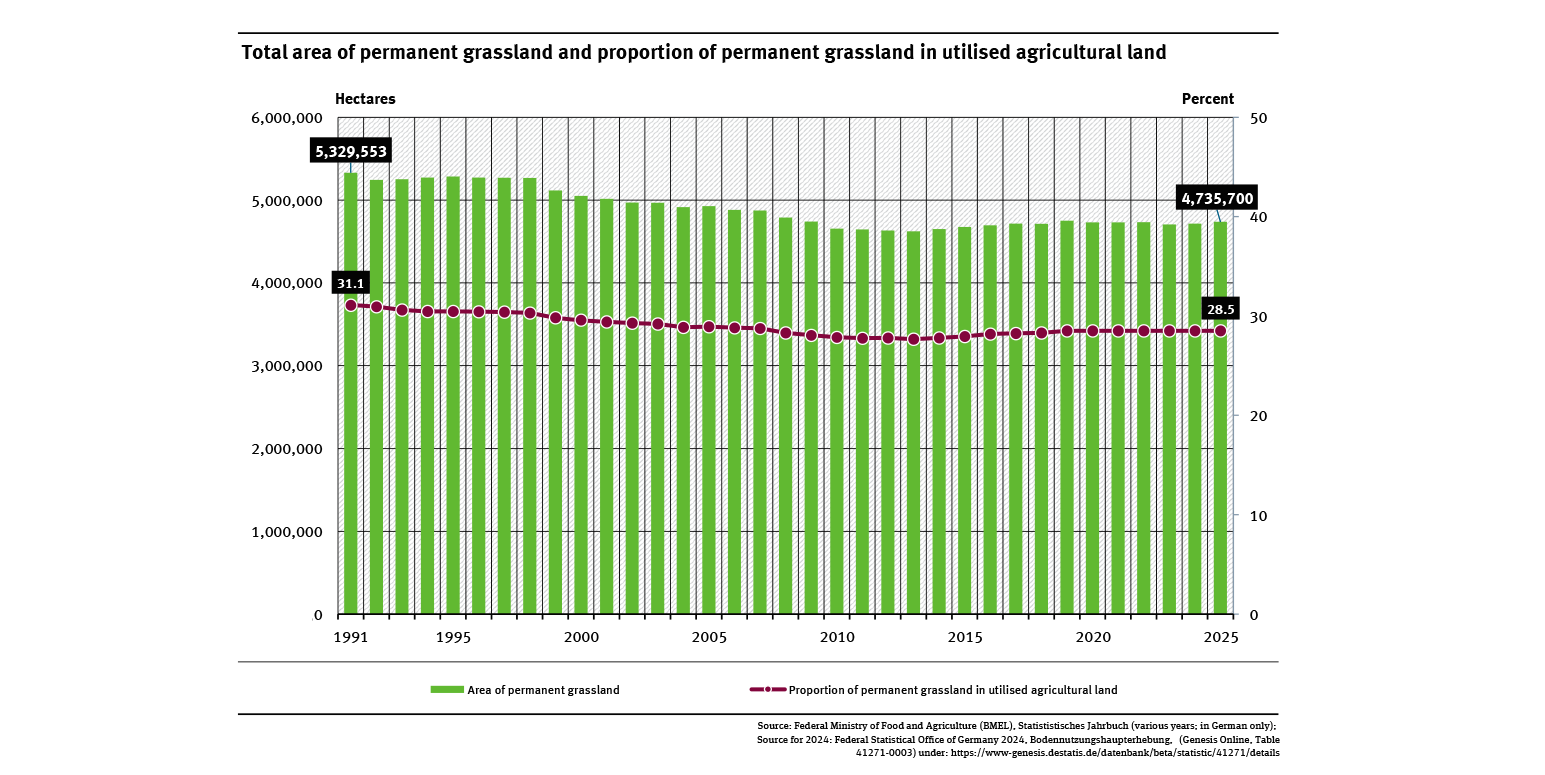
A graph shows the area of permanent grassland and its share of the total agricultural area from 1991 to 2025. Both indicators have been declining until 2013 and have then increased in the years that followed. Most recently, the values have stagnated.
Total area of permanent grassland and proportion of permanent grassland ...
Source: Federal Ministry of Food and Agriculture / Federal Statistical Office of Germany
Figure as PDF (356.71 kB)

Table of contents

At a glance

  • Between 1991 and 2025 the area of grassland in Germany decreased by around 11 %.
  • The area of permanent grassland has almost remained at the same level in recent years.
  • The loss of grassland was largely halted by the EU-agricultural policy introduced in 2014 and regulatory measures; since then, the area of grassland has remained stable at the 2013 level. However, effective conservation measures are still needed to ensure its long-term preservation.

Environmental importance

Extensively managed grassland is important for species-rich plant communities that require nutrient-poor soils and which have become rare in agricultural landscapes. Approximately 40 % of the endangered ferns and flowering plants in Germany are found in grassland (BfN 2023, in German only). But grasslands are also important for protecting soils and water and help to protect the climate by storing carbon. Permanent grassland is of particular value. It is defined as meadows and pastures that have not been used as arable land for at least five continuous years.

Assessing the development

Permanent grassland in Germany has been under pressure in recent decades. In 1991 there were still over 5.3 million hectares (m ha) of utilised agricultural land managed as permanent grassland. By 2025, the total area of permanent grassland had declined by 11 % to around 4.7 m ha. Since 2013, the area of permanent grassland and its share of the total agricultural land have risen slightly again, or have remained at nearly the same level in recent years.

With the EU agricultural policy from 2014 onwards, the preservation of permanent grassland was regulated via the "greening" requirements as a prerequisite for area-linked direct payments. The loss of permanent grassland was stopped with a general permit requirement for the conversion of permanent grassland and a complete ban on conversion and ploughing for permanent grassland worthy of special protection. In the current CAP funding period, which has been in effect since January 2023, the preservation of grassland is also ensured through so-called conditionality in the first pillar. Farmers who receive direct payments are only allowed to convert their grassland under certain conditions and only with permission. In addition, some federal states (e.g. Baden-Württemberg, Mecklenburg-Western Pomerania and Schleswig-Holstein) have state laws that generally prohibit the conversion of grassland.

However, the overarching drivers of grassland conversion remain largely unchanged. This applies in particular to the high demand for arable fodder, the promotion of the cultivation of energy crops, the land consumption of settlement and transport and the abandonment of use (see above). It can therefore be assumed that we will see continued pressure on grassland. Effective grassland conservation will therefore continue to be of high importance in the future.

Methodology

The indicator is based on the results of the 2025 Land Use Survey of the Federal Statistical Office. The results are published in Table 41271-0003 Agricultural holdings, Utilised agricultural area: Germany, years, land use types and in the Statistical Yearbook of the Federal Ministry of Food and Agriculture and on the Federal Statistical Office's website on the topic of grassland. A detailed description of the method is given in the quality report on the agricultural census.

More detailed information: 'Grünlandumbruch' (in German only).


Related contents

Tags

Short link: https://www.uba.de/n37679en