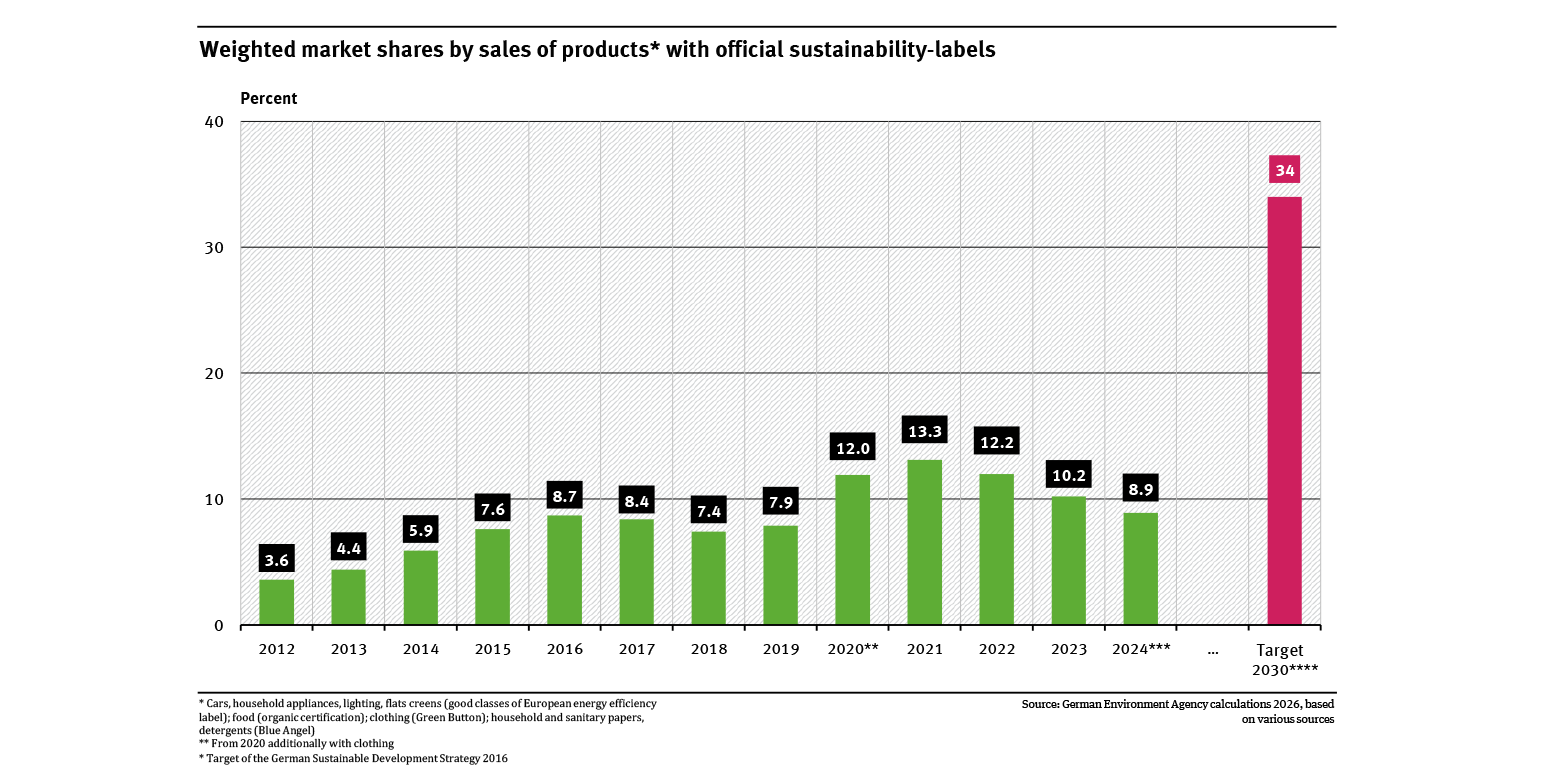
In 2024, environmentally friendly and socially responsible products accounted for an 8.9% market share in the product groups surveyed. This means the indicator is moving in the opposite direction of the target. This is primarily due to the market share of energy-efficient passenger cars. After peaking in 2021, the market share of A+ passenger cars declined in subsequent years. In 2024, the new passenger car CO2 label with new requirements was introduced, which prevents direct comparability with previous years.
Passenger cars with the best label (A) had a market share of 15.7% in 2024. Little has changed in the organic food sector over the past 5 years (6 to 7% market share). For large household appliances, significant shifts toward more efficient categories have been observed again since the introduction of the new efficiency categories. For sanitary paper products, market shares in private households have fallen by over 10 percentage points over the past 10 years to just 6.7%. Market shares vary significantly across different product categories: By 2024, 79.5% of washing machines sold had already been rated in the highest efficiency category, A. Refrigerators, freezers, and dishwashers only come close to this level when categories A through D are combined. For electric ranges and ovens, however, as well as for air conditioners, high energy efficiency remains a niche issue.
To achieve the sustainability strategy’s goal of a 34% market share by 2030, the low demand for environmentally friendly and socially responsible products must be revitalized.