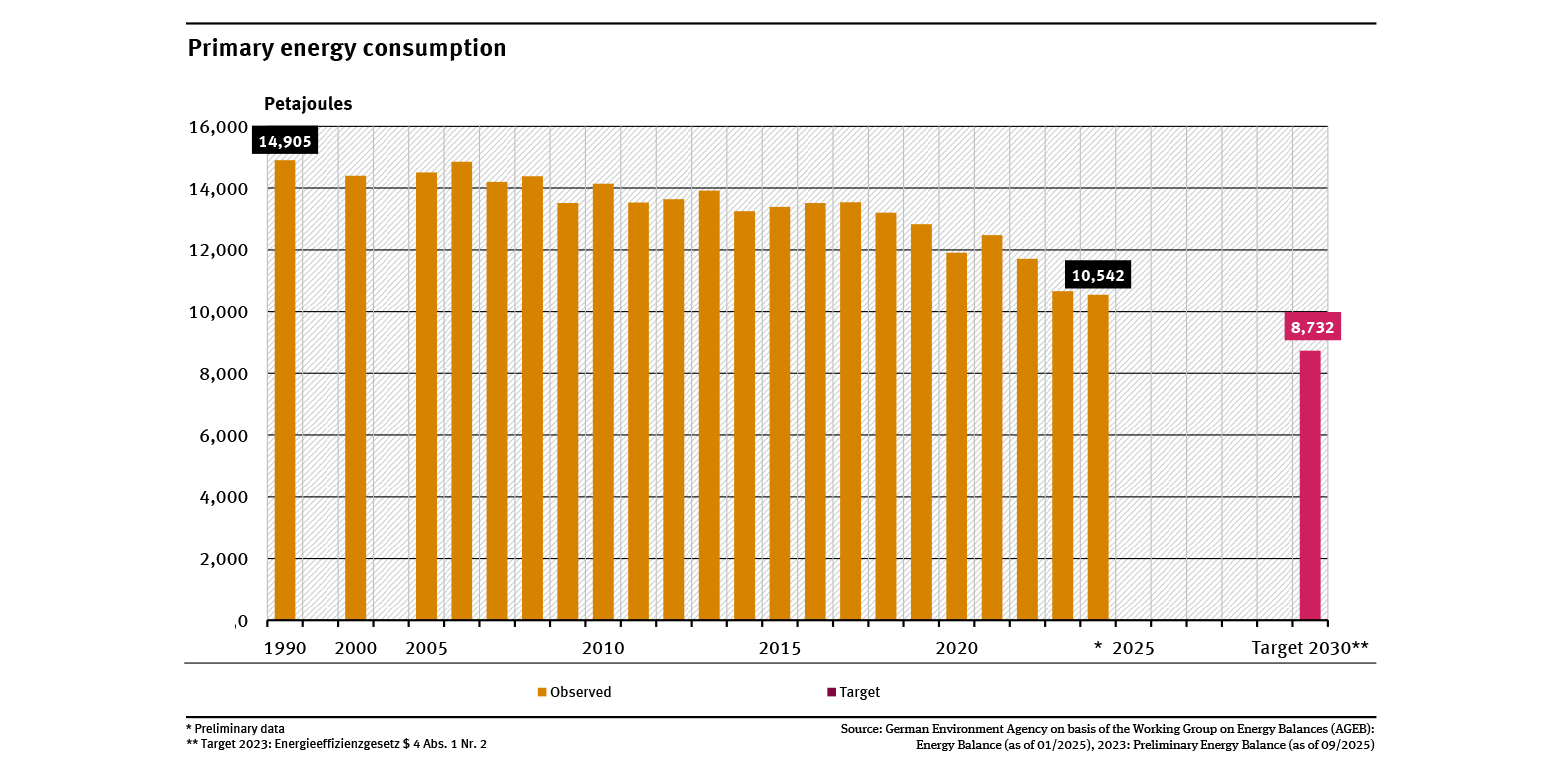
In 2024, Germany consumed approximately 29 % less primary energy than in 1990. In 2006, consumption was still almost as high as in 1990. Since then, it has fallen significantly. In part, this is due to falling final energy consumption. Also, the switch to renewable energy sources and the increase in net electricity imports was accompanied by a disproportionate decrease in PEC as a result of statistical effects. Apart from that, the energy crisis 2022 led to significant energy-savings and for 2024 to the lowest energy consumption since 1990.
The Energy Efficiency Act (EnEfG) adopted in 2023 sets the target of reducing the PEV by 39 % below 2008 by 2030. The 'Greenhouse Gas Projections 2025' (in German only) examined whether Germany can achieve its energy and climate targets in 2030 on the basis of scenario analyses: If all the measures planned by the government are implemented, the PEC is expected to fall by around 32 % by 2030 compared to 2008 (‘with measures scenario’). This would clearly fall short of the EnEfG target of a 39 % reduction by 2030. Further measures to reduce the PEC are therefore necessary in order to achieve the EnEfG targets.