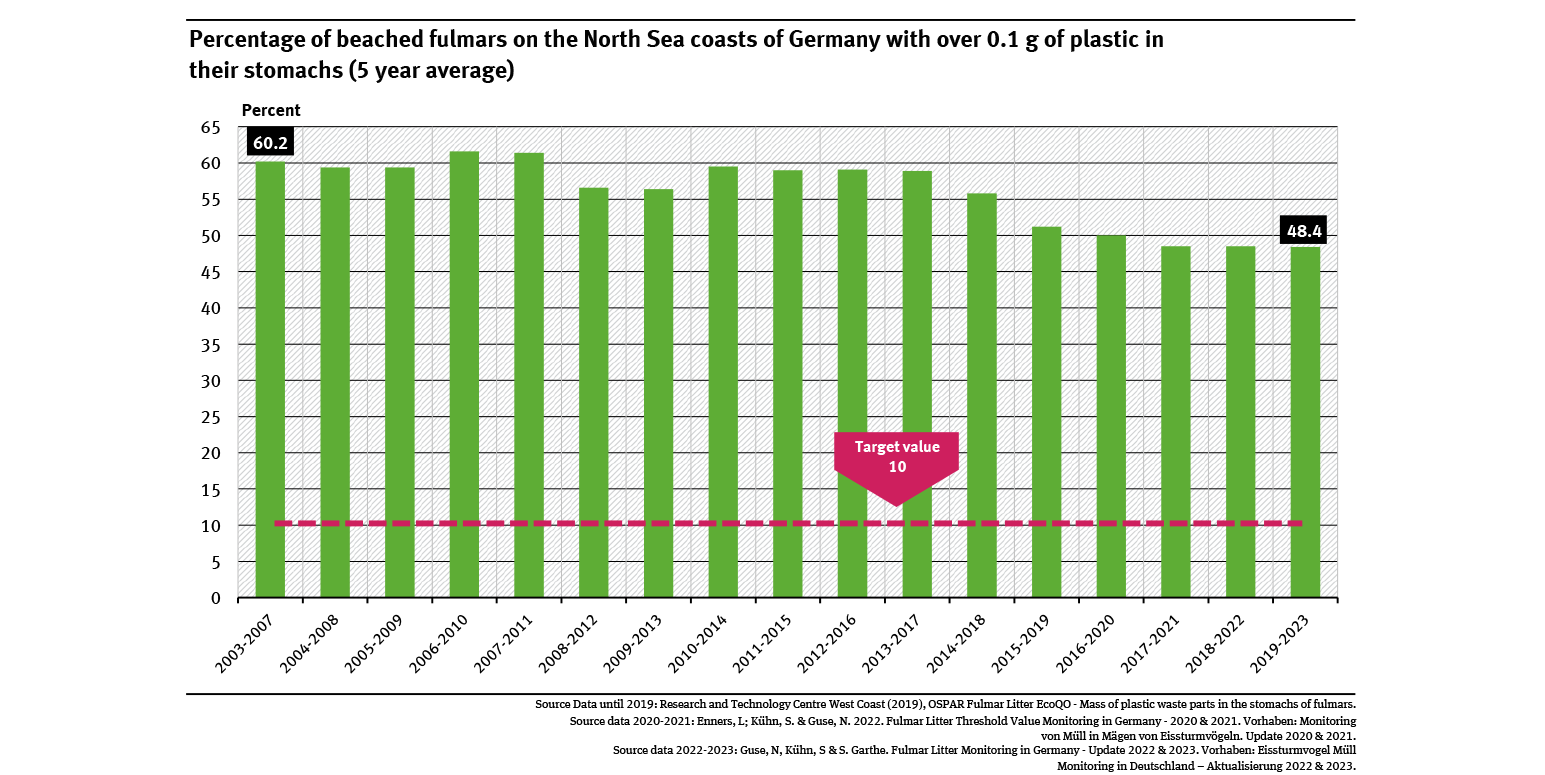
While 9-14 million tons of plastic waste ended up in the oceans in 2016, entries are expected to triple to 23-27 million tons by 2040. Garbage particles are mistaken for food by animals and, once consumed, can injure and clog their digestive organs, which can lead to the death of the animals. To date, interactions with waste have been described for 4,076 marine species of animals, plants, and microorganisms. The most prominent effects are the ingestion of and entanglement in pieces of waste. While entanglement in marine litter leads to visible injuries and even death, the consequences of ingesting plastic litter often remain invisible. These include internal injuries, blockages, and starvation despite a supposedly full stomach.
For monitoring purposes, the fulmar has been established as an indicator species in the North Sea. This seabird has a wide distribution and feeds exclusively at the open sea. There, he confuses floating plastic parts with food particles and accumulates them in his stomach for several weeks. So far no species has been identified for the Baltic Sea which can be used for similar studies. Therefore no comparable information for the Baltic Sea is available for the time being.