Summertime is just the right time to quench your thirst with healthy, eco-friendly, and inexpensive tap water. To ensure it stays that way, UBA is drawing attention to a pressing problem – the contamination of our groundwater with nitrate from intensive agricultural practices. Read more about the matter in this newsletter.
We would also like to recommend – hot off the press – our annual publication Schwerpunkte 2017 [What matters 2017]. This year's edition focuses on indoor air, and our new explanatory film on fast fashion highlights the downsides of this fast-paced, cheap fashion industry. We also cast a spotlight on transport. A radical change of course is urgently necessary if Germany is to achieve its climate goals. Further need for action in environmental and climate action is illustrated in our new Daten zur Umwelt 2017 [Data on the Environment] publication.
There are also a few success stories to report in this newsletter: green power production had a record month as the first half of 2017 came to a close. In other news, Wilma the dog, UBA's first mould detection dog, passed her test with flying colours.
We wish you interesting reading.
Yours sincerely,
Press Office at the German Environment Agency
The price of overfertilisation: Excessive application of slurry, manure etc. could make water more expensive
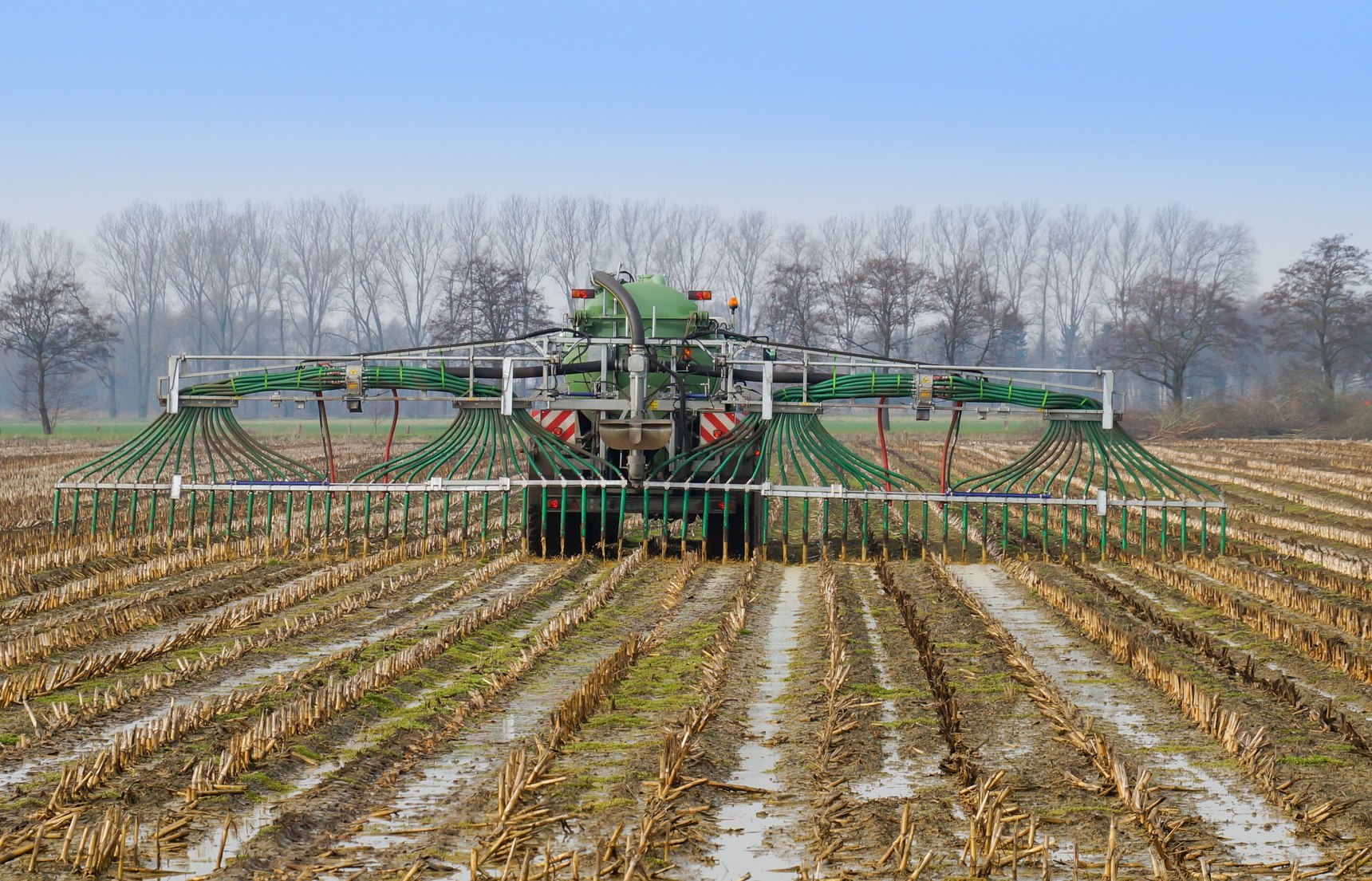
When more fertiliser is applied than plants and soil can absorb: groundwater contamination
Source: countrypixel / Fotolia.com
Drinking water is our most important foodstuff and is best quality in Germany. This is set to remain that way in the coming years, but at what cost? More than 27 per cent of the groundwater bodies in Germany exceed the quality standard for nitrate stipulated in the European Water Framework Directive (50 mg/litre). The German Drinking Water Ordinance also specifies this limit value, which is meant to ensure that there are no harmful health effects when water is consumed in normal amounts. To ensure compliance with this limit value, some water suppliers have been taking measures for years which are already affecting drinking water prices. These measures include drilling deeper wells or using uncontaminated groundwater supplies and mixing it to ensure compliance with the limit value.
The regions which are particularly affected are where there is intensive animal husbandry and therefore also produce large amounts of slurry and manure, or those where a lot of chemical fertiliser is used in fruit and vegetable growing. UBA warns that should overfertilisation in these area not be scaled back soon, the nitrate content of groundwater could rise sharply. The reservoir of substances underground which ensured the degradation of nitrate is slowly becoming depleted, which could result in a sudden surge in nitrate pollution in a short amount of time.
A new study done on behalf of UBA indicates that when water suppliers will ultimately have to resort to costly treatment methods to treat the raw water. This could lead to a rise in drinking water prices of 32 to 45 percent in the affected regions, depending on degree of pollution and treatment method. The processes for removing nitrate from drinking water are expensive – much more expensive in fact than preventive measures. According to estimates by the state agriculture ministry, the new provisions in the ordinance on the reform of best practices in fertilisation which entered into force in June 2017 will accrue costs of some 122 million euros per year to the agriculture sector. If nitrate inputs to groundwater are not reduced, the UBA study says it will cost water suppliers – and consumers of drinking water – between €580 million and €767 million per year.
UBA’s President Maria Krautzberger said: “The reforms in the Fertilisers Ordinance introduce some long overdue steps which will hopefully reduce pollution enough to avoid having the cost of expensive treatment passed on to drinking water customers. Rigorous enforcement and stepped up monitoring in the affected regions is important. If contamination levels do not come down, the agriculture sector will face new and more stringent requirements." UBA has responded in open letters to criticism about the study from farmers' unions the study.
We live in an age of fast fashion. The cost of the cheap t-shirt to man and the environment is unfortunately not reflected in the price tag. Our explanatory film (in German) highlights the problems and provides solutions for dealing with garments. read more (in German)
Bathing outdoors
A lake instead of a swimming pool, swimming without the technology and chemicals – it is a pity that not every river and lake is suitable for bathers. Currents, shallows and vegetation can cause accidents or pathogens and cyanobacteria can become a health risk. read more (in German)
The German Environment Agency (UBA) is warning of potential health risks as a result of staying in buildings which do not meet adequate European standards.
Climate change: transport sector must steer a new course now
To live up to the requirements of the Paris Agreement the German transport sector will have to make quick and drastic cuts in its greenhouse gas emissions. A new research report done on behalf of the German Environment Agency outlines these facts and proposes concrete measures by which to reduce emissions and ensure achievement of the climate change goals. read more (in German)
UBA's Daten zur Umwelt 2017 [Data on the Environment] publication offers a complete overview of all environmental sectors in Germany. It concludes that greater effort is required to achieve the national goal of reducing greenhouse gas emissions by 40 per cent until 2020; air quality in cities continues to be too heavily polluted. In contrast, drinking water quality remains good.
A special issue publication "Human Biomonitoring 2016“ has just been published. It features 34 articles which present the current status of human biomonitoring (HBM) worldwide. The volume focuses on the scientific, political strategic, European and global perspectives of HBM. All articles are available open access and online for one year.
Easy access to environmental information: online survey launched
The general public has a right to free access to environmental information from public authorities and certain private sources, too. This right is regulated by the Environmental Information Act. The German Environment Agency is investigating how this right is being exercised. You can share your experience on this issue in an online survey until 30 September 2017. read more (in German)
Nitrogen oxides: lower emissions but pollution still too high
Annual emissions of nitrogen oxides decreased from 2,886.63 kilotons (kt) in 1990 to 1,186.15 kt in 2015, which is a 59% decline in Germany for the period. This is a positive development but does not mean that nitrogen dioxide no longer poses a human health risk. read more (in German)
Germany's seas also victims of plastic litter
Plastic waste has now also become pervasive in the North Sea and Baltic Sea. Fish and birds are ingesting it with their food intake. New data provide evidence of the scale of the problem. read more (in German)
A new guide by the Federal Environment Ministry and the German Environment Agency offers companies advice on how to integrate sustainability into their supply chains.
Green power generation: first half-year of 2017 ends with a record month
The electricity production from renewable source of energy in the first half-year of 2017 was some ten per cent higher than in the same period of the previous year. A total volume of about 107 billion kilowatt hours was produced. This data is based on an evaluation of preliminary statistics by the working group on renewable energies statistics (AGEE-Stat). Their monthly report (in German) will now be published mid-month on a regular basis. read more (in German)
Blue Angel ecolabel now available for toys
Toy manufacturers can now apply for the new Blue Angel ecolabel for toys to be awarded to their cuddly toys, wooden train sets, rubber balls etc.. Not only must the products be exemplary in terms of pollutant content but also as concerns the social labour conditions of the extraction of raw materials and at the final assembly sites. read more (in German)
How much pollution do factories emit? New data for 2015
Ammonia is Germany’s number 1 air pollutant emitted from commercial enterprises and its main source is the mass production of livestock. The main sources of pollutants in waste water are the food and chemical industries. The energy sector is the largest emitter of CO2. The updated data in the Pollutant Release and Transfer Register provides this information and more. read more (in German)
New data on transfrontier shipment of wastes
Current data on the transfrontier shipment of waste which is subject to notification in 2016 and data on the detection and prosecution of illegal waste shipments in 2015 have been published. read more (in German)
High temperatures and heat waves are adding up to public health problems – and the impact of climate change is becoming more noticeable also in Germany. The federal states and local authorities can draft and implement heat wave action plans to protect public health. The German Environment Agency (UBA) has developed a master plan in collaboration with many experts from various disciplines.
Quick info: European Mobility Week in 90 seconds
What is European Mobility Week about and how can you be part of the action? Watch our video (in German) for answers to this question and more. read more (in German)
The EU Commission is seeking to adopt EU wide minimum quality requirements for water reuse for agricultural irrigation and groundwater recharge by the end of 2017. As the current draft falls short to set standards that are rigorous enough to protect the environment and human health, UBA has published a Scientific Opinion Paper to express its concerns and recommendations.
Law & legislation
Glyphosate: a step backwards in protection of biodiversity?
Glyphosate herbicides destroy virtually all the wild plants growing on crop fields. It is a threat to biological diversity because it also robs insects and vertebrates of their natural environment. The European Union will be taking a decision on the reauthorisation of the chemical. read more (in German)
Vulcanization accelerator DCBS: Producers have obligation to inform
DCBS is a vulcanization accelerator which is used in rubber manufacturing. The German Environment Agency (UBA) and the Federal Institute for Risk Assessment (BfR) have conducted a substance evaluation which resulted in requests for more data and information from the manufacturer. The objection filed by a tyre manufacturer against disclosure of information has now been ruled inadmissible. read more (in German)
Emission reduction credits (ERCs) from high-quality international climate change mitigation projects will continue to compensate the official travel by German federal employees. The Federal Government plans to purchase more than 235,000 ERCs which will then be cancelled. ERCs for emissions in 2015 were purchased earlier this year. The next compensation procedure for 2016 emissions will now follow.
Soil organisms in manure or organisms that colonize dung pats can be impacted by the application of veterinary medical products, especially parasiticides, to livestock. For this reason, the authorization process for veterinary medicinal products in the European Union and other countries includes a requirement for “higher-tier” tests when adverse effects on dung organisms can be detected in single…
To minimize the impact of end-of life vehicles on the environment they have to be managed in accordance with the legal requirements. Against this background it is important to comprehend the whereabouts of permanently decommissioned passenger cars. From the available statistical sources it was only possible to account for the whereabouts in parts for the last years. The subject-matter of the…
This report explores the introduction of carbon taxes with a national offset component and their interactions with other policy areas, and makes recommendations on this topic. In this task, the study focuses on the approaches Chile, Mexico and South Africa have chosen for elaborating their carbon taxes. The study identifies the objectives the three countries pursue by introducing these new systems…
The present Manual summarizes the provisions, measurement procedures and legal framework of the 1st Federal Immission Control Ordinance. In addition to a description of measurement objectives, information on measurement technology is provided. This document also describes the emission measurement procedure as well as the involvement and responsibilities of the competent bodies. It also describes…
Texte
123
What exactly does...
... a working dog do at UBA? (Episode 2)
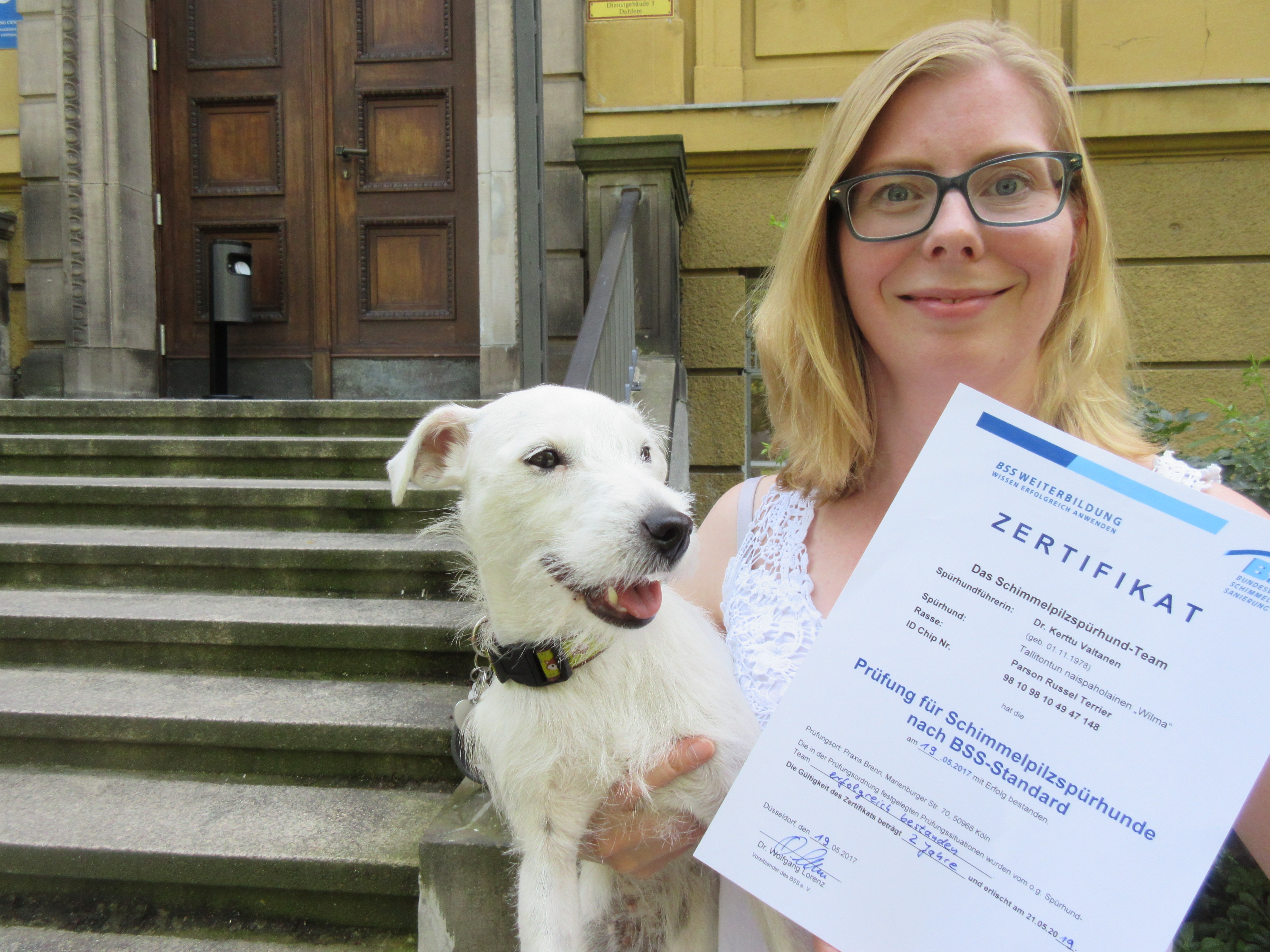
Wilma the dog and UBA staff member Dr. Kerttu Valtanen with the BSS certificate
Source: Umweltbundesamt
She passed! Wilma, UBA’s terrier she-dog (see our first report in UBA aktuell 5/2015) is now a certified mould detection dog. She had a perfect score on both the personality test and the search test of the German Federal Association for Mould Remediation (Bundesverband Schimmelpilzsanierung e.V. (BSS)). Her owner, Dr. Kerttu Valtanen from UBA’s Microbiological Risks unit, has been training the two-year-old Parson Russel terrier since she was three months old to detect ten different types of mould and several kinds of bacteria on various construction materials such as plasterboard or mineral wool.
Certification of detection dog teams by the BSS is a major step to lastingly ensure a high level of quality in mould detection dogs in Germany. Currently, ten dogs in Germany have been certified by the BSS. UBA has organised and been actively involved in international seminars and workshops to promote expert exchange among detection dog owners. Highly qualified, legitimate mould detection dogs can successfully track hidden mould damage. It is an important topic for UBA because mould can be a health risk.
Wilma the dog will be part of future UBA research projects on detecting hidden mould. However, she will continue to be trained – even a mould detection dog never stops learning!